


























Views
Downloads
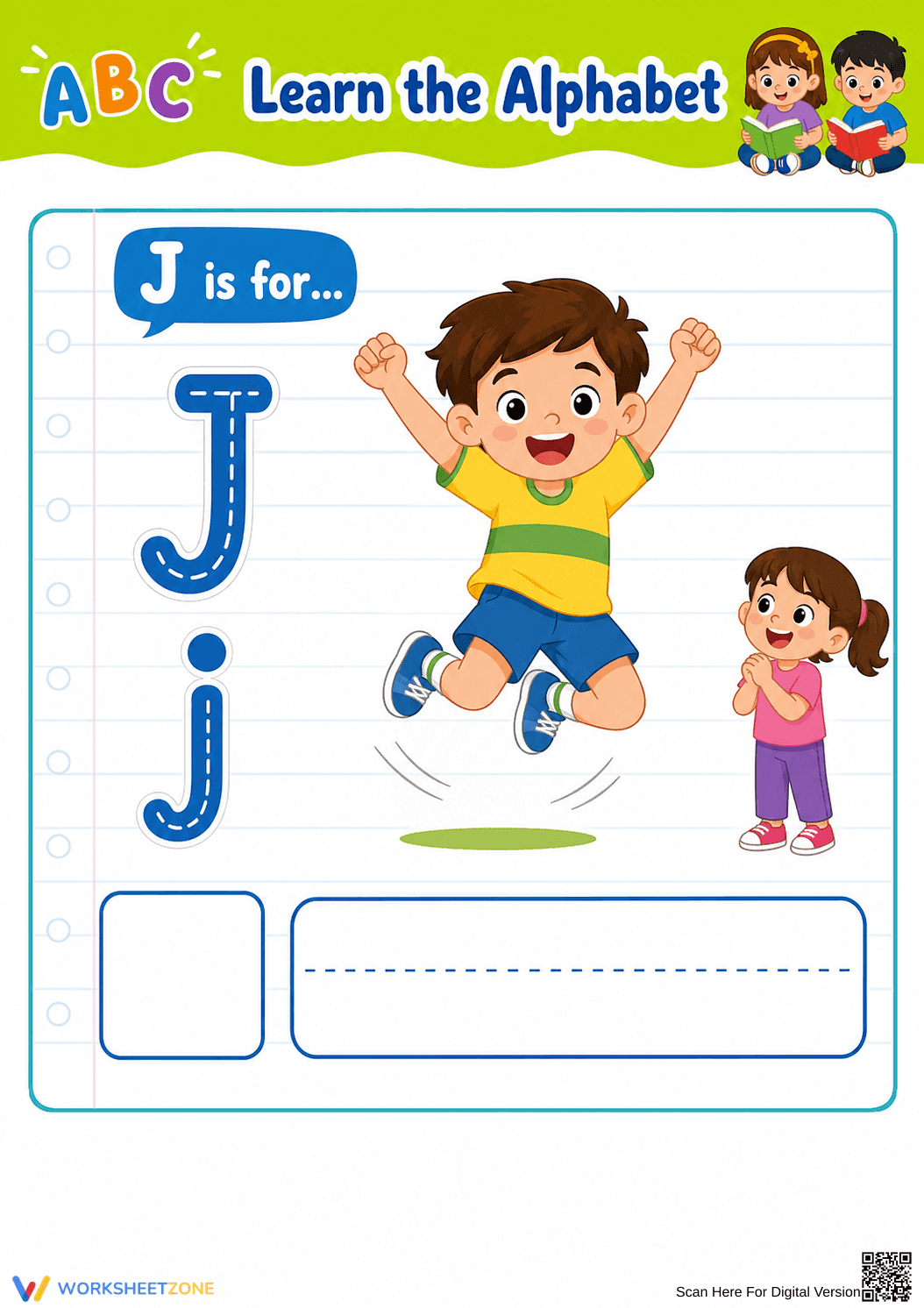

Printable Letter J Beginning Sound Worksheet | Grade K
Paste this activity's link or code into your existing LMS (Google Classroom, Canvas, Teams, Schoology, Moodle, etc.).
Students can open and work on the activity right away, with no student login required.
You'll still be able to track student progress and results from your teacher account.
This foundational phonics worksheet helps early learners master the beginning sound of the letter J. By tracing uppercase and lowercase letters and connecting the visual of a jumping boy to the sound, students build essential letter-sound correspondence skills. This resource provides targeted practice for developing strong early reading abilities.
At a Glance
- Grade: K · Subject: ELA
- Standard:
CCSS.ELA-LITERACY.RF.K.3.A— Produce primary sounds for consonants- Skill Focus: Letter J Beginning Sound
- Format: 1 page · 3 problems · No answer key · PDF
- Best For: Independent phonics practice
- Time: 10–15 minutes
Inside this single-page printable, educators will find three task types designed to reinforce letter recognition. The page features guided tracing paths for uppercase and lowercase J, an illustration box for students to draw a J-word, and primary writing lines for independent letter formation. The clear layout ensures young learners remain focused.
Implementing this resource requires minimal teacher preparation.
- Print (1 minute): Download the PDF and print copies.
- Distribute (1 minute): Hand out during morning work. The intuitive layout means students begin immediately.
- Review (1 minute): Quickly scan work to verify correct letter formation.
Total teacher prep time is under two minutes. This worksheet functions perfectly as a sub plan.
This material is directly aligned with primary standard CCSS.ELA-LITERACY.RF.K.3.A, requiring students to demonstrate basic knowledge of one-to-one letter-sound correspondences by producing the primary sound or many of the most frequent sounds for each consonant. It also supports handwriting development by encouraging proper letter formation. Both standard codes can be copied directly into lesson plans, IEP goals, or district curriculum mapping tools.
Teachers can utilize this worksheet effectively during morning work routines to activate prior knowledge before a formal phonics lesson. Alternatively, it serves as an excellent independent literacy center activity while the teacher conducts small group guided reading. As a formative assessment observation tip, watch how students trace the letters; ensure they start at the top line and pull down, correcting pencil grip and stroke order in real-time. Expected completion time ranges from ten to fifteen minutes.
This resource is primarily designed for Kindergarten students developing foundational phonics and handwriting skills. It also serves as an effective intervention tool for first-grade students who need additional reinforcement with consonant sounds. To differentiate for early finishers, teachers can ask students to flip the page and write three more words that start with the letter J. This worksheet pairs naturally with an alphabet anchor chart or a read-aloud book featuring heavy J-alliteration.
Mastering letter-sound correspondence, such as the skills practiced in this CCSS.ELA-LITERACY.RF.K.3.A aligned resource, is a critical predictor of future reading success. When students produce primary sounds for consonants accurately, they build the necessary cognitive framework for decoding complex texts. According to a comprehensive EdReports 2024 analysis of early literacy curricula, explicit and systematic phonics instruction that combines visual, auditory, and kinesthetic modalities—like tracing letters while vocalizing their sounds—significantly accelerates phonemic awareness acquisition in early childhood settings. This worksheet integrates these evidence-based practices by pairing the physical act of writing with the visual cue of the jumping boy, reinforcing the target phoneme through multiple pathways. Consistent practice with targeted, single-letter focus materials ensures that young learners develop the automaticity required for fluent reading, reducing cognitive load during later text comprehension tasks.


