


























Views
Downloads

Essential Letter J Beginning Sound Worksheet | Grade K
Paste this activity's link or code into your existing LMS (Google Classroom, Canvas, Teams, Schoology, Moodle, etc.).
Students can open and work on the activity right away, with no student login required.
You'll still be able to track student progress and results from your teacher account.
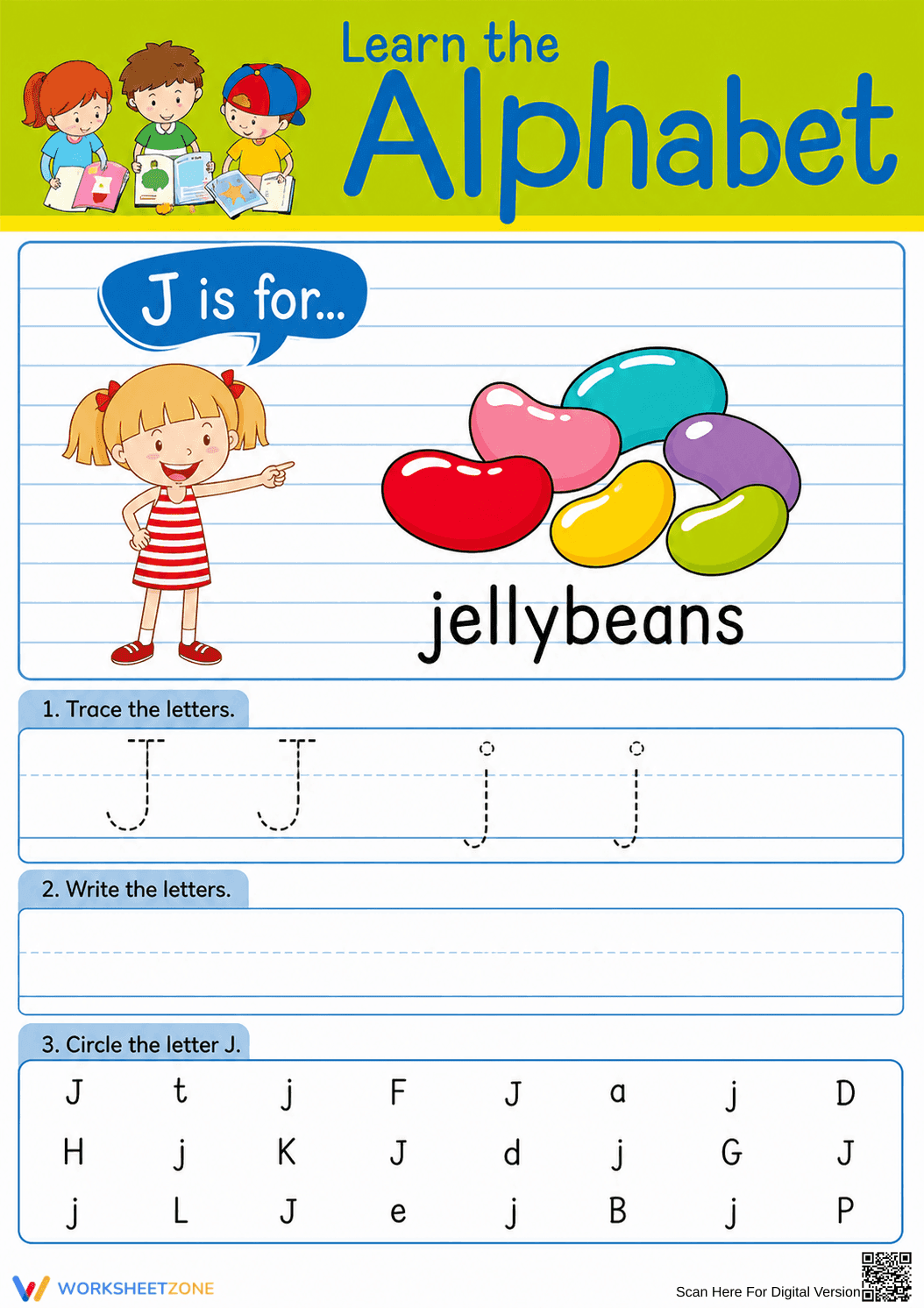
This essential Letter J beginning sound worksheet helps early learners identify, trace, and write the letter J while connecting it to the "jellybeans" anchor word. Students develop phonemic awareness and fine motor skills through a structured sequence of letter-recognition tasks. It provides a clear path from visual identification to independent letter production.
At a Glance
- Grade: Kindergarten · Subject: ELA Phonics
- Standard:
CCSS.ELA-LITERACY.RF.K.1.D— Recognize and name all upper- and lowercase letters of the alphabet- Skill Focus: Letter J formation and identification
- Format: 1 page · 3 tasks · Answer key included · PDF
- Best For: Initial phonics instruction and letter centers
- Time: 10–15 minutes
What's Inside: This single-page PDF features a vibrant "J is for jellybeans" header to establish the initial sound. The worksheet contains three distinct sections: a tracing area for uppercase and lowercase J, a blank primary-ruled line for independent writing, and a letter-search grid containing 24 different characters for identification practice.
The worksheet follows a logical skill progression. First, students engage in guided practice by tracing four dashed-line models of uppercase and lowercase J. Next, they move to supported practice by writing the letters independently on a guided primary line. Finally, they demonstrate mastery through an independent identification task, circling every instance of the letter J within a diverse character grid. This gradual-release model ensures students build confidence before working alone.
Standards Alignment: The primary focus is `CCSS.ELA-LITERACY.RF.K.1.D`, which requires students to recognize and name all upper- and lowercase letters of the alphabet. It also supports `CCSS.ELA-LITERACY.RF.K.3.A` by linking the letter shape to its primary consonant sound. Both standard codes can be copied directly into lesson plans, IEP goals, or district curriculum mapping tools.
How to Use It: Use this worksheet during the "You Do" phase of a phonics lesson after introducing the letter J with an anchor chart. It also serves as an effective formative assessment; observe students during the circling task to identify those struggling with letter reversals or visual discrimination. Completion typically takes 10 to 15 minutes.
Who It's For: This resource is designed for Kindergarten students beginning their literacy journey, but it also supports Grade 1 students needing remedial phonics support. It pairs naturally with a "Letter J" alphabet book or a sensory bin activity involving jellybeans to reinforce the beginning sound.
According to the NAEP (2024) framework, early mastery of letter-sound correspondence is the strongest predictor of future reading fluency and comprehension. This Letter J worksheet addresses this critical developmental milestone by integrating visual recognition with kinesthetic tracing and writing. Research from Fisher & Frey (2014) emphasizes that the gradual release of responsibility—moving from tracing to independent production—is vital for long-term retention in early childhood education. By providing 3 distinct tasks that move from high support to independent identification, this resource ensures that students internalize the specific features of the letter J. The inclusion of both uppercase and lowercase forms aligns with current evidence-based practices for comprehensive alphabet instruction. Educators can utilize this structured approach to bridge the gap between phonemic awareness and orthographic mapping, providing a stable foundation for decoding more complex CVC words in later primary grades.


