


























Views
Downloads
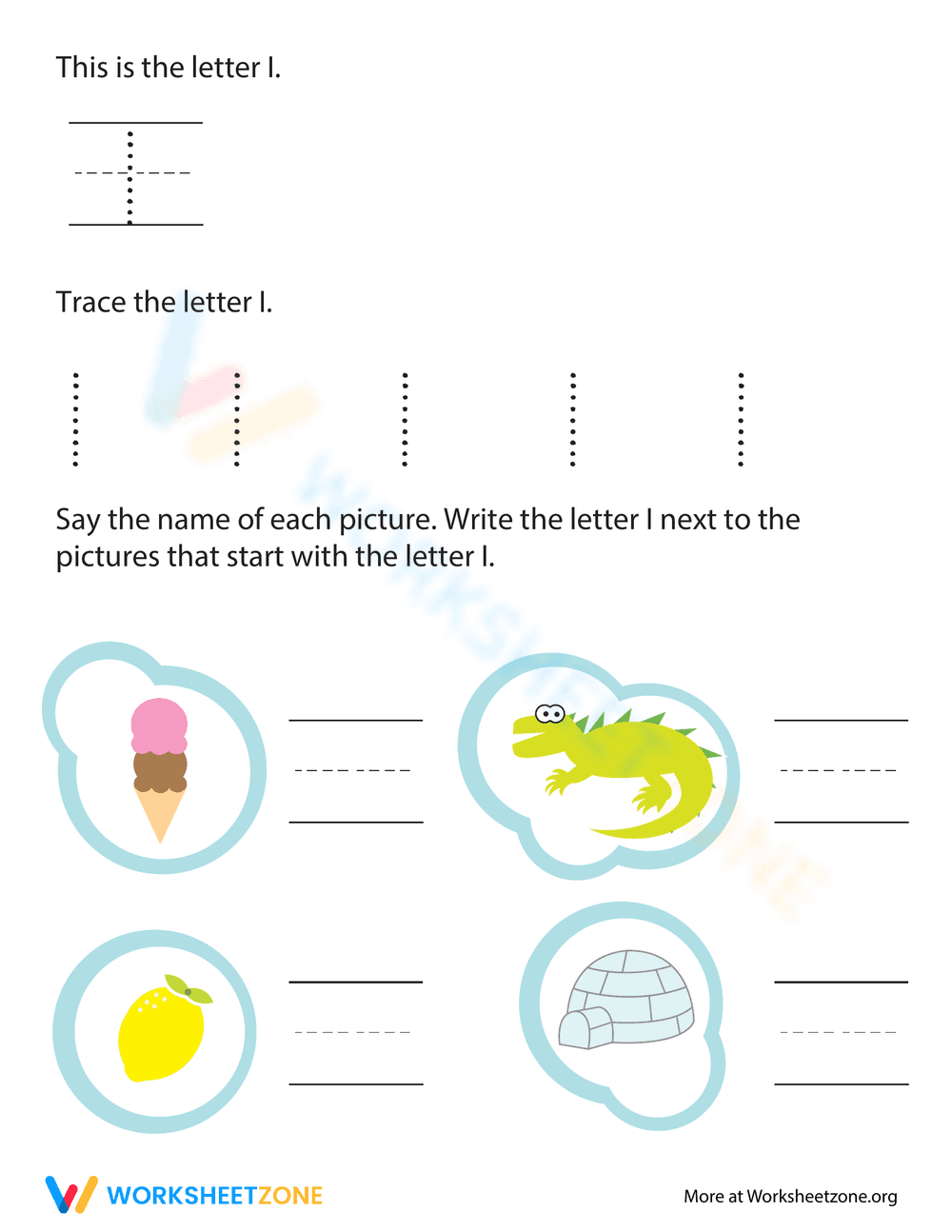

Grade K Letter I Tracing — Printable No-Prep Worksheet
Paste this activity's link or code into your existing LMS (Google Classroom, Canvas, Teams, Schoology, Moodle, etc.).
Students can open and work on the activity right away, with no student login required.
You'll still be able to track student progress and results from your teacher account.
This printable Letter I handwriting worksheet develops early literacy skills by combining letter formation practice with beginning sound identification. Kindergarten students practice proper stroke mechanics to write uppercase letter I, then apply phonics knowledge to identify pictures beginning with the /i/ sound, establishing strong foundational reading habits.
At a Glance
- Grade: Kindergarten · Subject: English
- Standard:
CCSS.ELA-LITERACY.L.K.1.A— Print many upper- and lowercase letters correctly- Skill Focus: Letter I Tracing and Beginning Sounds
- Format: 1 page · 10 problems · Answer key included · PDF
- Best For: Independent practice and morning work
- Time: 10–15 minutes
This single-page worksheet features two activity sections designed to reinforce letter recognition. The top section provides a guided example of uppercase Letter I on primary lines, followed by five dotted tracing prompts for vertical stroke mechanics. The bottom section presents four picture prompts—ice cream, iguana, lemon, and igloo—where students write the letter I next to images starting with the target sound. A complete answer key is included.
Zero-Prep Classroom Workflow
This worksheet is engineered for immediate classroom deployment, requiring zero teacher preparation. The streamlined workflow ensures maximum instructional time:
- Print (1 minute): Generate the single-page PDF file directly from your printer. No special cutting or assembly required.
- Distribute (1 minute): Hand out sheets with pencils or primary crayons during morning arrival or literacy transitions.
- Review (1 minute): Model the top-to-bottom stroke on the whiteboard, say the picture names aloud, and let students work independently.
With total teacher preparation time under two minutes, this resource serves as an ideal substitute teacher plan or morning tub activity.
Standards Alignment
This worksheet aligns directly to primary standard CCSS.ELA-LITERACY.L.K.1.A, requiring students to print many upper- and lowercase letters. By integrating phonemic awareness through picture sorting, it also supports foundational reading standards. Both standard codes can be copied directly into lesson plans, IEP goals, or district curriculum mapping tools.
How to Use It
Teachers can deploy this worksheet during two instructional moments: as independent practice immediately following direct instruction, or as a literacy center station while the teacher conducts small group reading. As a formative assessment observation tip, watch students as they trace to ensure they start at the top line and pull down, rather than pushing upward from the baseline. Expected completion time ranges from 10 to 15 minutes.
Who It's For
This resource is designed for kindergarten students and first-grade students needing handwriting remediation. For differentiation, teachers can support emerging bilingual students by pre-teaching vocabulary words (ice cream, iguana, lemon, igloo) before independent work begins. Advanced students can write the entire word next to the picture. This worksheet pairs naturally with classroom alphabet anchor charts or direct instruction phonics lessons.
Integrating explicit handwriting instruction with phonemic awareness activities provides a highly effective approach to early literacy acquisition. According to research from Fisher & Frey (2014), structured, guided practice with immediate application reinforces neural pathways essential for automaticity in early reading and writing skills. By focusing on CCSS.ELA-LITERACY.L.K.1.A to print many upper- and lowercase letters correctly, this worksheet ensures young learners develop the fine motor memory required for fluent letter formation. Simultaneously connecting the physical motor movement of writing the letter I to the cognitive task of identifying initial phonemes in words like iguana and igloo solidifies letter-sound correspondence. This systematic approach prevents cognitive overload during later reading tasks, allowing students to focus on decoding and comprehension rather than basic letter formation mechanics. Providing targeted practice materials directly supports long-term academic achievement.


