




























Views
Downloads
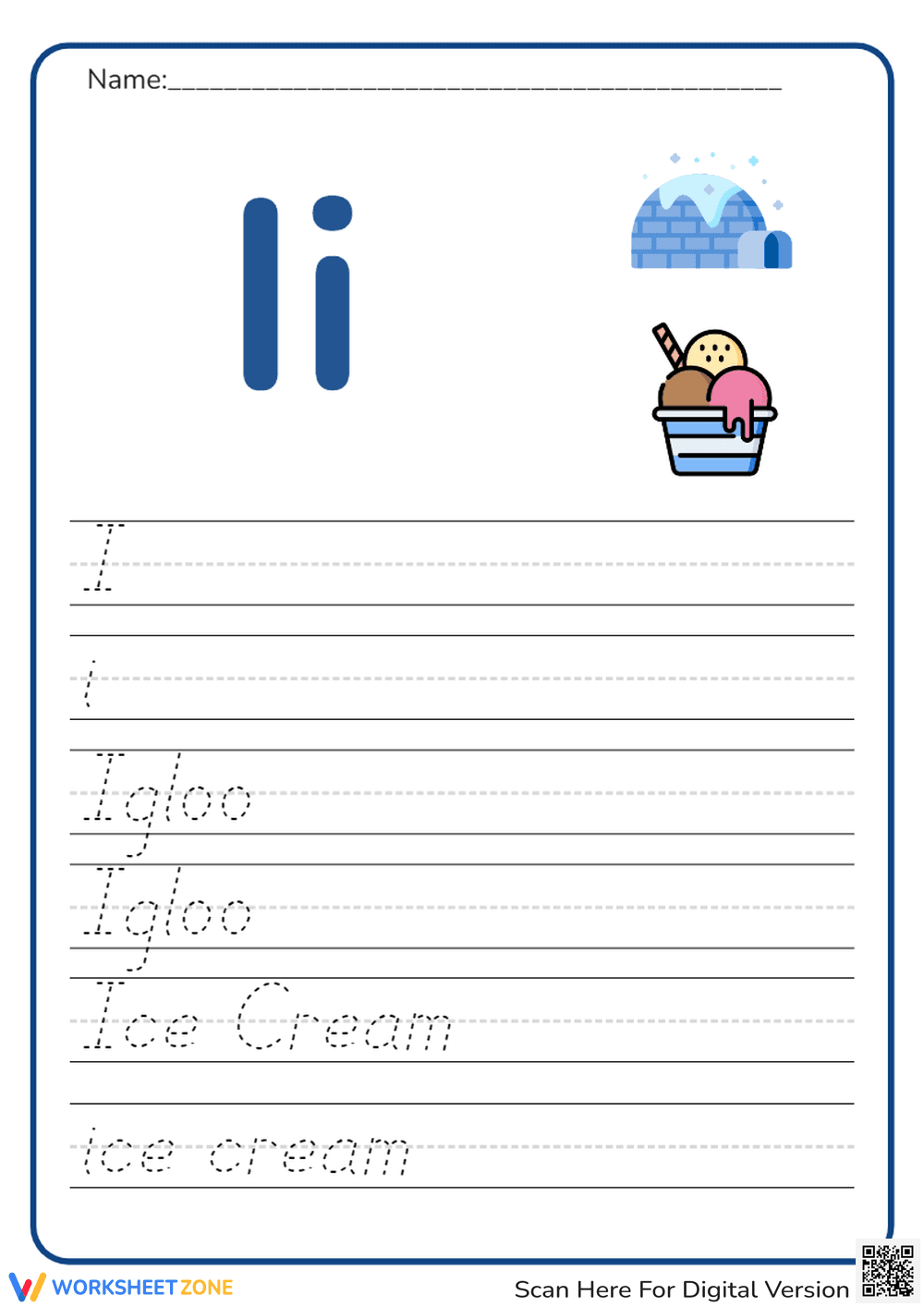

Letter I Tracing Worksheet | Grade K Printable

Paste this activity's link or code into your existing LMS (Google Classroom, Canvas, Teams, Schoology, Moodle, etc.).
Students can open and work on the activity right away, with no student login required.
You'll still be able to track student progress and results from your teacher account.
This printable handwriting worksheet helps early learners master the letter I. Students practice proper stroke formation for both uppercase and lowercase letters before advancing to full words. By tracing familiar vocabulary like "igloo" and "ice cream," children build essential fine motor skills and letter recognition simultaneously.
At a Glance
- Grade: K · Subject: English
- Standard:
CCSS.ELA-LITERACY.L.K.1.A— Print many upper- and lowercase letters- Skill Focus: Letter I Tracing
- Format: 1 page · 6 problems · No answer key needed · PDF
- Best For: Independent practice
- Time: 10–15 minutes
Inside this single-page resource, educators will find a structured progression of handwriting exercises. The page features clear, dashed-line models for the uppercase "I" and lowercase "i," followed by traceable words starting with the target letter. Visual cues, including colorful illustrations of an igloo and ice cream, provide helpful context for early readers. The standard primary writing lines ensure students practice proper letter height and placement.
This resource is designed for immediate classroom implementation with a seamless zero-prep workflow:
- Print (1 minute): Download the PDF and print copies.
- Distribute (1 minute): Hand out during morning work or literacy centers.
- Review (0 minutes): Tracing paths are self-correcting; no formal grading required.
Total teacher prep time is under two minutes, making this an ideal option for emergency sub plans.
This worksheet is directly aligned to CCSS.ELA-LITERACY.L.K.1.A, which requires students to print many upper- and lowercase letters. It also supports foundational reading skills by associating the letter I with its corresponding initial sounds in familiar words. Both standard codes can be copied directly into lesson plans, IEP goals, or district curriculum mapping tools.
Teachers can utilize this worksheet in multiple instructional contexts. It serves as an excellent independent activity during literacy centers, allowing students to practice fine motor control while the teacher conducts small group reading instruction. Alternatively, it can be assigned as targeted homework following a whole-class phonics lesson. While students work, teachers should observe their pencil grip and stroke direction, providing immediate corrective feedback if a child starts letters from the bottom line. Expected completion time ranges from 10 to 15 minutes.
This resource is primarily designed for Kindergarten and early Grade 1 students who are developing their foundational handwriting skills. It is also highly beneficial for occupational therapy sessions or special education students requiring additional fine motor repetition. For students needing extra scaffolding, teachers can highlight the top and bottom writing lines in different colors. This worksheet pairs perfectly with an alphabet anchor chart or a direct instruction lesson on vowel sounds.
Developing automaticity in letter formation is a critical stepping stone for early literacy and written expression. When students practice printing letters, such as through this targeted exercise aligned to CCSS.ELA-LITERACY.L.K.1.A, they free up cognitive resources needed for higher-order tasks like spelling and sentence composition. The ability to print many upper- and lowercase letters efficiently reduces frustration and builds writing stamina. According to a recent ScienceDirect TpT Analysis, structured tracing activities that combine visual models with repetitive motor practice significantly improve letter legibility and recognition speed in early childhood settings. By integrating familiar vocabulary words alongside isolated letter practice, this resource reinforces the alphabetic principle while refining fine motor control. Consistent practice with proper stroke sequences ensures young learners establish foundational habits necessary for long-term academic success.


