


























Views
Downloads

Letter G Tracing Worksheet | Essential Kindergarten Phonics
Paste this activity's link or code into your existing LMS (Google Classroom, Canvas, Teams, Schoology, Moodle, etc.).
Students can open and work on the activity right away, with no student login required.
You'll still be able to track student progress and results from your teacher account.
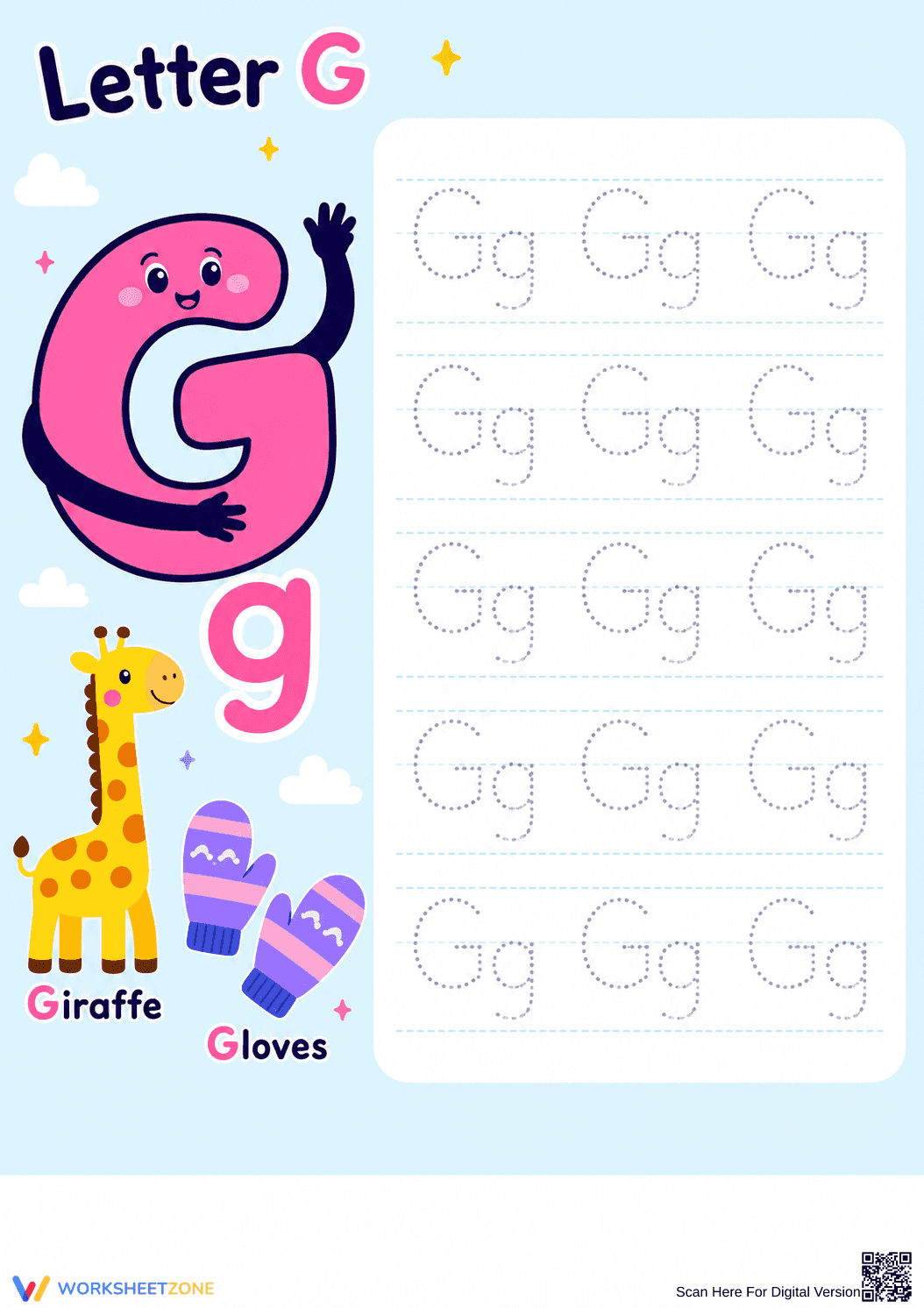
This Letter G tracing worksheet helps early learners master uppercase and lowercase letter formation while connecting sounds to familiar objects like giraffes and gloves. Students develop fine motor control and phonemic awareness through repetitive, guided practice. It provides a clear visual path for handwriting success in Kindergarten and First Grade classrooms.
At a Glance
- Grade: Kindergarten · Subject: ELA Phonics
- Standard:
CCSS.ELA-LITERACY.RF.K.1.D— Recognize and name all upper- and lowercase letters of the alphabet- Skill Focus: Letter G formation and beginning sounds
- Format: 1 page · 15 tracing pairs · Self-correcting · PDF
- Best For: Morning work or independent literacy centers
- Time: 10–15 minutes
The worksheet features a large, friendly Letter G character to engage young students. It includes 15 sets of dotted-line "Gg" pairs for tracing, organized in a clean grid. Visual cues for the hard and soft "G" sounds are provided through high-quality illustrations of a giraffe and gloves, reinforcing vocabulary alongside handwriting practice.
Zero-Prep Workflow
- Print: Generate the single-page PDF in less than 30 seconds for your entire class.
- Distribute: Hand out sheets during morning transitions or as a quick-start activity for literacy blocks.
- Review: Monitor student progress instantly as the tracing lines provide immediate visual feedback on stroke precision.
Total teacher preparation time is under 2 minutes, making this an ideal resource for sub plans or busy morning routines.
Standards Alignment
Aligned to `CCSS.ELA-LITERACY.RF.K.1.D`, this activity ensures students can identify and produce the written form of the letter G. It also supports `CCSS.ELA-LITERACY.RF.K.3.A` by linking the letter to its common phonemes. Both standard codes can be copied directly into lesson plans, IEP goals, or district curriculum mapping tools.
How to Use It
Use this worksheet during the "You Do" phase of a phonics lesson after demonstrating the proper stroke order on a whiteboard. It also serves as an excellent formative assessment tool; observe students to see if they start their strokes from the top. Expected completion time ranges from 10 to 15 minutes depending on student dexterity.
Who It's For
This resource is ideal for Kindergarteners beginning their literacy journey and Grade 1 students needing handwriting intervention. It pairs naturally with alphabet anchor charts or a read-aloud featuring "G" words. The visual supports make it accessible for English Language Learners (ELL) and students with fine motor delays.
According to research from Fisher & Frey (2014) on the gradual release of responsibility, structured tracing activities provide the necessary scaffolding for early childhood learners to transition from guided to independent writing. This worksheet specifically targets CCSS.ELA-LITERACY.RF.K.1.D by providing 15 repetitions of the letter G, which helps solidify muscle memory and letter recognition. Studies by the NAEP indicate that early mastery of letter-sound correspondence is a primary predictor of later reading fluency. By integrating visual mnemonics like the giraffe and gloves, the worksheet leverages dual-coding theory to enhance phonemic retention. This printable resource offers a high-utility, low-barrier entry point for daily phonics instruction, ensuring that students meet foundational literacy benchmarks with minimal teacher intervention. It is a reliable tool for building the prerequisite skills required for more complex decoding and encoding tasks in subsequent primary grades.


