


























Views
Downloads

Letter D Handwriting Practice | Grade 1 Essential
Paste this activity's link or code into your existing LMS (Google Classroom, Canvas, Teams, Schoology, Moodle, etc.).
Students can open and work on the activity right away, with no student login required.
You'll still be able to track student progress and results from your teacher account.
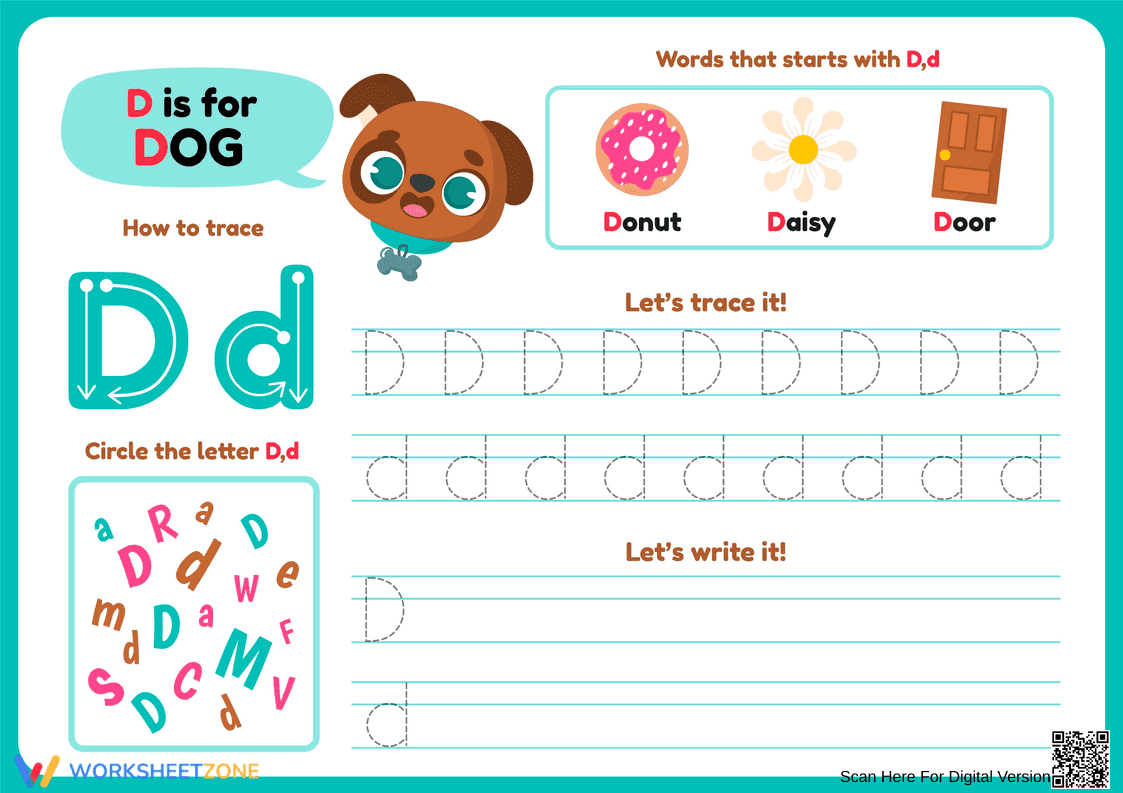
This Grade 1 handwriting worksheet provides a comprehensive approach to mastering the letter D. Students engage in multisensory learning by tracing, writing, and identifying the letter in both its uppercase and lowercase forms. By connecting the letter shape to familiar objects like dogs and donuts, learners build the foundational phonics and fine motor skills necessary for early literacy success.
At a Glance
- Grade: 1 · Subject: English
- Standard:
CCSS.ELA-LITERACY.L.1.1.A— Print all upper- and lowercase letters accurately- Skill Focus: Letter D formation and recognition
- Format: 1 page · 25 problems · Answer key included · PDF
- Best For: Morning work or independent literacy centers
- Time: 10–15 minutes
The worksheet is a single-page PDF designed for maximum student engagement. It includes a large "How to Trace" guide with directional arrows for proper stroke order. Students complete 10 uppercase and 10 lowercase tracing repetitions before moving to two lines of independent writing practice. A "Circle the Letter" visual discrimination box contains over 20 mixed letters to sharpen identification skills, alongside three illustrated vocabulary words: donut, daisy, and door.
This resource is optimized for a zero-prep classroom environment. First, print the single-page PDF (30 seconds). Second, distribute the sheets to students during your phonics block or as a transition activity (1 minute). Finally, review the letter search box as a whole group to check for accuracy (1 minute). The total teacher preparation time is under two minutes, making it an ideal choice for emergency sub plans or busy morning routines.
The primary focus is CCSS.ELA-LITERACY.L.1.1.A, which requires students to demonstrate command of the conventions of standard English grammar and usage by printing all upper- and lowercase letters. This worksheet specifically targets the letter D, ensuring students understand the distinct vertical and curved strokes required for both cases. This standard code can be copied directly into lesson plans, IEP goals, or district curriculum mapping tools.
Use this worksheet during the "You Do" phase of a gradual release lesson on the alphabet. After demonstrating the letter D on the board, assign this for independent practice to monitor fine motor control. It also serves as an effective formative assessment tool; observe students during the "Circle the Letter" task to identify those struggling with visual discrimination between 'd' and 'b'. Expect completion within 15 minutes.
This resource is designed for Grade 1 students who need to solidify their handwriting mechanics. It is also highly effective for Kindergarteners ready for advanced tracing or English Language Learners (ELLs) building basic vocabulary. Pair this worksheet with a letter D anchor chart or a short reading passage featuring "D" words to reinforce the connection between letter formation and phonemic awareness.
Effective handwriting instruction in Grade 1 is a critical predictor of later writing fluency and compositional quality. According to the RAND AIRS 2024 report on early literacy, explicit practice in letter formation, such as the tracing and independent writing tasks found in this worksheet, helps automate the physical act of writing. This automation allows students to dedicate more cognitive resources to higher-level tasks like spelling and sentence construction. By aligning with CCSS.ELA-LITERACY.L.1.1.A, this resource ensures that students meet the national benchmark for printing upper- and lowercase letters. The inclusion of visual discrimination tasks further supports the development of orthographic mapping, a key component of the Science of Reading. Educators can confidently integrate this 25-task practice sheet into their curriculum to provide the structured, repetitive practice necessary for students to achieve mastery of the letter D.


