




























Views
Downloads
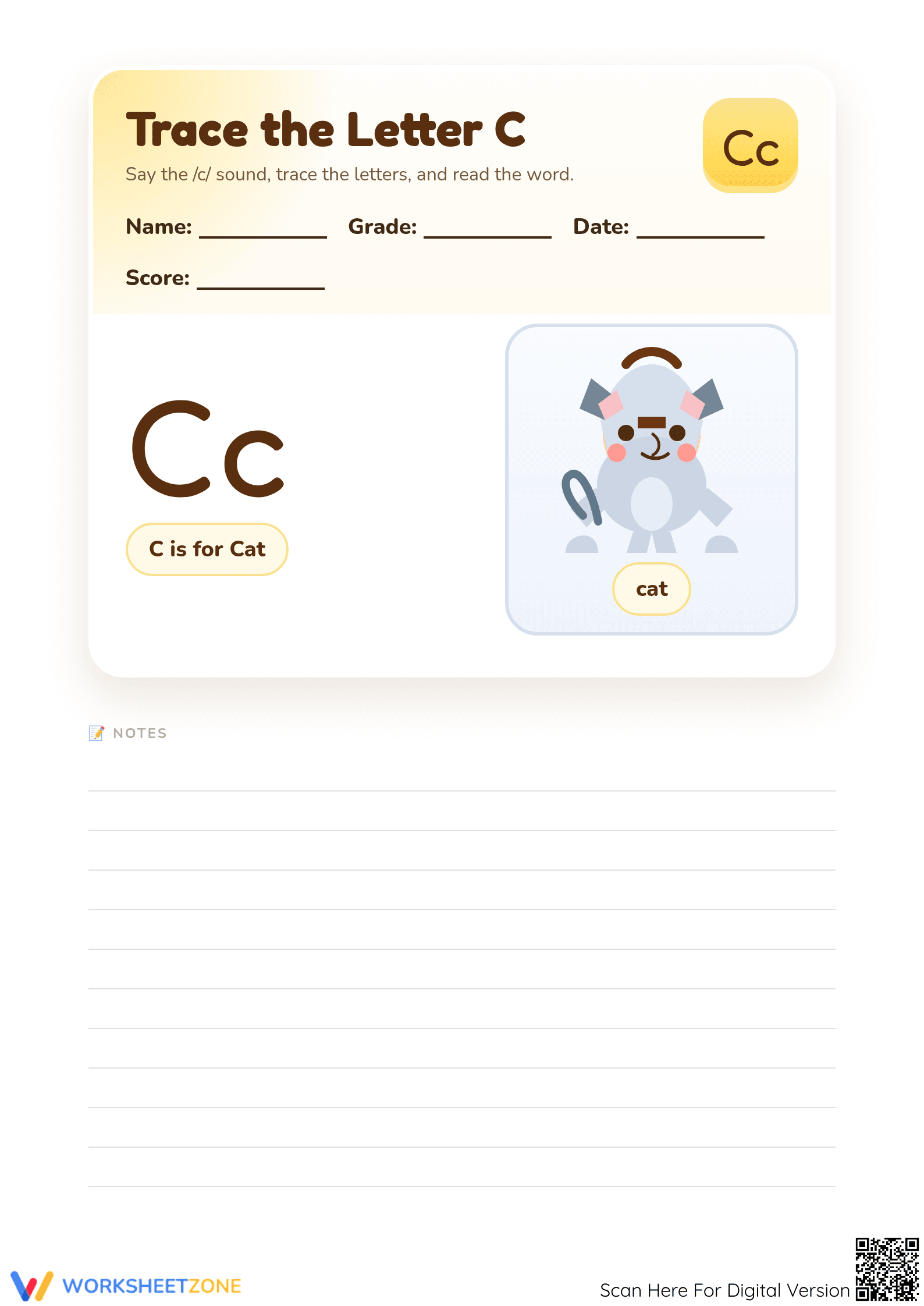


Printable Letter C Worksheet | Kindergarten ELA

Paste this activity's link or code into your existing LMS (Google Classroom, Canvas, Teams, Schoology, Moodle, etc.).
Students can open and work on the activity right away, with no student login required.
You'll still be able to track student progress and results from your teacher account.
This comprehensive Letter C worksheet provides a structured path for early learners to master the third letter of the alphabet. Students engage in multi-sensory practice, combining phonemic awareness with fine motor tracing and introductory reading. By the end of these activities, students will confidently recognize, write, and associate the /c/ sound with familiar objects.
At a Glance
- Grade: K · Subject: English Language Arts
- Standard:
CCSS.ELA-LITERACY.RF.K.1.D— Recognize and name all upper- and lowercase letters of the alphabet- Skill Focus: Letter C recognition, tracing, and initial phonics
- Format: 3 pages · 19 tasks · Answer key included · PDF
- Best For: Daily phonics practice or morning work
- Time: 15–20 minutes
The packet consists of three high-quality pages designed for clarity and student engagement. It features large, clear models for uppercase 'C' and lowercase 'c', eight dedicated tracing lines with starting dot guides, and a phonics sorting task featuring six distinct illustrations. Additionally, the set includes a reading section for CVC words like 'cat' and 'car', plus a creative drawing space to reinforce conceptual connections.
Instruction follows a logical gradual-release model across 19 specific tasks. First, students begin by tracing the letter 'C' eight times, following explicit directional cues and starting dots to build muscle memory and correct stroke order. Next, the sound identification section presents six visual prompts where students must discriminate between the /c/ sound in 'cake' or 'cookie' versus other phonemes. Finally, learners transition to reading four foundational CVC words independently and applying their knowledge by drawing an original object that begins with the target letter.
This resource is explicitly aligned to CCSS.ELA-LITERACY.RF.K.1.D, which requires students to recognize and name all upper- and lowercase letters of the alphabet. It also supports CCSS.ELA-LITERACY.RF.K.3.A by helping students demonstrate basic knowledge of one-to-one letter-sound correspondences. These standard codes can be copied directly into lesson plans, IEP goals, or district curriculum mapping tools to ensure instructional compliance.
Use this worksheet during the independent practice portion of a direct instruction lesson on the letter 'C'. It works exceptionally well as a transition activity between whole-group phonics and small-group literacy centers. For formative assessment, observe students during the sound-identification task to see if they can orally produce the hard /c/ sound before circling the images. Expect most Kindergarten students to complete the full three-page set in approximately 18 minutes.
This set is primarily designed for Kindergarten students but serves as an excellent remedial tool for Grade 1 learners or an enrichment resource for Preschoolers showing early literacy readiness. It pairs naturally with a "Letter of the Week" animal-themed anchor chart or a short reading passage about cats and cakes. Differentiation is easily achieved by having advanced students write the words they find in the sound-sorting section.
The acquisition of letter-name knowledge and phonemic awareness is a critical precursor to decoding and overall reading fluency in early childhood education. According to the EdReports 2024 analysis of foundational literacy materials, explicit instruction in letter-sound correspondences, such as the /c/ sound featured in this resource, provides the necessary scaffolding for students to move from simple recognition to complex phonics applications. This worksheet utilizes high-frequency CVC words and clear visual anchors to reduce cognitive load, allowing Preschool and Kindergarten students to focus on the motor skills of tracing while simultaneously building their internal lexicon. By integrating tracing, sound identification, and introductory reading, the resource aligns with research-based practices for multi-sensory alphabet instruction. The inclusion of CCSS.ELA-LITERACY.RF.K.1.D ensures that teachers can justify the instructional time spent on these tasks as being directly contributory to state and national literacy benchmarks for early learners.


