


























Views
Downloads


Printable Letter E Phonics Worksheet | Kindergarten ELA
Paste this activity's link or code into your existing LMS (Google Classroom, Canvas, Teams, Schoology, Moodle, etc.).
Students can open and work on the activity right away, with no student login required.
You'll still be able to track student progress and results from your teacher account.
This printable Kindergarten phonics worksheet helps early readers master the letter E through targeted letter recognition, vocabulary building, and handwriting practice. Students will identify upper- and lowercase letters, explore beginning sounds, and practice proper letter formation to build essential foundational literacy skills.
At a Glance
- Grade: Kindergarten · Subject: ELA
- Standard:
CCSS.ELA-LITERACY.RF.K.1.D— Recognize and name all upper- and lowercase letters.- Skill Focus: Letter E Recognition and Tracing
- Format: 2 pages · 3 problems · PDF
- Best For: Independent practice or morning work
- Time: 10–15 minutes
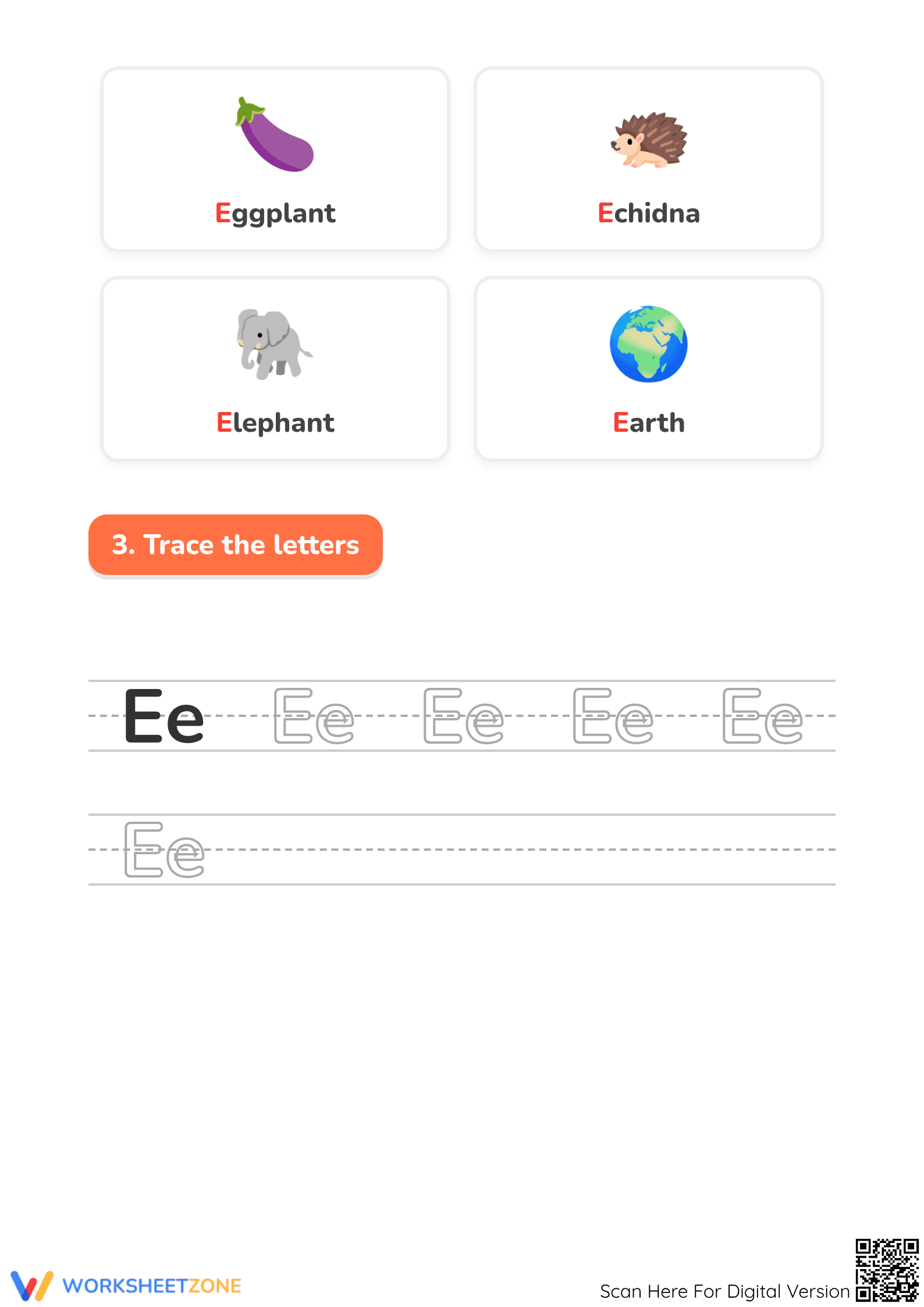
This two-page resource features three distinct task types designed to reinforce letter knowledge. The first page includes a visual discrimination activity where students circle the target letter among distractors, followed by a notes section for writing practice. The second page introduces four vocabulary words with corresponding illustrations (Eggplant, Echidna, Elephant, Earth) to reinforce the short 'E' beginning sound, concluding with guided tracing lines for both uppercase and lowercase 'Ee'.
Designed for immediate classroom implementation, this resource requires zero teacher setup.
- Print (1 minute): Simply download the PDF and print double-sided to save paper.
- Distribute (1 minute): Hand out to students during morning work or literacy centers. The instructions are highly visual and intuitive.
- Review (2 minutes): Quickly scan the circled letters and tracing lines to check for understanding and correct letter formation.
This seamless workflow makes it an excellent addition to any emergency sub plan or quick-grab literacy center.
Aligned to primary standard CCSS.ELA-LITERACY.RF.K.1.D: Recognize and name all upper- and lowercase letters of the alphabet. It also supports handwriting development by encouraging students to print upper- and lowercase letters accurately. Both standard codes can be copied directly into lesson plans, IEP goals, or district curriculum mapping tools.
This worksheet is highly versatile for early childhood classrooms. Use it during small group literacy centers after introducing the letter E, allowing students to practice visual discrimination and fine motor skills independently. Alternatively, assign it as morning work to establish a calm, focused routine while reinforcing phonics concepts. Teachers can easily observe students during the tracing activity to provide immediate formative feedback on pencil grip and stroke order. Expected completion time is 10 to 15 minutes.
This resource is ideal for Kindergarten students, pre-K learners ready for formal letter instruction, or first graders needing a quick phonics refresher. The clear, uncluttered layout and visual cues provide built-in scaffolding for English Language Learners (ELLs) and students receiving occupational therapy for fine motor delays. Pair this worksheet with a read-aloud focusing on the short 'E' sound or an interactive anchor chart to maximize engagement.
Mastering foundational alphabet skills, including the ability to recognize and name all upper- and lowercase letters (CCSS.ELA-LITERACY.RF.K.1.D), is a critical predictor of future reading success. According to a recent EdReports 2024 analysis of early literacy curricula, explicit and systematic instruction in letter recognition and formation significantly improves decoding fluency in later grades. This worksheet provides the structured repetition necessary for young learners to internalize these visual and motor patterns. By combining visual discrimination tasks with guided handwriting practice, educators can ensure students build robust neural pathways connecting letter symbols to their corresponding sounds. This multi-sensory approach not only solidifies alphabet knowledge but also fosters the fine motor control required for independent writing, setting a strong foundation for comprehensive literacy development.


