


























Views
Downloads

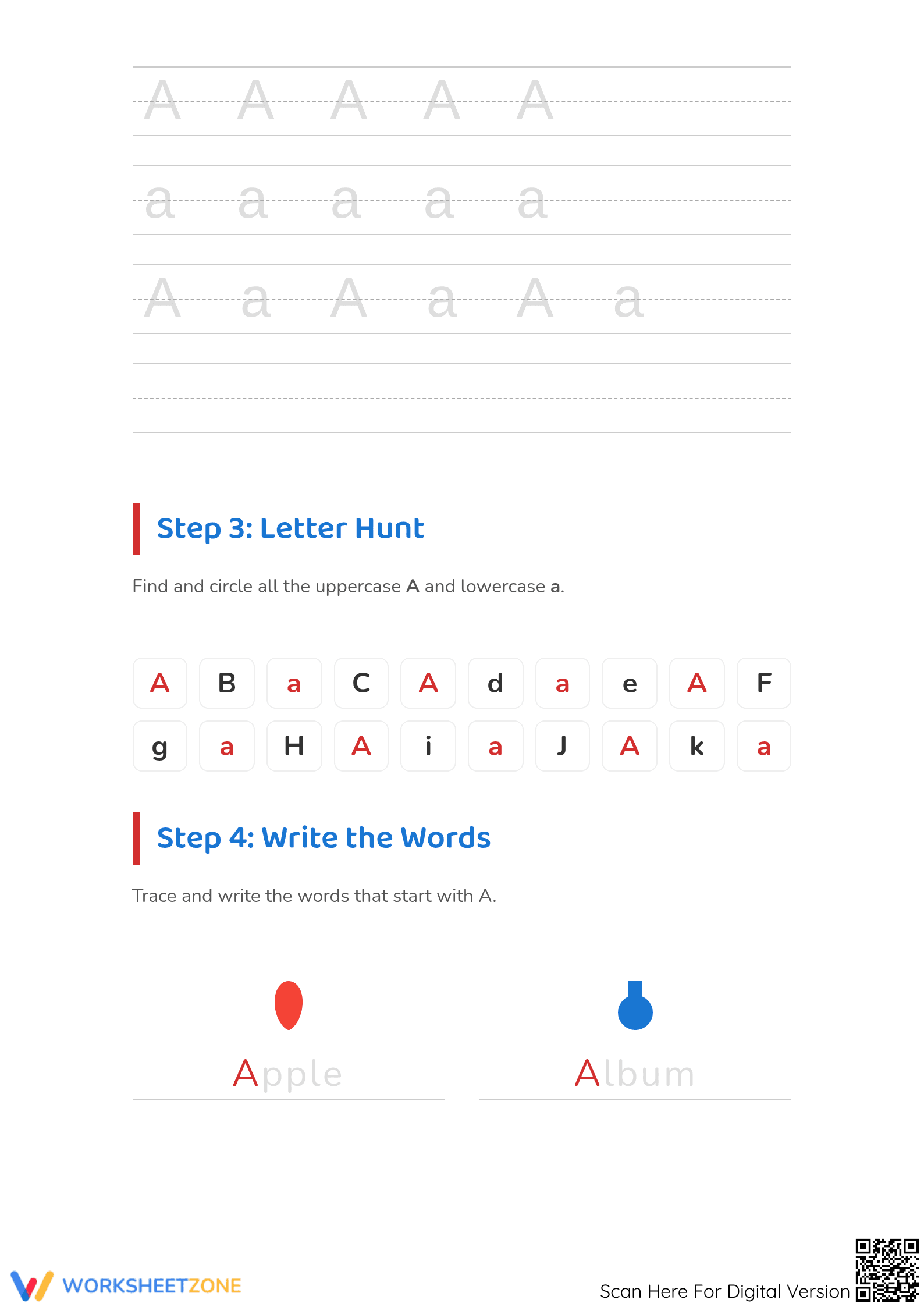


Essential Letter A Beginning Sound Worksheet | Grade K
Paste this activity's link or code into your existing LMS (Google Classroom, Canvas, Teams, Schoology, Moodle, etc.).
Students can open and work on the activity right away, with no student login required.
You'll still be able to track student progress and results from your teacher account.
This Kindergarten English Language Arts worksheet provides a comprehensive introduction to the letter A, focusing on both uppercase and lowercase formation alongside initial sound recognition. Students engage in multi-sensory learning by tracing, identifying, and writing words like "Apple" and "Album" to solidify their foundational literacy skills and phonemic awareness.
At a Glance
- Grade: Kindergarten · Subject: ELA Phonics
- Standard:
CCSS.ELA-LITERACY.RF.K.1.D— Recognize and name all upper- and lowercase letters of the alphabet- Skill Focus: Letter A formation and beginning sounds
- Format: 3 pages · 4 tasks · Answer key included · PDF
- Best For: Morning work or initial phonics instruction
- Time: 15–20 minutes
What's Inside
The packet contains three pages of structured activities. Page one introduces directional arrows for proper letter formation. Page two features a dedicated tracing section for both cases, a "Letter Hunt" visual discrimination grid containing 20 different characters, and a vocabulary section where students trace beginning-sound words. A full answer key is included for the letter hunt, and the final page offers positive reinforcement for student completion.
Zero-Prep Workflow
This resource is optimized for busy classrooms and is an ideal sub-plan component. 1. Print: Select the pages and print in under 1 minute. 2. Distribute: Hand out the sheets during your phonics block (under 1 minute). 3. Review: Use the letter hunt for a quick check. Total teacher prep time is under 2 minutes.
Standards Alignment
The primary focus is `CCSS.ELA-LITERACY.RF.K.1.D`, which requires students to "Recognize and name all upper- and lowercase letters of the alphabet." Additionally, it supports `CCSS.ELA-LITERACY.RF.K.3.A` by linking the letter shape to its primary consonant or vowel sound in context. Both standard codes can be copied directly into lesson plans, IEP goals, or district curriculum mapping tools.
How to Use It
Use this worksheet during the "I Do" phase of a phonics lesson to model correct stroke order on a projector. Alternatively, assign the "Letter Hunt" as a formative assessment after direct instruction to gauge visual discrimination accuracy. Expected completion time ranges from 15 to 20 minutes depending on the student's fine motor development.
Who It's For
This resource is ideal for Kindergarten students beginning their literacy journey, as well as Grade 1 students requiring remedial support in letter recognition. It pairs naturally with an alphabet anchor chart or a physical "letter of the week" tub containing objects like plastic apples or toy airplanes.
Early literacy research emphasizes the importance of explicit instruction in letter-sound correspondence and grapheme formation. According to the National Assessment of Educational Progress (NAEP), students who master letter recognition in Kindergarten demonstrate significantly higher reading proficiency in later primary grades. This worksheet addresses CCSS.ELA-LITERACY.RF.K.1.D by providing the repetitive, scaffolded practice necessary for cognitive mapping of the letter A. By combining visual discrimination (the Letter Hunt) with kinesthetic tracing, the resource aligns with the multi-sensory approaches advocated by Fisher & Frey (2014) for foundational skill acquisition. The inclusion of beginning sound vocabulary further bridges the gap between isolated letter recognition and functional reading. Educators can utilize this tool to ensure that 100% of their students meet the benchmark for identifying the first letter of the alphabet within a structured, no-prep instructional framework.


