


























Views
Downloads


Letter A Tracing & Sounds Worksheet | Grade K Printable
Paste this activity's link or code into your existing LMS (Google Classroom, Canvas, Teams, Schoology, Moodle, etc.).
Students can open and work on the activity right away, with no student login required.
You'll still be able to track student progress and results from your teacher account.
This foundational phonics worksheet helps Kindergarten students master the letter A through targeted handwriting practice and phonemic awareness exercises. By combining uppercase and lowercase tracing with beginning sound identification, young learners develop the essential fine motor and decoding skills needed for early reading success.
At a Glance
- Grade: K · Subject: ELA
- Standard:
CCSS.ELA-LITERACY.L.K.1.A— Print many upper- and lowercase letters- Skill Focus: Letter A tracing and beginning sounds
- Format: 2 pages · 4 parts · Answer key included · PDF
- Best For: Independent practice or morning work
- Time: 10–15 minutes
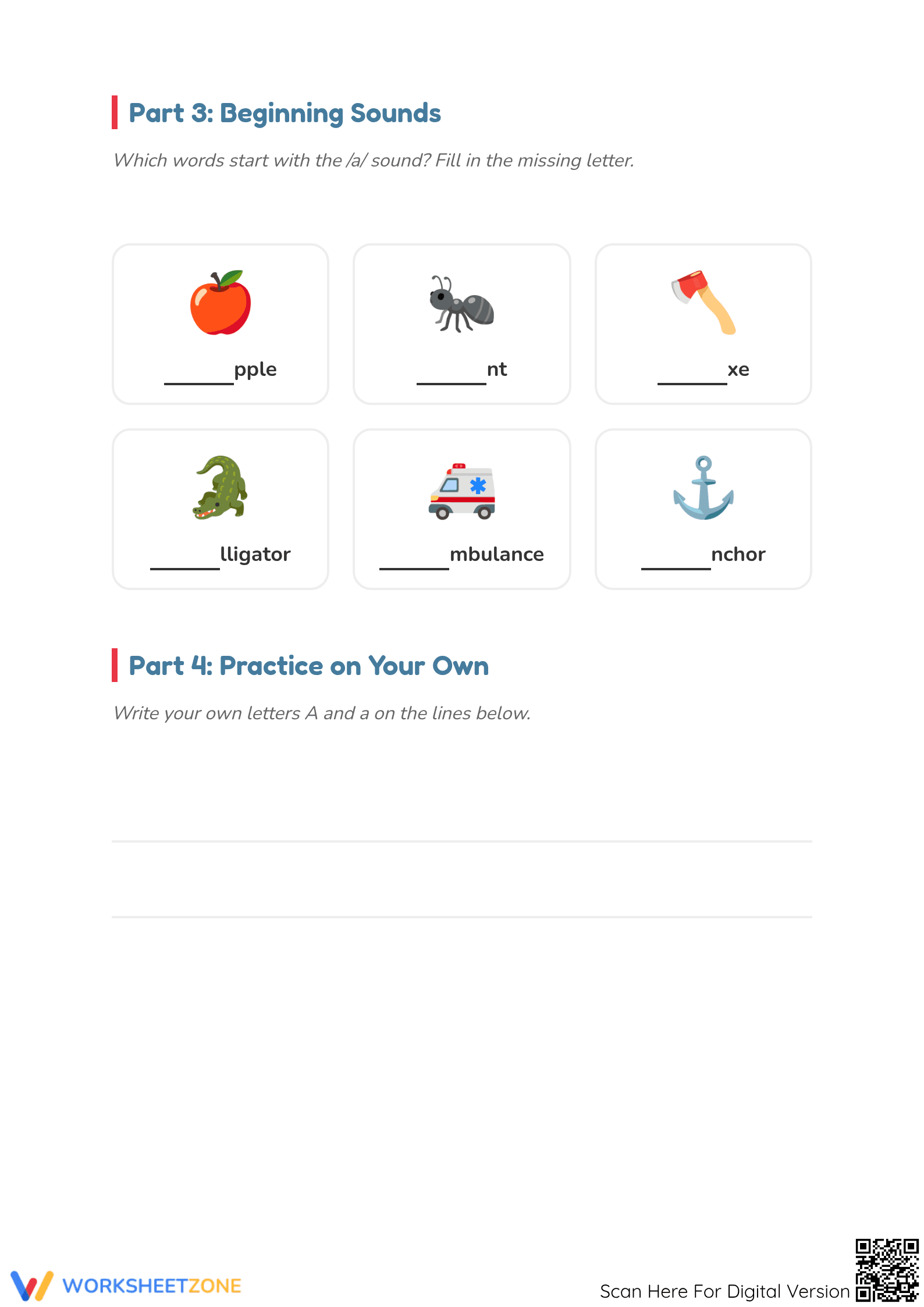
This two-page resource features four distinct sections designed to build letter familiarity step-by-step. Students begin with guided tracing of uppercase and lowercase letters using directional arrows. The worksheet then transitions into a vocabulary-building exercise where students fill in the missing initial letter for six common "A" words, such as apple and alligator. Finally, a blank writing line provides space for independent letter formation. A complete answer key is included for quick grading.
- Guided practice: Students trace the uppercase and lowercase letter A using dotted lines and directional arrows to ensure proper stroke order.
- Supported practice: Learners apply their knowledge by identifying the beginning sound for familiar pictures and writing the missing letter to complete the word.
- Independent practice: A blank writing line challenges students to form the letters entirely on their own without tracing guides.
This gradual-release approach ensures students build confidence as they move from heavily scaffolded tracing to independent writing.
This resource is aligned to CCSS.ELA-LITERACY.L.K.1.A, requiring students to print many upper- and lowercase letters. It also supports phonological awareness by having students isolate and pronounce the initial sounds in spoken words. Both standard codes can be copied directly into lesson plans, IEP goals, or district curriculum mapping tools.
Deploy this worksheet during morning work routines to give students immediate, focused practice as they settle into the classroom. It also serves as an excellent independent center activity following a whole-group phonics lesson on the short /a/ sound. While students are working, teachers can use this time for formative assessment by observing pencil grip and stroke direction during the tracing portions. Most Kindergarteners will complete the two pages in 10 to 15 minutes.
This printable is ideal for Kindergarten students who are just beginning their alphabet journey or need extra reinforcement with letter formation. The clear visual cues make it highly accessible for early learners and students receiving occupational therapy support for fine motor skills. Pair this worksheet with an interactive alphabet anchor chart or a read-aloud focused on the letter A to create a comprehensive phonics lesson.
Developing strong letter recognition and formation skills is a critical milestone in early childhood education. This worksheet aligns with CCSS.ELA-LITERACY.L.K.1.A, which requires students to print many upper- and lowercase letters accurately. According to a 2024 report by EdReports, foundational phonics materials that integrate handwriting practice with phonemic awareness significantly improve early decoding abilities. When students physically write the letters while simultaneously associating them with beginning sounds, they build stronger neural pathways for reading. This resource provides that exact dual-modality practice, ensuring learners not only recognize the letter A but can also produce it and connect it to its corresponding sound in everyday vocabulary words. By utilizing structured, gradual-release tasks, educators can effectively support early literacy development and prepare students for more complex reading challenges.


