


























Views
Downloads
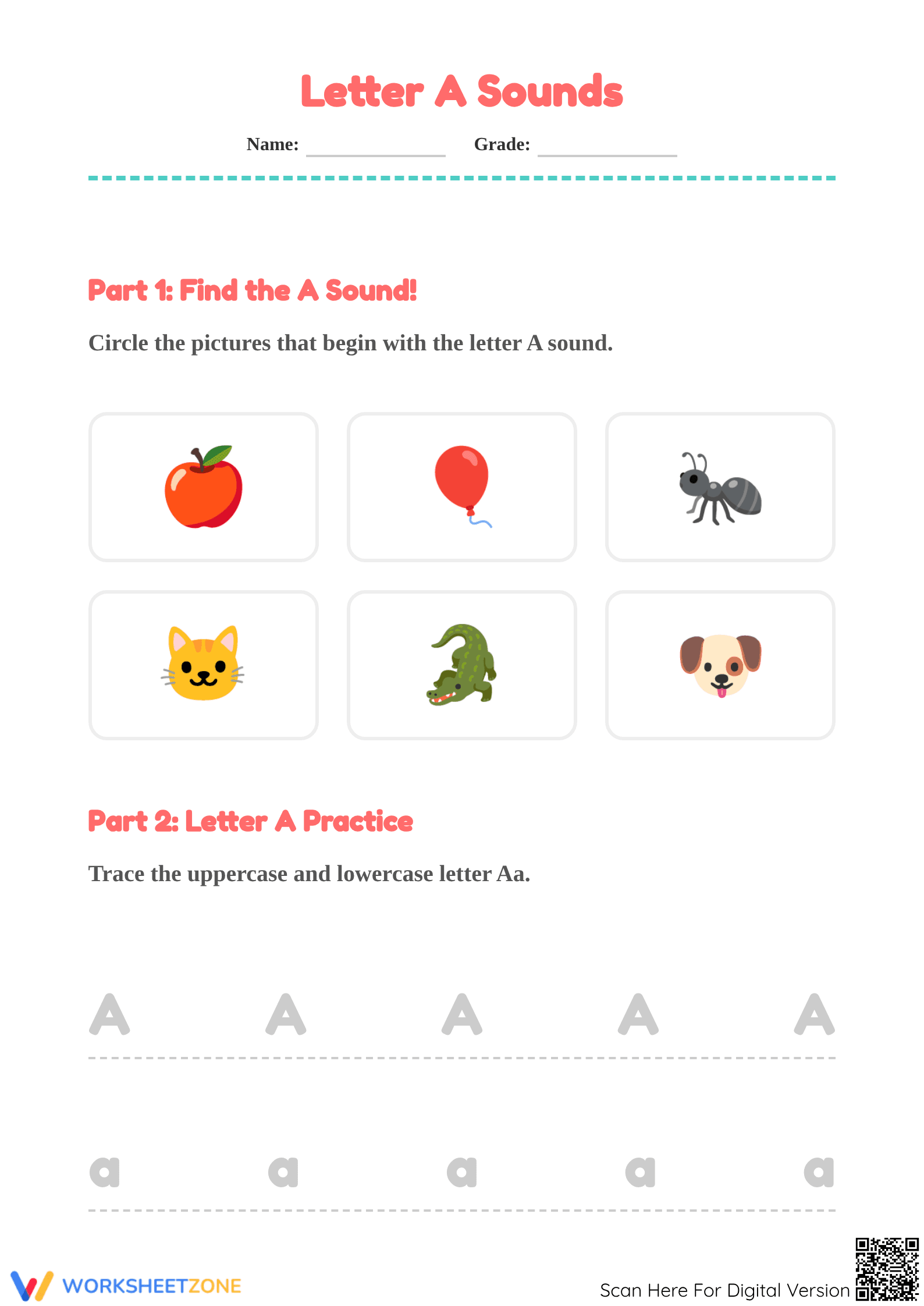

Letter A Beginning Sound Worksheet | Essential Grade K-1
Paste this activity's link or code into your existing LMS (Google Classroom, Canvas, Teams, Schoology, Moodle, etc.).
Students can open and work on the activity right away, with no student login required.
You'll still be able to track student progress and results from your teacher account.
This Kindergarten Letter A worksheet helps early learners identify initial phonemes and master letter formation. Students practice phonemic awareness by selecting images that start with the "a" sound and develop fine motor skills through guided tracing. It provides a clear path from sound recognition to written production.
At a Glance
- Grade: Kindergarten · Subject: ELA
- Standard:
CCSS.ELA-LITERACY.RF.K.3.A— Demonstrate basic knowledge of one-to-one letter-sound correspondences for consonants and vowels- Skill Focus: Initial /a/ sound and letter formation
- Format: 1 page · 16 tasks · Answer key included · PDF
- Best For: Morning work or phonics centers
- Time: 10–15 minutes
The worksheet features two distinct sections. Part one contains 6 high-quality illustrations where students must distinguish between the short "a" sound and distractor sounds. Part two provides 10 tracing opportunities for both uppercase "A" and lowercase "a" on dashed lines. A full answer key is included for quick grading.
This resource follows a 3-step zero-prep workflow. First, print the single-page PDF (30 seconds). Second, distribute to students for independent or guided work (30 seconds). Third, review the circling and tracing using the provided answer key (1 minute). Total teacher preparation time is under 2 minutes, making it an ideal sub plan.
Aligned to `CCSS.ELA-LITERACY.RF.K.3.A`, this worksheet focuses on the foundational skill of associating the letter A with its primary sound. It also supports `CCSS.ELA-LITERACY.L.K.1.A` regarding letter formation. Both standard codes can be copied directly into lesson plans, IEP goals, or district curriculum mapping tools.
Use this during the "You Do" phase of a phonics lesson. After introducing the letter A, assign this for independent practice. For formative assessment, observe if students can name the distractor images (balloon, cat, dog) and explain why they do not start with "a." Expected completion typically takes 10 to 15 minutes.
This is designed for Kindergarten students, though it serves as an excellent intervention for Grade 1 or 2 students needing phonemic support. It pairs naturally with an alphabet anchor chart or a short-vowel reading passage. The visual cues support English Language Learners in identifying common vocabulary.
Research from Fisher & Frey (2014) emphasizes the importance of the gradual release of responsibility, which this worksheet facilitates through clear visual prompts and structured tracing. By combining phonemic awareness with orthographic practice, the resource addresses two critical pillars of early literacy. According to the RAND AIRS 2024 report, high-quality supplemental materials that target specific letter-sound correspondences like CCSS.ELA-LITERACY.RF.K.3.A significantly improve student readiness for decoding. This worksheet provides 16 targeted tasks that ensure students can both recognize the initial /a/ sound in words like apple and ant and correctly form the corresponding grapheme. Such focused practice is essential for building the neural pathways required for fluent reading and writing in the primary grades. This structured approach ensures that every student masters the foundational phonics skills necessary for long-term academic success.


