


























Views
Downloads
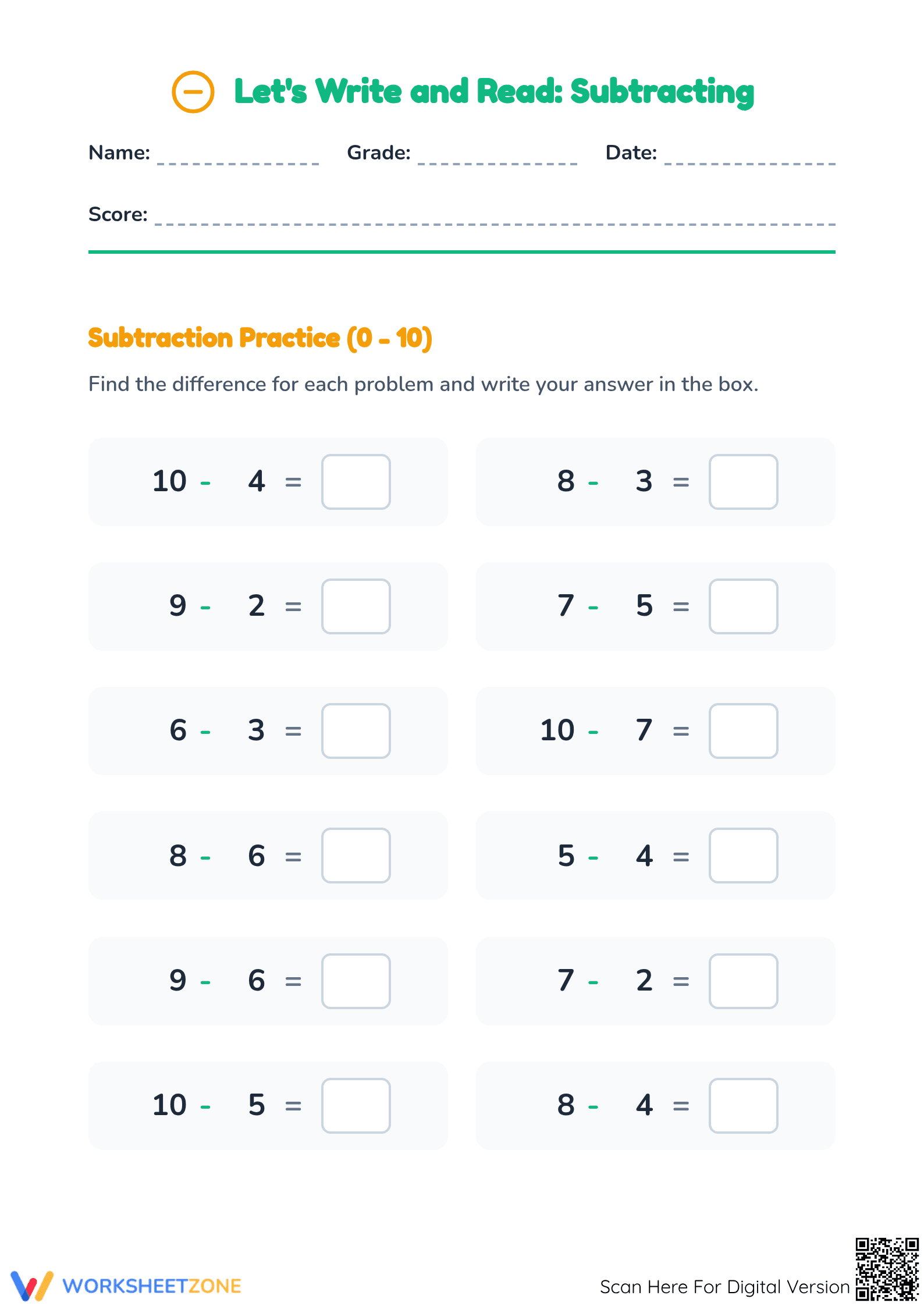


Subtraction 0-10 Worksheet | Grade 1 Essential Practice
Paste this activity's link or code into your existing LMS (Google Classroom, Canvas, Teams, Schoology, Moodle, etc.).
Students can open and work on the activity right away, with no student login required.
You'll still be able to track student progress and results from your teacher account.
Master fundamental subtraction skills with this focused practice worksheet designed for early learners. Students will build numerical fluency by solving differences between 0 and 10, ensuring they develop the mental math confidence required for more complex arithmetic. This resource provides a clear, structured path to mastering basic subtraction facts in a classroom-ready format.
At a Glance
- Grade: Grade 1 · Subject: Math
- Standard:
CCSS.MATH.CONTENT.1.OA.C.6— Demonstrate fluency for addition and subtraction within 10- Skill Focus: Subtraction within 10
- Format: 2 pages · 24 problems · Answer key included · PDF
- Best For: Independent math centers or morning work
- Time: 15–20 minutes
What's Inside
This two-page PDF contains 24 horizontal subtraction problems using digits 0 through 10. Each problem is presented with a dedicated response box, promoting neatness and easy grading. The worksheet includes a scoring section at the top for quick teacher feedback and a comprehensive answer key to support self-correction or rapid assessment.
Zero-Prep Workflow
Implementation is simple and takes less than 2 minutes of teacher time. First, print the desired number of copies for your student group (30 seconds). Second, distribute the worksheets during your independent practice block or as a transition activity (30 seconds). Finally, use the provided answer key to review responses or allow students to self-grade their progress (1 minute).
Standards Alignment
This resource is aligned to CCSS.MATH.CONTENT.1.OA.C.6, which requires students to "add and subtract within 20, demonstrating fluency for addition and subtraction within 10." It also supports the development of mental strategies for subtraction as outlined in the Kindergarten and First Grade math progressions. This standard code can be copied directly into lesson plans, IEP goals, or district curriculum mapping tools.
How to Use It
Use this worksheet as a formative assessment after introducing the concept of "taking away" with manipulatives. Alternatively, assign it as a "fast finisher" task to keep students engaged while you work with small groups. During the activity, observe if students are counting back on their fingers or utilizing known addition facts to find the difference to help evaluate their mathematical strategy development.
Who It's For
This worksheet is tailored for Grade 1 students working toward fluency, though it serves as an excellent challenge for Kindergarten learners or a vital review for Grade 2 students needing to solidify their basic facts. It is ideal for general education classrooms, special education resource rooms, and home-schooling environments requiring consistent, low-prep practice.
According to the EdReports (2024) analysis of foundational math curriculum, the development of procedural fluency in early subtraction is a critical predictor of later success in algebraic thinking. This worksheet directly addresses the requirements of CCSS.MATH.CONTENT.1.OA.C.6 by providing 24 focused repetitions of subtraction within 10. Research from the NAEP underscores that students who achieve early mastery of these basic operations demonstrate significantly higher proficiency in multi-step word problems and mathematical reasoning. By isolating the operation within a clear, distraction-free layout, this resource allows students to focus entirely on the relationship between numbers. Educational practitioners can confidently integrate this tool into their daily routines as a reliable method for measuring and improving student accuracy. The alignment with established standards ensures that every problem contributes to the overarching goal of mathematical literacy and readiness for second-grade curriculum expectations.


