


























Views
Downloads

Let's Count Fruit Worksheet | Essential Kindergarten Math
Paste this activity's link or code into your existing LMS (Google Classroom, Canvas, Teams, Schoology, Moodle, etc.).
Students can open and work on the activity right away, with no student login required.
You'll still be able to track student progress and results from your teacher account.
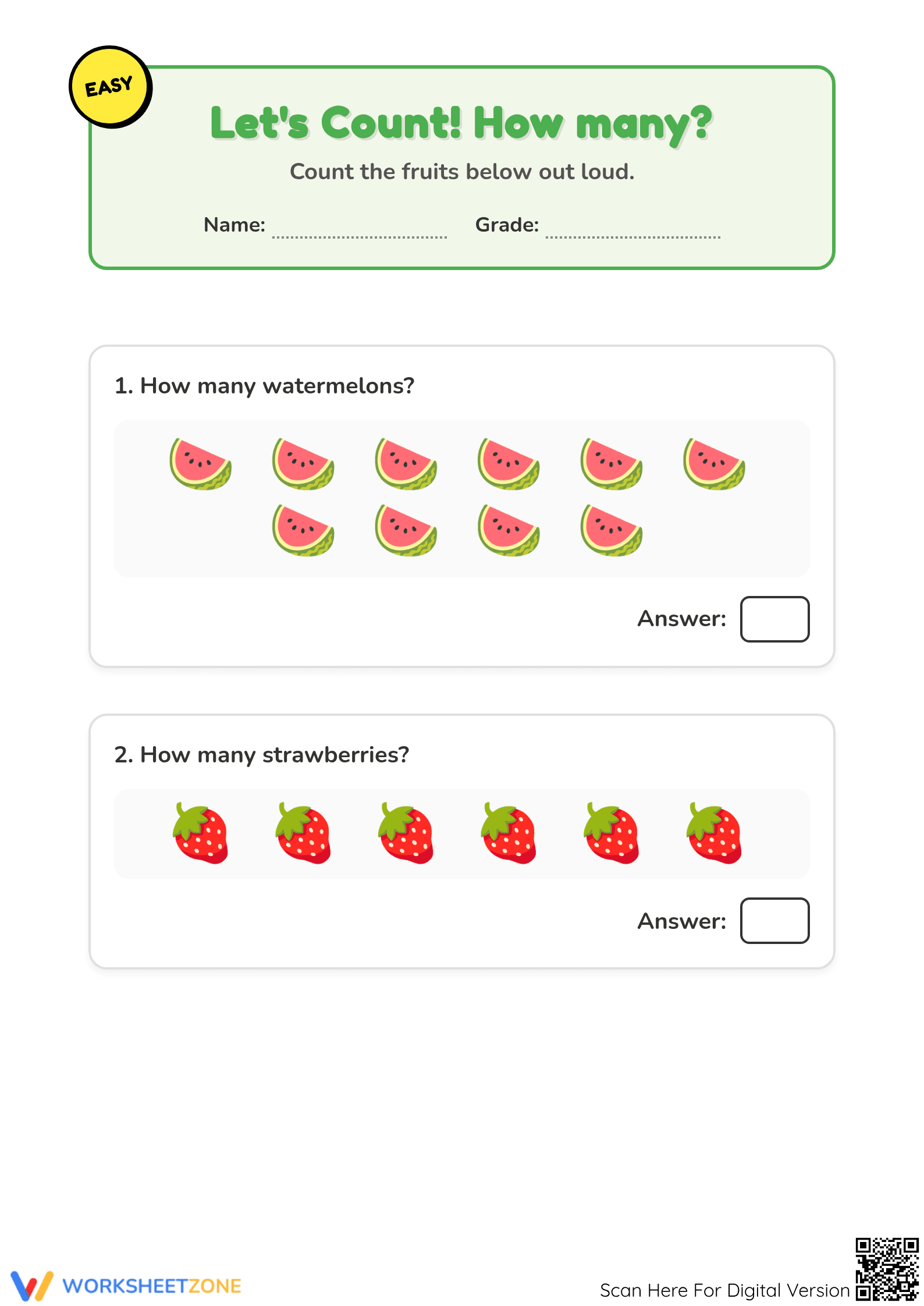
This Essential Kindergarten math worksheet makes counting fruit as easy as one, two, three! Students practice counting various fruits arranged in arrays, building the foundational one-to-one correspondence needed for math mastery. By identifying how many watermelons, strawberries, and apples appear on the page, children develop confidence and numerical fluency.
At a Glance
- Grade: Kindergarten · Subject: Math
- Standard:
K.CC.B.5— Count to answer "how many?" questions about things in an array- Skill Focus: Cardinality and One-to-One Correspondence
- Format: 2 pages · 5 problems · Answer key included · PDF
- Best For: Daily math centers and morning work
- Time: 10–15 minutes
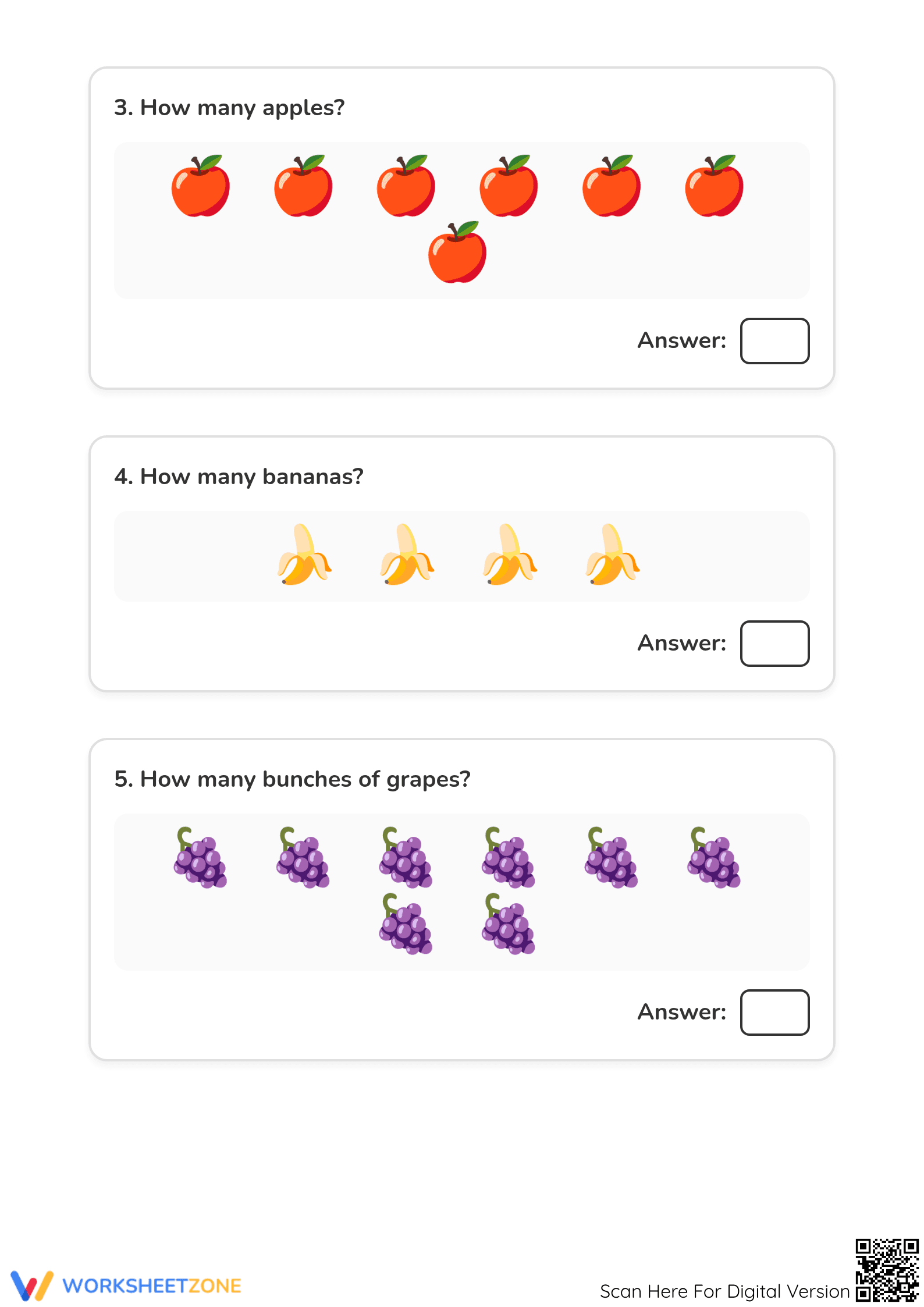
This resource features two high-quality pages containing five distinct counting tasks. Each task presents a vibrant array of fruit—including watermelons, strawberries, apples, bananas, and grapes—set within a clean, distraction-free layout. A dedicated answer box is provided for each question, and a complete answer key is included to facilitate quick grading or student self-correction.
To implement this resource, follow this simple three-step zero-prep workflow. First, print the PDF in seconds, ensuring you have enough copies for your math block. Second, distribute the two-page set to students during your independent practice time. Finally, review the work using the included answer key or project it for a whole-class check. Total teacher preparation time is under two minutes, making this an ideal solution for emergency sub plans or busy morning routines.
The primary focus of this activity is the K.CC.B.5 standard: "Count to answer 'how many?' questions about as many as 20 things arranged in a line, a rectangular array, or a circle." The worksheet also supports the K.CC.B.4 anchor by reinforcing the relationship between numbers and quantities. Both standard codes can be copied directly into lesson plans, IEP goals, or district curriculum mapping tools to ensure administrative compliance and instructional alignment.
Use this printable during the "independent practice" portion of a lesson on cardinality. As students count the watermelons and strawberries, circulate to observe if they are touching each fruit as they count, which is a key formative assessment indicator of tag-counting proficiency. Alternatively, assign this as a "fast finisher" activity for students who complete their primary math lesson ahead of schedule and need meaningful reinforcement.
This printable is designed for Kindergarten students but also serves as an excellent intervention tool for first graders or a challenge for preschoolers. It pairs naturally with fruit-themed counting manipulatives or an anchor chart showing numerals and corresponding sets to provide additional visual support for English Language Learners. The clear formatting ensures that the focus remains on the mathematical skill rather than complex instructions.
This resource provides focused practice on K.CC.B.5, a critical Kindergarten milestone according to the Common Core State Standards. Research by Fisher & Frey (2014) emphasizes the importance of visual arrays in developing early cardinality and number sense. By requiring students to count items in structured rows, this worksheet scaffolds the transition from concrete counting to abstract numerical representation. The use of familiar objects like fruit reduces cognitive load, allowing students to focus entirely on the counting sequence. Educational data from NAEP indicates that early proficiency in one-to-one correspondence is a strong predictor of later arithmetic success. This zero-prep tool ensures that every student can access high-quality, standards-aligned practice that builds the mental models necessary for advanced operations. Teachers can confidently integrate this into their curriculum knowing it meets the rigorous demands of modern early childhood mathematics instruction.


