


























Views
Downloads


Grade 6 Multi-Step Addition Word Problems | Printable
Paste this activity's link or code into your existing LMS (Google Classroom, Canvas, Teams, Schoology, Moodle, etc.).
Students can open and work on the activity right away, with no student login required.
You'll still be able to track student progress and results from your teacher account.
This Grade 6 math worksheet provides targeted practice in solving multi-step addition word problems within real-world contexts. By engaging with scenarios involving equipment maintenance and inventory management, students develop the computational fluency required to process multiple data points and arrive at accurate sums. This resource ensures students can translate narrative text into precise mathematical operations.
At a Glance
- Grade: 6 · Subject: Math
- Standard:
CCSS.MATH.CONTENT.6.NS.B.3— Fluently add multi-digit decimals and whole numbers using the standard algorithm- Skill Focus: Multi-step addition word problems
- Format: 2 pages · 3 problems · Answer key included · PDF
- Best For: Fluency practice and formative assessment
- Time: 15–20 minutes
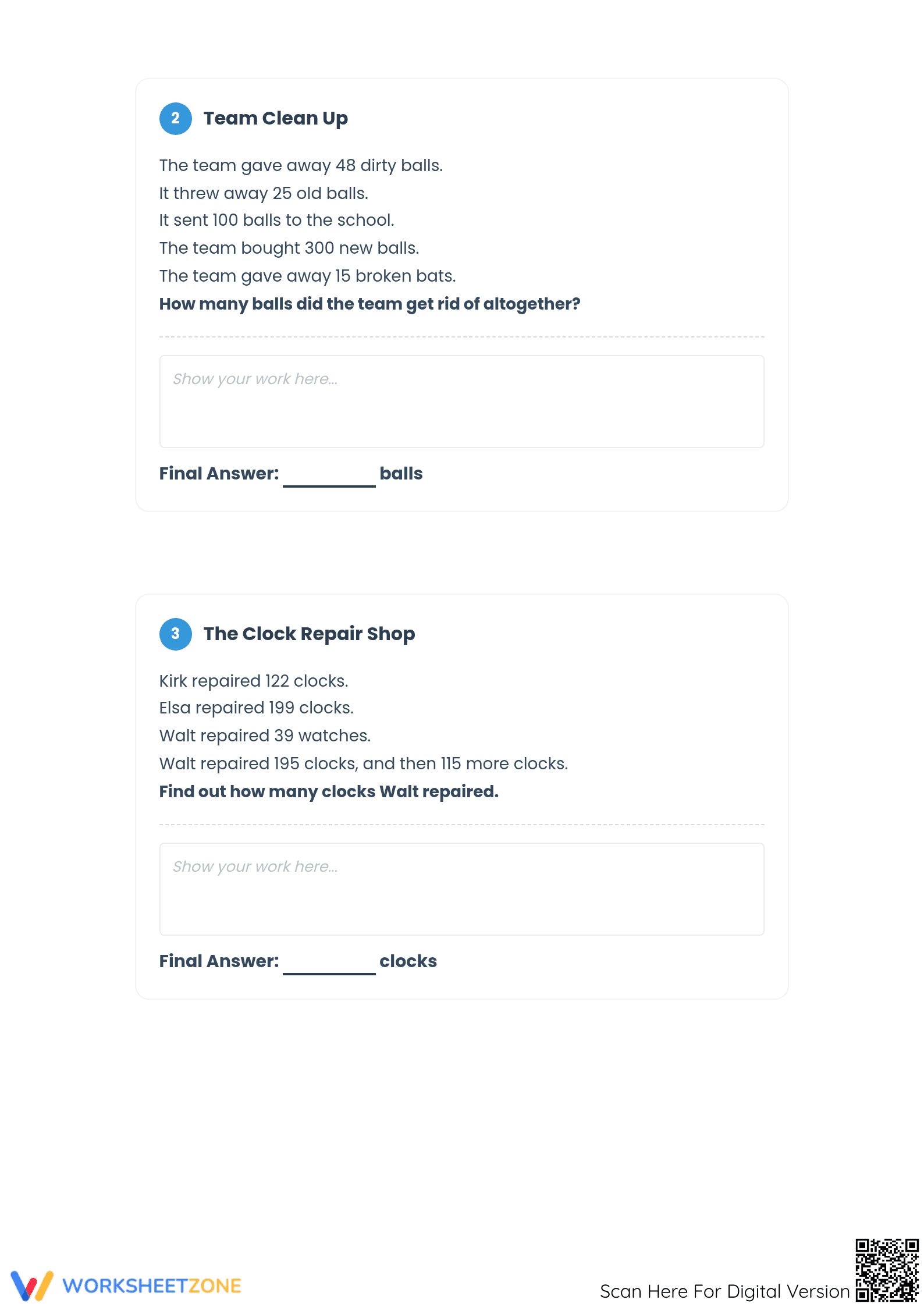
What's Inside: This two-page PDF features three comprehensive word problems that require students to extract multiple numerical values from a short narrative. Each problem includes a dedicated "Show Your Work" box to encourage organized calculation and a clear "Final Answer" line. The layout is clean and distraction-free, ensuring students remain focused on the logic of the addition tasks. A full answer key is provided for rapid grading.
Zero-Prep Workflow: This resource is designed for immediate classroom implementation. First, print the two-page document (1 minute). Second, distribute the sheets to students for independent or small-group work (30 seconds). Third, use the included answer key to review results or facilitate peer-grading (under 1 minute). The total teacher preparation time is less than two minutes, making it an ideal choice for busy mornings or unexpected sub plans.
Standards Alignment: The primary focus is `CCSS.MATH.CONTENT.6.NS.B.3`, which requires students to fluently add multi-digit numbers. While the numbers in these specific problems are whole numbers, the multi-step nature of the tasks builds the cognitive endurance necessary for higher-level arithmetic. This standard code can be copied directly into lesson plans, IEP goals, or district curriculum mapping tools.
How to Use It: This worksheet is most effective as a formative assessment after a lesson on multi-digit addition or as a warm-up activity to reinforce mental math and regrouping skills. During instruction, observe students to see if they are identifying all relevant numbers in the text before beginning their calculations. Expect most students to complete the three problems within a 15 to 20-minute window, depending on their reading speed.
Who It's For: This resource is tailored for Grade 6 students who need to strengthen their word problem decoding skills. It is also highly effective for Grade 7 students requiring remediation or as a quick review for special education populations. Pair this worksheet with a visual anchor chart on "Keywords for Addition" to support English Language Learners and struggling readers.
According to the Fisher & Frey (2014) framework for gradual release of responsibility, providing students with structured word problems that mirror real-world scenarios is vital for moving from guided instruction to independent mastery. This worksheet aligns with that research by offering a clear workspace that prompts students to externalize their mathematical thinking. By requiring students to sum multiple values—such as the various counts of broken dishes or repaired clocks—the resource reinforces the standard algorithm for addition (CCSS.MATH.CONTENT.6.NS.B.3). Research from the NAEP suggests that students often struggle more with the linguistic extraction of data than the arithmetic itself; therefore, these 3 targeted tasks provide essential practice in identifying relevant information within a text. The inclusion of a dedicated answer key allows for immediate feedback, a critical component in preventing the solidification of procedural errors during the fluency-building phase of middle school mathematics.


