


























Views
Downloads
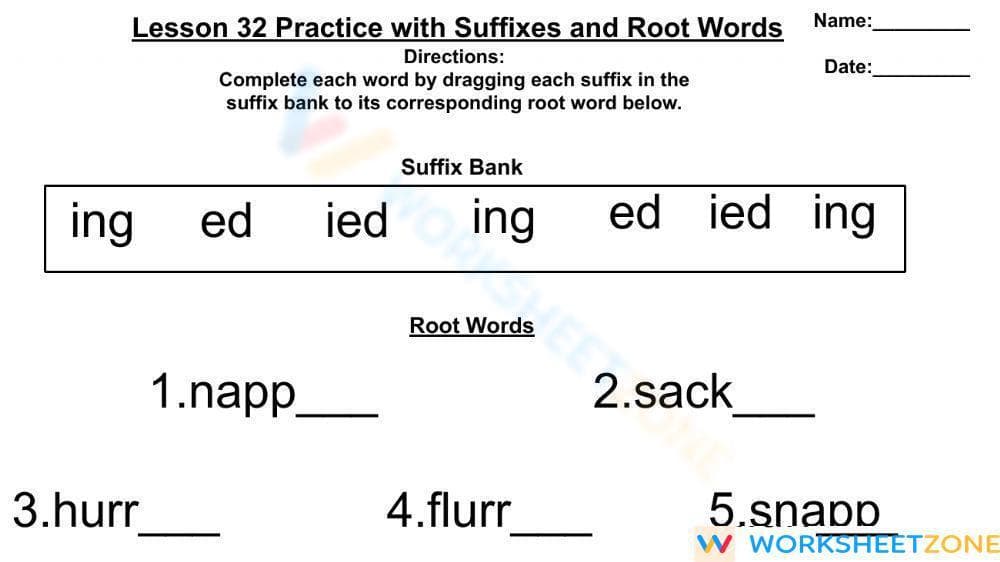

Grade 3 Root Words & Suffixes — Printable No-Prep Worksheet
Paste this activity's link or code into your existing LMS (Google Classroom, Canvas, Teams, Schoology, Moodle, etc.).
Students can open and work on the activity right away, with no student login required.
You'll still be able to track student progress and results from your teacher account.
This Grade 3 English Language Arts worksheet provides targeted practice with root words and suffixes to build foundational spelling and decoding skills. Students combine base words with appropriate endings, reinforcing spelling rules like consonant doubling and changing y to i, ensuring they master essential morphological patterns.
At a Glance
- Grade: 3 · Subject: ELA
- Standard:
CCSS.ELA-LITERACY.L.3.2.E— Add suffixes to base words correctly- Skill Focus: Root Words and Suffixes
- Format: 1 page · 7 problems · Answer key included · PDF
- Best For: Independent practice and review
- Time: 10–15 minutes
This single-page resource features a straightforward matching and spelling task where students select endings from a provided suffix bank containing -ing, -ed, and -ied. The worksheet includes seven structured problems requiring learners to attach the correct suffix to modified root words such as "napp" and "hurr." A complete answer key is provided to facilitate quick grading and immediate student feedback.
- Print (1 minute): Generate enough copies for the entire class directly from the PDF file.
- Distribute (1 minute): Hand out the worksheets as students transition to independent work time.
- Review (3 minutes): Go over the directions and the suffix bank together before students begin.
Total teacher preparation time is under two minutes. The clear instructions and familiar format make this an excellent option for emergency substitute plans or unexpected schedule changes.
This resource aligns directly to CCSS.ELA-LITERACY.L.3.2.E: Use conventional spelling for high-frequency and other studied words and for adding suffixes to base words. It also supports general vocabulary acquisition by helping students recognize how affixes change word meanings. Both standard codes can be copied directly into lesson plans, IEP goals, or district curriculum mapping tools.
Deploy this worksheet immediately following direct instruction on spelling rules for adding suffixes, or use it as a morning work activity to review previously taught morphological concepts. While students work, circulate and observe whether they correctly identify when to use "-ied" versus "-ed" for past tense verbs ending in y. Expected completion time ranges from 10 to 15 minutes, depending on reading fluency.
This activity is designed for third-grade students developing their spelling and morphological awareness. It serves as an effective intervention tool for older learners who struggle with foundational spelling conventions. Pair this worksheet with an anchor chart detailing the "drop the y" and "double the consonant" spelling rules to provide additional visual support during independent practice.
Mastering morphological conventions, specifically the ability to add suffixes to base words correctly, is a critical component of reading fluency and writing proficiency in elementary education. According to a 2024 report by EdReports, explicit instruction in word parts and spelling rules significantly improves students' reading comprehension and written expression across diverse learning populations. When students practice with targeted resources aligned to CCSS.ELA-LITERACY.L.3.2.E, they internalize the structural patterns of the English language. This automaticity reduces cognitive load during complex writing tasks, allowing young learners to focus on content generation and idea organization rather than basic spelling mechanics. Consistent, structured practice with root words and affixes ensures that students can decode unfamiliar vocabulary and spell complex words accurately across all academic subjects, building a strong foundation for future literacy success.


