


























Views
Downloads
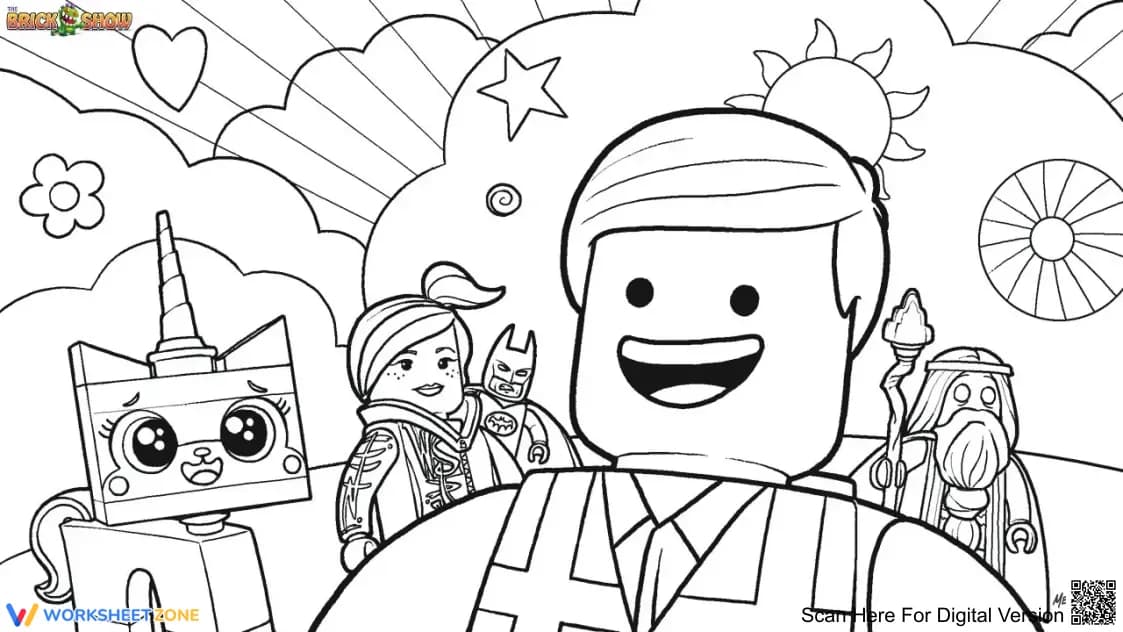

Printable Lego Movie Coloring Page for Grades 2-3
Paste this activity's link or code into your existing LMS (Google Classroom, Canvas, Teams, Schoology, Moodle, etc.).
Students can open and work on the activity right away, with no student login required.
You'll still be able to track student progress and results from your teacher account.
This printable Lego Movie coloring page helps second and third-grade students develop fine motor control, spatial awareness, and color theory application. By coloring Emmet and his friends, children practice precision and creative decision-making, translating visual ideas into a completed artistic work that builds confidence and artistic focus.
At a Glance
- Grade: Grade 2 · Grade 3 · Subject: Fine Art
- Standard:
VA:Cr1.2.2a— Make art to explore personal interests, questions, or curiosity- Skill Focus: Fine motor control and creative expression
- Format: 1 page · 1 task · No answer key · PDF
- Best For: Morning work, early finishers, or art centers
- Time: 15–30 minutes
This single-page PDF download features a high-quality, clean line-art illustration of popular characters from the Lego Movie, including Emmet, Wyldstyle, Batman, Unikitty, and Vitruvius. The layout includes detailed foreground characters and a structured background with a sun, clouds, and geometric patterns, providing varied coloring challenges. No answer key is required for this open-ended creative activity, allowing students complete artistic freedom with their color choices.
Zero-Prep Classroom Workflow
This activity requires under 2 minutes of teacher prep. First, print the single-page PDF (1 minute). Second, distribute the sheets with crayons or markers (30 seconds). Third, review the completed artwork by displaying them on a bulletin board (30 seconds). This simple workflow makes the sheet an ideal emergency sub plan.
Standards Alignment
This activity aligns with National Core Arts Standard VA:Cr1.2.2a, which requires students to make art with various materials to explore personal interests. It also supports ELA speaking standards when students describe their work. Both standard codes can be copied directly into lesson plans, IEP goals, or curriculum mapping tools.
How to Use in the Classroom
Use this coloring page as a quiet transition activity after direct instruction, or as an independent task during art centers. While students work, observe their grip as a quick formative assessment of fine motor development. Most students will complete their coloring within a 15 to 30 minute timeframe.
Target Audience and Differentiation
This worksheet is designed for second and third-grade students. For students requiring support, suggest larger coloring tools like thick markers. Pair this activity with a short reading passage about teamwork or a brief lesson on colors to deepen the educational value.
According to research by Fisher & Frey (2014) on student engagement and learning transitions, integrating creative visual tasks like coloring helps lower cognitive load and transitions students smoothly between intensive academic blocks. This worksheet aligns with standard VA:Cr1.2.2a, focusing on the plain-English skill of using artistic tools to explore personal interests and develop fine motor control. By engaging with familiar characters, students build visual stamina and spatial awareness. The structured lines guide hand-eye coordination, which directly supports early writing development. Educators can utilize this resource to reinforce focus and self-regulation in elementary classrooms. The simple, single-page format ensures immediate utility without administrative overhead, making it a highly practical tool for daily classroom management, creative expression, and fine motor skill reinforcement.


