


























Views
Downloads
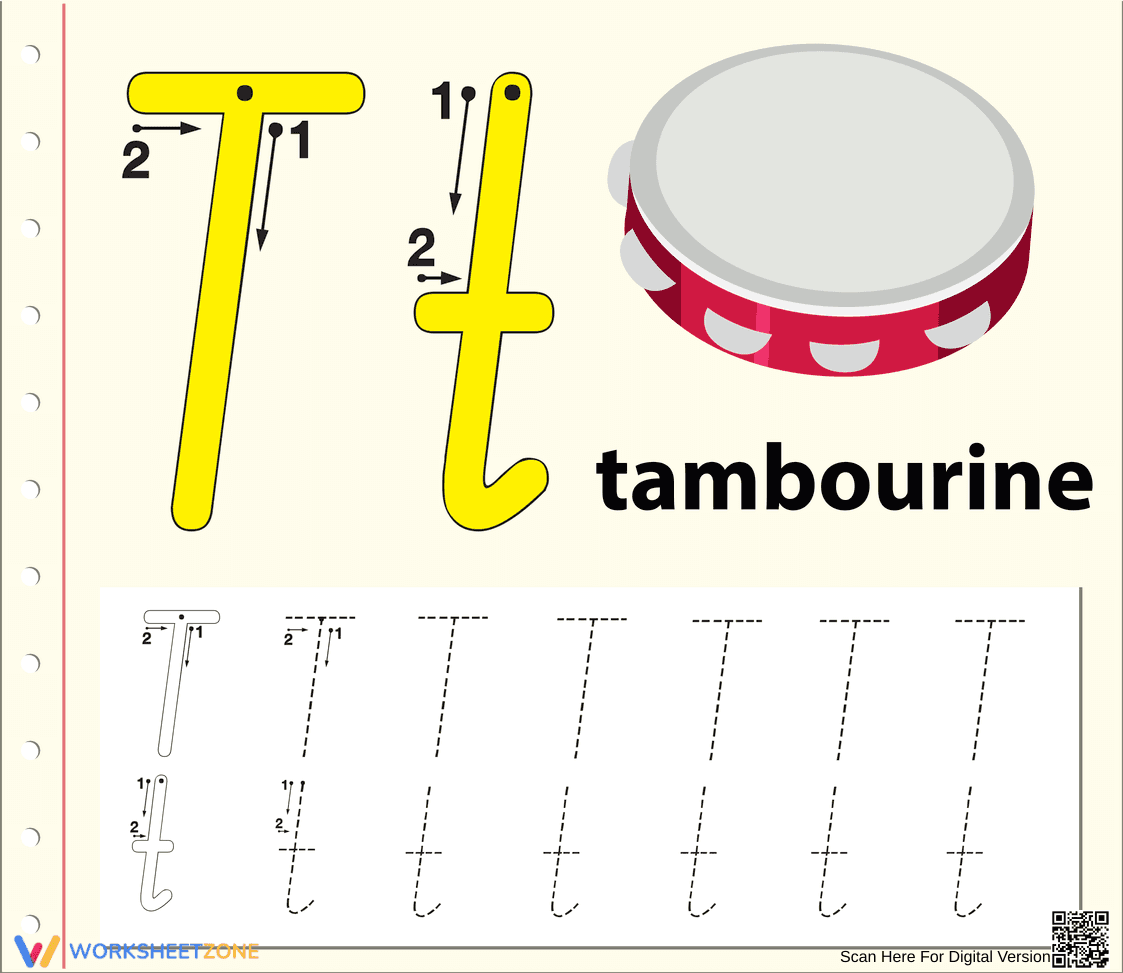

Letter T Tracing Worksheet | Grade 1 Essential
Paste this activity's link or code into your existing LMS (Google Classroom, Canvas, Teams, Schoology, Moodle, etc.).
Students can open and work on the activity right away, with no student login required.
You'll still be able to track student progress and results from your teacher account.
This Grade 1 handwriting worksheet provides focused practice for mastering the letter T. By combining visual cues with repetitive tracing, students develop the fine motor control necessary for legible writing. The inclusion of the tambourine illustration reinforces phonemic awareness, helping learners connect the letter shape to its initial sound in a meaningful context.
At a Glance
- Grade: 1 · Subject: English
- Standard:
CCSS.ELA-LITERACY.L.1.1.A— Print all upper- and lowercase letters correctly and legibly- Skill Focus: Letter T formation
- Format: 1 page · 14 problems · Answer key included · PDF
- Best For: Independent morning work or literacy centers
- Time: 10–15 minutes
What's Inside
The worksheet features a clear, large-scale model of both uppercase 'T' and lowercase 't' with numbered stroke arrows to guide initial formation. Below the models, students find two rows of tracing practice: seven uppercase letters and seven lowercase letters. The "T is for tambourine" graphic serves as a visual anchor for early readers, while the dotted-line font provides the necessary scaffolding for developing hands.
Zero-Prep Workflow
- Print: Generate the single-page PDF in under 30 seconds.
- Distribute: Hand out sheets during literacy blocks or as a transition activity (1 minute).
- Review: Check for proper stroke order and pencil grip as students work (1 minute).
Total teacher preparation time is under two minutes, making it an ideal choice for sub plans or unexpected schedule changes.
Standards Alignment
This activity is directly aligned with `CCSS.ELA-LITERACY.L.1.1.A`, which requires students to print all upper- and lowercase letters. By focusing specifically on the vertical and horizontal strokes of the letter T, students build the foundational muscle memory required for more complex writing tasks. Both standard codes can be copied directly into lesson plans, IEP goals, or district curriculum mapping tools.
How to Use It
Use this worksheet as a formative assessment during the first weeks of school to identify students who may need additional fine motor support. It also works well as a quiet-time activity after direct instruction on the letter T. Observe students as they trace to ensure they are following the numbered arrows rather than drawing the letters from the bottom up. Expected completion time ranges from 10 to 15 minutes.
Who It's For
This resource is perfect for first-grade students, kindergarteners ready for advancement, or English Language Learners (ELL) who are familiarizing themselves with the Latin alphabet. It pairs naturally with an alphabet anchor chart or a phonics lesson focused on the /t/ sound.
Handwriting remains a critical component of early literacy development. According to Fisher & Frey (2014), the physical act of forming letters supports the orthographic mapping process, which is essential for both reading fluency and spelling accuracy. Research indicates that students who receive explicit instruction in letter formation, including stroke order and directionality, demonstrate higher levels of writing automaticity in later grades. This worksheet facilitates that development by providing clear visual models and sufficient repetition to move from guided to independent production. By mastering the letter T through structured tracing, students reduce the cognitive load associated with handwriting, allowing them to focus more energy on composition and creative expression as they progress through the primary grades. This resource provides the consistent, low-stakes practice necessary for achieving the legibility standards outlined in national frameworks like CCSS.ELA-LITERACY.L.1.1.A.


