


























Views
Downloads
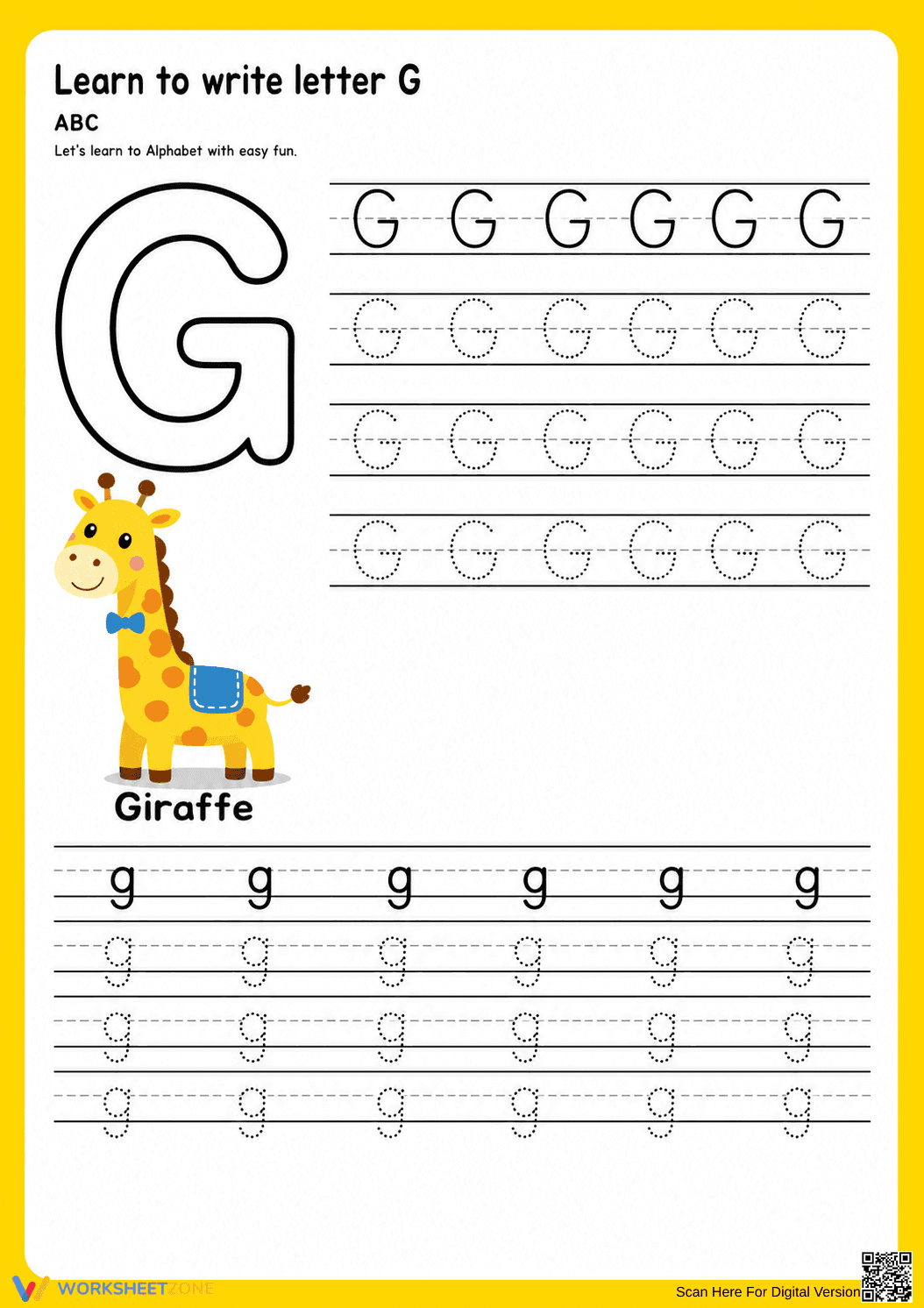

Letter G Tracing Worksheet | Printable Kindergarten ELA
Paste this activity's link or code into your existing LMS (Google Classroom, Canvas, Teams, Schoology, Moodle, etc.).
Students can open and work on the activity right away, with no student login required.
You'll still be able to track student progress and results from your teacher account.
This printable letter G tracing worksheet helps early learners master uppercase and lowercase letter formation. Students practice fine motor skills and letter recognition by tracing guided dotted lines. Featuring a fun giraffe illustration, this resource provides essential handwriting practice to build foundational literacy skills for kindergarten students.
At a Glance
- Grade: Kindergarten · Subject: ELA
- Standard:
CCSS.ELA-LITERACY.L.K.1.A— Print many upper- and lowercase letters- Skill Focus: Letter G Handwriting
- Format: 1 page · 48 problems · No answer key needed · PDF
- Best For: Independent morning work
- Time: 10–15 minutes
This single-page resource features a large, colorable uppercase G alongside an engaging giraffe illustration to reinforce the beginning sound. The main activity includes four rows of uppercase G tracing practice and four rows of lowercase g tracing practice. Each row provides clear, dotted guidelines on standard primary writing lines to ensure proper letter proportion and placement. With 48 total tracing opportunities, students receive ample repetition to develop muscle memory.
This resource is designed for a zero-prep workflow.
- Print (1 minute): Download the PDF and print.
- Distribute (1 minute): Hand out sheets and pencils.
- Review (0 minutes): The intuitive format requires no direct instruction.
Total teacher prep time is under two minutes, making this an excellent addition to any sub plan folder.
This worksheet is directly aligned to CCSS.ELA-LITERACY.L.K.1.A, requiring students to print many upper- and lowercase letters. By providing structured, repetitive tracing tasks on standard handwriting lines, the activity ensures students meet foundational writing expectations. Both standard codes can be copied directly into lesson plans, IEP goals, or district curriculum mapping tools.
Teachers can utilize this worksheet during morning work routines to establish a calm, focused start to the day. It also serves as an effective independent center activity while the teacher conducts small group reading instruction. Expected completion time ranges from 10 to 15 minutes. As a formative assessment observation tip, watch students as they trace to ensure they are starting their letters from the top line rather than the bottom, correcting pencil grip and stroke direction in real time.
This practice page is primarily designed for kindergarten students developing their initial handwriting skills. It is also highly beneficial for preschool students ready for a challenge, or first-grade students requiring targeted intervention on letter formation. To support differentiation, teachers can provide textured surfaces underneath the paper for tactile feedback. Pair this worksheet with a direct instruction phonics lesson on the hard and soft sounds of the letter G or a read-aloud featuring a giraffe character.
Developing automaticity in handwriting is a critical component of early literacy. This resource targets CCSS.ELA-LITERACY.L.K.1.A, helping students print many upper- and lowercase letters. According to Fisher & Frey (2014), providing structured practice is essential for transferring discrete skills into long-term memory. When young learners do not expend cognitive energy on forming letters, they dedicate more working memory to generating ideas. By offering 48 tracing tasks, this worksheet ensures students build the necessary muscle memory and fine motor control required for academic success. Consistent practice establishes a strong foundation for subsequent written communication tasks.


