


























Views
Downloads
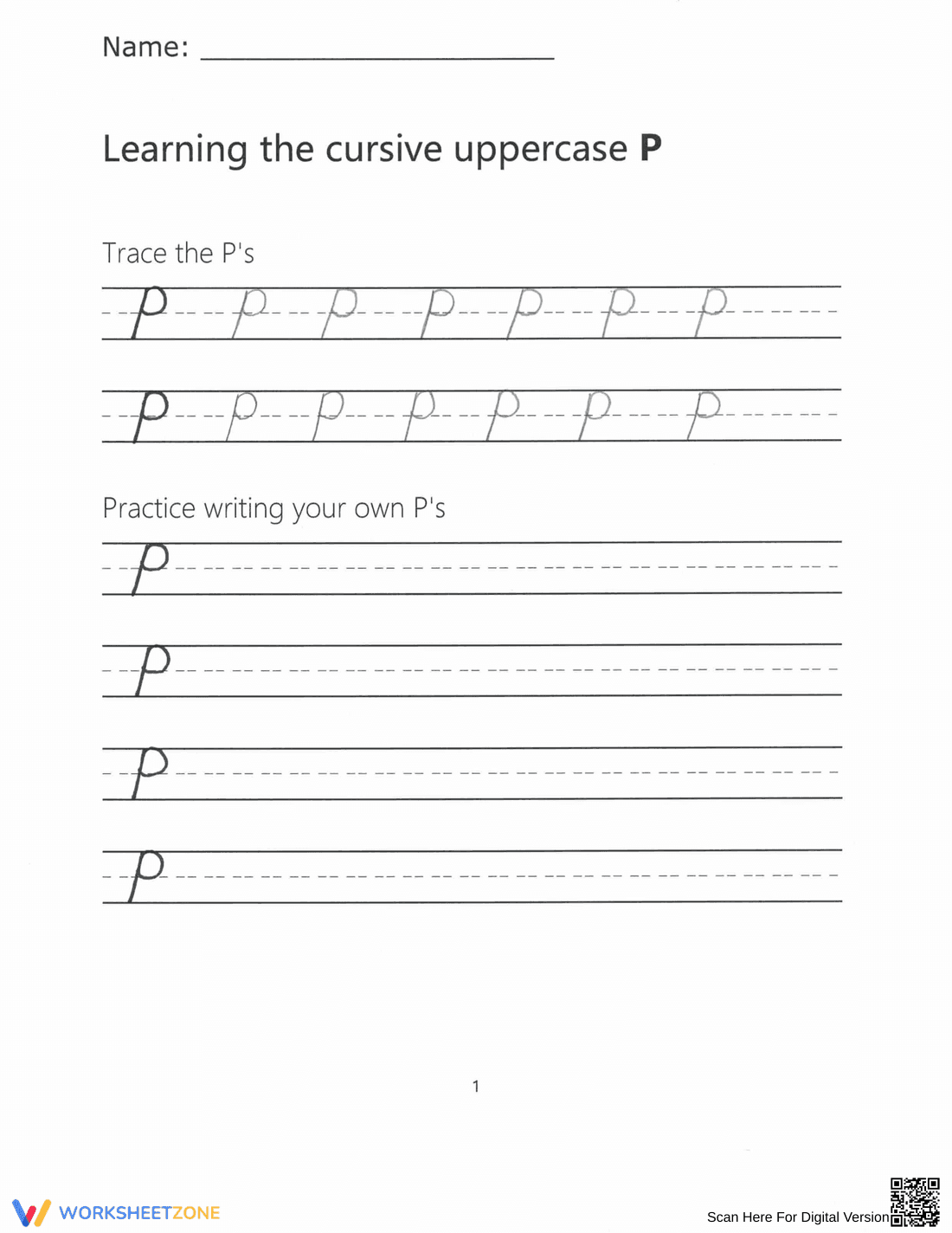

Grade 2 Cursive P — Printable No-Prep Worksheet
Paste this activity's link or code into your existing LMS (Google Classroom, Canvas, Teams, Schoology, Moodle, etc.).
Students can open and work on the activity right away, with no student login required.
You'll still be able to track student progress and results from your teacher account.
This Grade 2 cursive handwriting worksheet provides focused practice for mastering the uppercase letter P. Students transition from guided tracing to independent letter formation, ensuring they develop the fluid penmanship required for academic success. By focusing on a single character, learners can perfect the specific loops and strokes unique to the cursive P.
At a Glance
- Grade: 2 · Subject: English Handwriting
- Standard:
CCSS.ELA-LITERACY.L.2.1— Write uppercase letters in cursive with proper form and alignment- Skill Focus: Cursive uppercase P formation
- Format: 1 page · 18 tasks · No-prep · PDF
- Best For: Morning work or handwriting centers
- Time: 10–15 minutes
This single-page PDF features a clean, distraction-free layout. It includes two rows of dashed-line tracing prompts to establish the correct stroke order, followed by four rows of wide-ruled lines for independent practice. Each independent line begins with a reference letter to maintain consistency in size and slant throughout the exercise, providing a clear visual model for the student.
The workflow for this resource is designed for maximum efficiency in busy classrooms. First, print the single-page PDF (30 seconds). Next, distribute the sheets to students during a handwriting block or as a transition activity (1 minute). Finally, perform a quick visual check of letter slant and connection points as students complete their 18 practice tasks. This makes it an ideal choice for emergency sub plans.
This resource aligns with CCSS.ELA-LITERACY.L.2.1, which requires students to demonstrate command of the conventions of standard English capitalization and penmanship. Legible handwriting remains a foundational skill for cognitive development. This standard code can be copied directly into lesson plans, IEP goals, or district curriculum mapping tools.
Use this worksheet during the independent practice phase of a handwriting lesson. After demonstrating the uppercase P on the board, have students complete the tracing section to calibrate their hand movements. It also serves as an excellent formative assessment tool; observe if students start the letter at the correct midline or topline point to identify who needs additional 1-on-1 coaching. Expect completion within 15 minutes.
This worksheet is ideal for second-grade students beginning their cursive journey or first graders ready for an early introduction to script. It is particularly helpful for students requiring fine motor intervention or those in homeschooling environments. Pair this with a cursive alphabet anchor chart or a tactile tracing tray for a multi-sensory learning experience that reinforces letter shape recognition.
Handwriting instruction, specifically cursive, is linked to improved syntax and composition quality in elementary learners. According to Fisher & Frey (2014), the gradual release of responsibility—moving from guided tracing to independent production—is essential for motor skill acquisition. This worksheet implements that model through 18 specific tasks aligned to CCSS.ELA-LITERACY.L.2.1. Research from the RAND AIRS 2024 report suggests that short, focused bursts of handwriting practice (10–15 minutes) are more effective for retention than infrequent, long-form sessions. By isolating the uppercase P, students can achieve mastery without cognitive overload. This resource provides the structured repetition necessary to move letter formation from conscious effort to automaticity, allowing students to eventually focus on the content of their writing rather than the mechanics of the pen. It is a reliable tool for building foundational literacy skills.


