


























Views
Downloads

Essential Landforms Drawing Worksheet | Grades K-2 Science
Paste this activity's link or code into your existing LMS (Google Classroom, Canvas, Teams, Schoology, Moodle, etc.).
Students can open and work on the activity right away, with no student login required.
You'll still be able to track student progress and results from your teacher account.
This Landforms Drawing Worksheet provides a focused, creative way for students in Kindergarten through Grade 2 to identify and visualize major Earth features. By translating vocabulary into visual representations, learners solidify their understanding of geographical diversity and physical science. Students move beyond rote memorization to active conceptual modeling of the natural world.
At a Glance
- Grade: K–2 · Subject: Science
- Standard:
2-ESS2-2— Develop a model to represent the shapes and kinds of land and bodies of water- Skill Focus: Landform Identification and Vocabulary Acquisition
- Format: 1 page · 6 problems · No-prep activity · PDF
- Best For: Introduction to Earth's systems and geography
- Time: 15–25 minutes
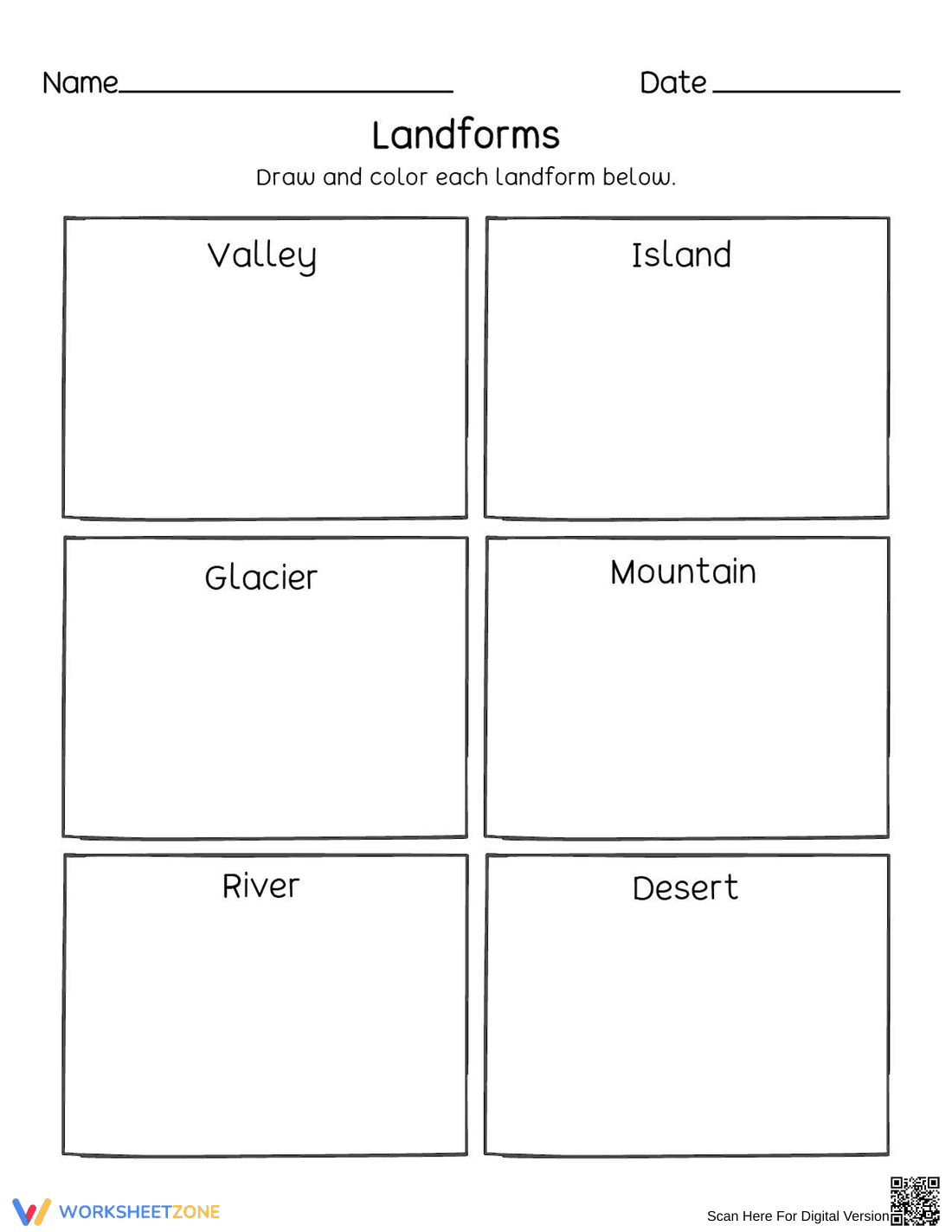
This one-page PDF features six drawing zones labeled: Valley, Island, Glacier, Mountain, River, and Desert. The layout is clean and uncluttered, providing ample space for young students to illustrate their understanding. This structural simplicity ensures cognitive load remains focused on the scientific characteristics of each geographical feature rather than complex worksheet navigation.
Zero-Prep Workflow
The zero-prep design allows for immediate implementation. Print the single-page document in under a minute. Distribute the sheets with basic coloring supplies. Finally, review student work as a whole-group discussion to reinforce vocabulary. Total teacher preparation time is under two minutes, making this an ideal solution for substitute plans or spontaneous instructional shifts.
Standards Alignment
This resource is directly aligned to 2-ESS2-2, requiring students to develop models of land and water features. Creating these illustrations builds foundational mental models for Earth science. It also supports CCSS.ELA-LITERACY.L.1.6 through academic language acquisition. Both standard codes can be copied directly into lesson plans, IEP goals, or district curriculum mapping tools.
How to Use It
Use this during the "Explain" or "Elaborate" phase of a 5E lesson cycle after viewing terrain photos. It serves as a formative assessment; observe if students distinguish between the steep peaks of a mountain and the arid characteristics of a desert. This quick visual check allows for immediate clarification of geographical misconceptions.
Who It's For
Designed for primary elementary students, this is particularly effective for English Language Learners and visual learners. It pairs naturally with an anchor chart showing real-world photos or a science read-aloud. Differentiation is achieved through drawing complexity, allowing students to demonstrate varying levels of detail based on their fine motor development.
According to the RAND AIRS 2024 report on elementary science pedagogy, visual modeling is a critical bridge for young learners transitioning from concrete observation to abstract scientific reasoning. This Landforms Drawing Worksheet facilitates this by requiring students to translate the abstract term into a concrete representation. Research by Fisher & Frey (2014) highlights that such non-linguistic representation is among the most effective strategies for long-term vocabulary retention in the primary grades. By engaging with 2-ESS2-2 through active modeling, students develop a more durable schema for geographical systems than they would through passive identification alone. This worksheet provides the essential structure for this cognitive process, ensuring that the student action is grounded in scientific vocabulary. It acts as a classroom-ready tool that integrates artistic expression with rigorous standard alignment, meeting the needs of diverse learners in early childhood environments.


