


























Views
Downloads

Essential Landforms Worksheet | Grade 1-2 Printable Ready
Paste this activity's link or code into your existing LMS (Google Classroom, Canvas, Teams, Schoology, Moodle, etc.).
Students can open and work on the activity right away, with no student login required.
You'll still be able to track student progress and results from your teacher account.
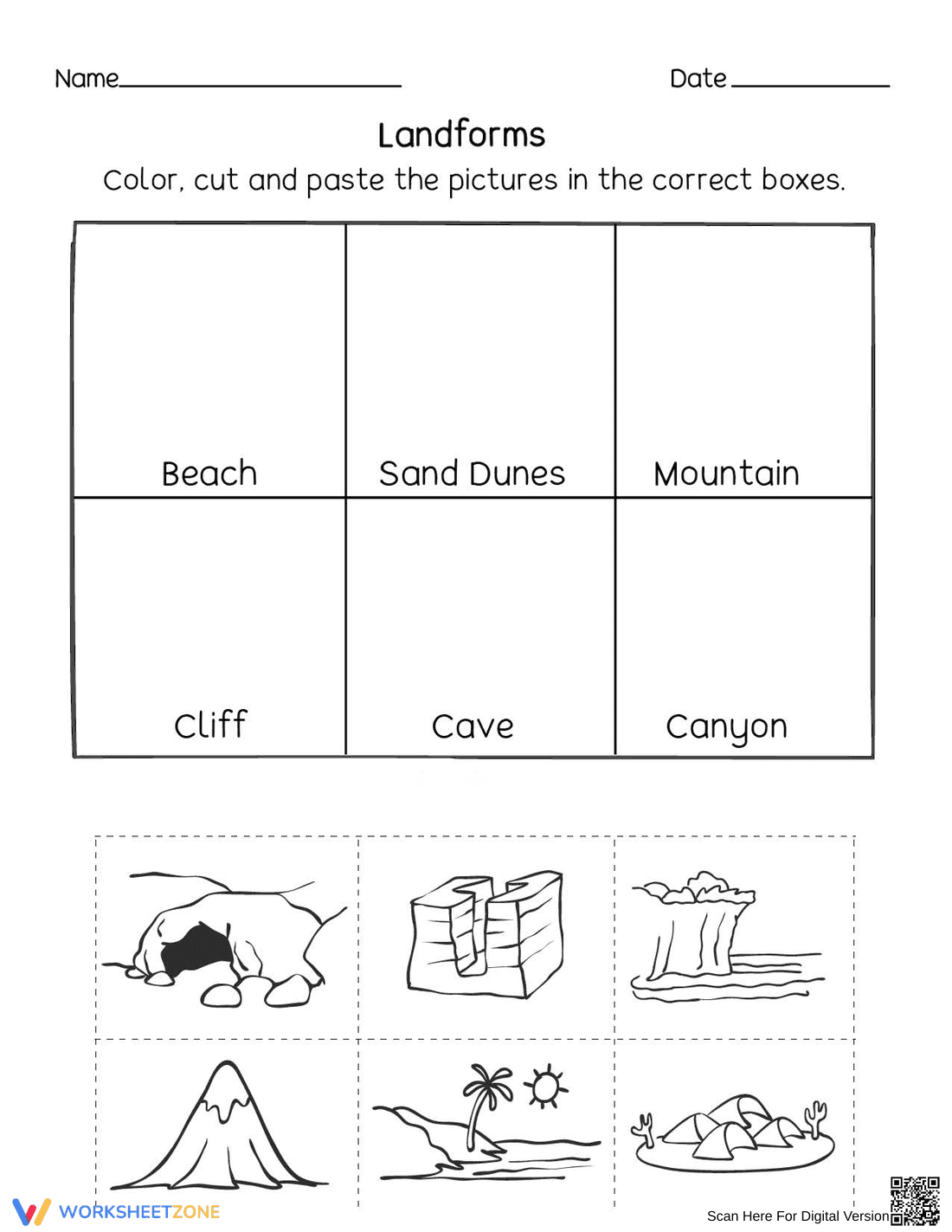
This essential landforms worksheet provides a hands-on classification activity for early elementary students to identify and categorize geological features. Students develop visual literacy and vocabulary by matching representative illustrations to specific terrain types. This interactive approach ensures that learners actively engage with scientific concepts while refining the fine motor skills required for primary science success.
At a Glance
- Grade: K–2 · Subject: Science
- Standard:
2-ESS2-2— Develop a model to represent the shapes and kinds of land and water- Skill Focus: Landform Identification
- Format: 1 page · 6 problems · Answer key included · PDF
- Best For: Interactive Science Journals and Centers
- Time: 15–20 minutes
Inside this printable resource, you will find a structured one-page activity featuring six distinct landform boxes and six corresponding illustrations. The worksheet covers major terrestrial features including beaches, sand dunes, mountains, cliffs, caves, and canyons. The layout is specifically designed with clear cutting lines and high-contrast illustrations to support students in independent work.
Zero-Prep Workflow
- Print: Output the single-page PDF for your entire class in under one minute.
- Distribute: Provide sheets along with scissors and glue sticks, requiring zero additional teacher setup.
- Review: Check completed work as a quick formative assessment piece to gauge vocabulary retention.
This streamlined process is designed for maximum efficiency, making it an ideal choice for busy mornings or unexpected substitute teacher plans.
This activity aligns with 2-ESS2-2, requiring students to develop a model to represent the shapes and kinds of land in an area. By physically placing the correct icons into labeled categories, students are building a conceptual model of Earth's diverse surface. This standard code can be copied directly into lesson plans, IEP goals, or district curriculum mapping tools.
Use this worksheet during the "Explain" phase of a 5E science lesson to solidify the definitions of different landforms after a slideshow or read-aloud. Alternatively, assign it as a morning work activity to reinforce vocabulary introduced in previous days. Observe students as they match the 'mountain' and 'cliff' icons to distinguish between vertical and sloped elevation changes.
This resource is ideal for Kindergarten through Grade 2 students who are beginning to explore Earth systems. It provides natural differentiation through visual cues for English Language Learners and students with IEPs. For a complete lesson, pair this activity with a physical landform anchor chart or a short video clip showing real-world examples of each feature.
According to RAND AIRS 2024, the integration of tactile, kinesthetic activities like cutting and pasting significantly improves the retention of scientific vocabulary in early childhood education. This 2-ESS2-2 worksheet facilitates landform identification by requiring students to actively process the visual characteristics of geological features such as canyons and dunes. Fisher & Frey (2014) emphasize that such scaffolded, independent practice is a critical component of the gradual release of responsibility model, ensuring students transition from guided instruction to mastery. By engaging with these six specific landform types, students develop the foundational schemas necessary for more complex topographical analysis in later grades. The clear spatial organization of the worksheet reduces cognitive load, allowing learners to focus exclusively on the distinguishing traits of each terrain. This resource serves as a valid evidentiary tool for tracking student progress toward state and national science standards in the primary classroom.


