


























Views
Downloads
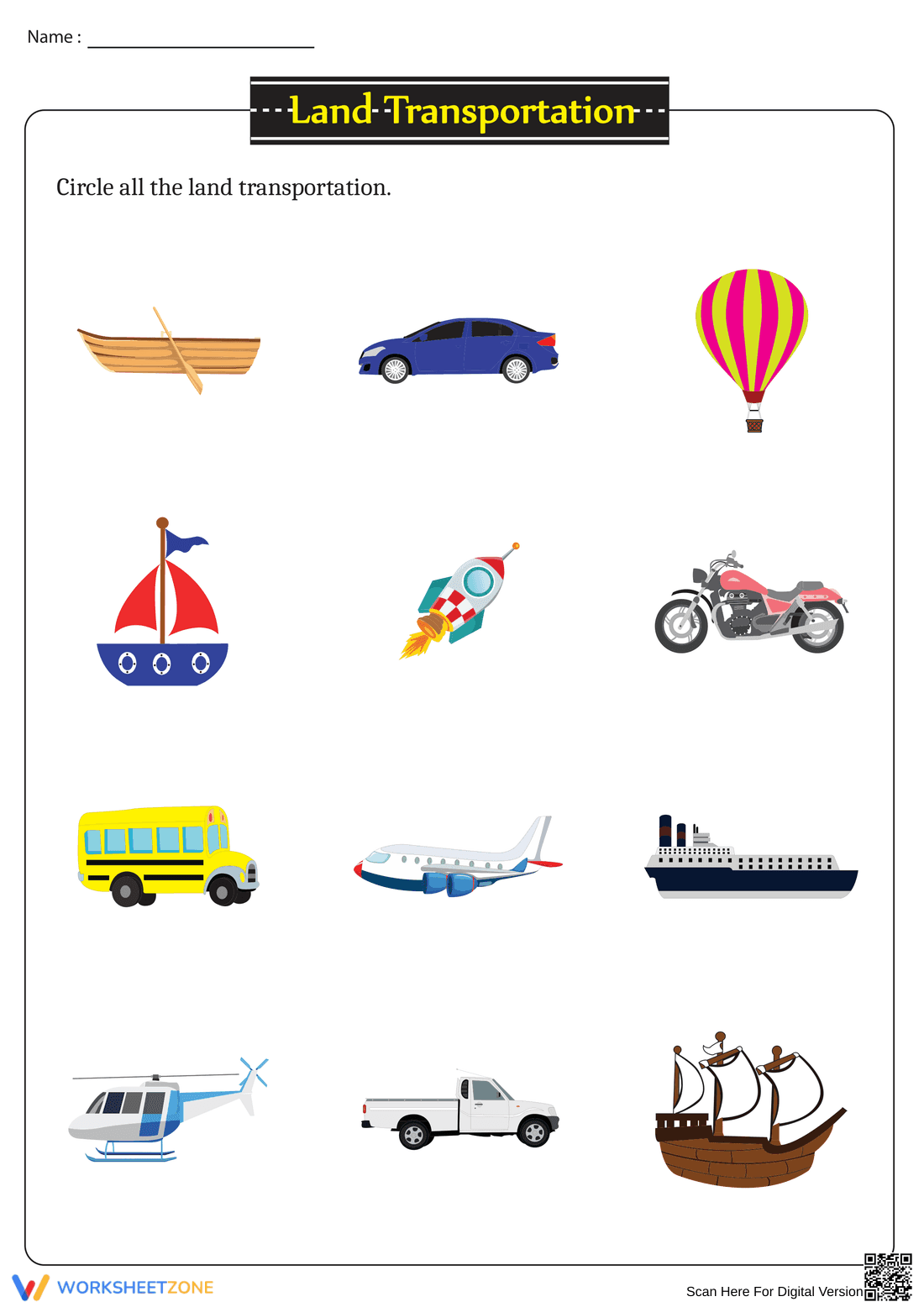

Essential Land Transportation Worksheet | Kindergarten Ready
Paste this activity's link or code into your existing LMS (Google Classroom, Canvas, Teams, Schoology, Moodle, etc.).
Students can open and work on the activity right away, with no student login required.
You'll still be able to track student progress and results from your teacher account.
This land transportation worksheet helps young learners differentiate between modes of travel by identifying vehicles that move on the ground. Students analyze 12 distinct icons and circle the correct examples, building the classification skills essential for early science and literacy development. It provides a focused, printable task that requires zero teacher preparation.
At a Glance
- Grade: Preschool · Kindergarten · Subject: Science
- Standard:
CCSS.ELA-LITERACY.L.K.5.A— Sort common objects into categories to gain a sense of the concepts represented- Skill Focus: Transportation Classification
- Format: 1 page · 12 problems · Answer key included · PDF
- Best For: Early finishers and science center rotations
- Time: 5–10 minutes
What's inside this resource is a clearly organized single-page activity featuring 12 high-contrast vehicle illustrations. The worksheet includes land, air, and water transportation types mixed together to challenge student recognition. A complete answer key is provided to ensure quick grading, and the layout is designed with large icons suitable for students still developing fine motor control.
Preparation is minimal for this classroom-ready resource. Step 1: Print the single-page PDF (30 seconds). Step 2: Distribute to students for a quick warm-up or center activity (1 minute). Step 3: Review the answers as a whole group to reinforce vocabulary (3 minutes). This streamlined process takes less than five minutes of teacher time, making it an excellent option for substitute folders or transition periods.
Standards Alignment
This activity aligns with CCSS.ELA-LITERACY.L.K.5.A, which requires students to sort common objects into categories to gain a sense of the concepts the categories represent. By identifying vehicles that move specifically on land, students practice attribute-based grouping. This standard code can be copied directly into lesson plans, IEP goals, or district curriculum mapping tools.
Use this worksheet as an introductory activity when launching a transportation unit. It serves as an effective pre-assessment to gauge students' existing knowledge of vehicle types. Alternatively, assign it as an exit ticket after reading a book about community workers. Observe whether students can explain why they circled specific vehicles to assess their oral language and reasoning skills.
This resource is designed for Preschool and Kindergarten students who are learning to categorize the world around them. It is especially helpful for English Language Learners (ELL) to build foundational vocabulary related to transportation. Pair this worksheet with a physical vehicle sorting bin or an anchor chart showing the three main environments: land, water, and air.
Classifying objects is a fundamental cognitive milestone for early learners, providing the organizational framework necessary for advanced vocabulary acquisition. This land transportation worksheet aligns with CCSS.ELA-LITERACY.L.K.5.A by requiring students to sort 12 different vehicles into categories based on their primary mode of travel. By distinguishing between land, air, and sea transportation, students develop the conceptual boundaries required for scientific observation and social studies comprehension. According to the ScienceDirect TpT Analysis, structured classification tasks at the preschool level are associated with a significant increase in category-specific noun retention compared to unstructured play. The worksheet provides a high-contrast visual environment that supports focused attention, making it an ideal tool for formative assessment during a community helpers or transportation unit. Teachers can use the resulting data to identify students needing additional support with attribute-based grouping or fine motor circling skills, ensuring that every child masters basic environmental classification before progressing to complex systems.


