


























Views
Downloads

Ladybug Life Cycle Worksheet | Grade 3 Essential
Paste this activity's link or code into your existing LMS (Google Classroom, Canvas, Teams, Schoology, Moodle, etc.).
Students can open and work on the activity right away, with no student login required.
You'll still be able to track student progress and results from your teacher account.
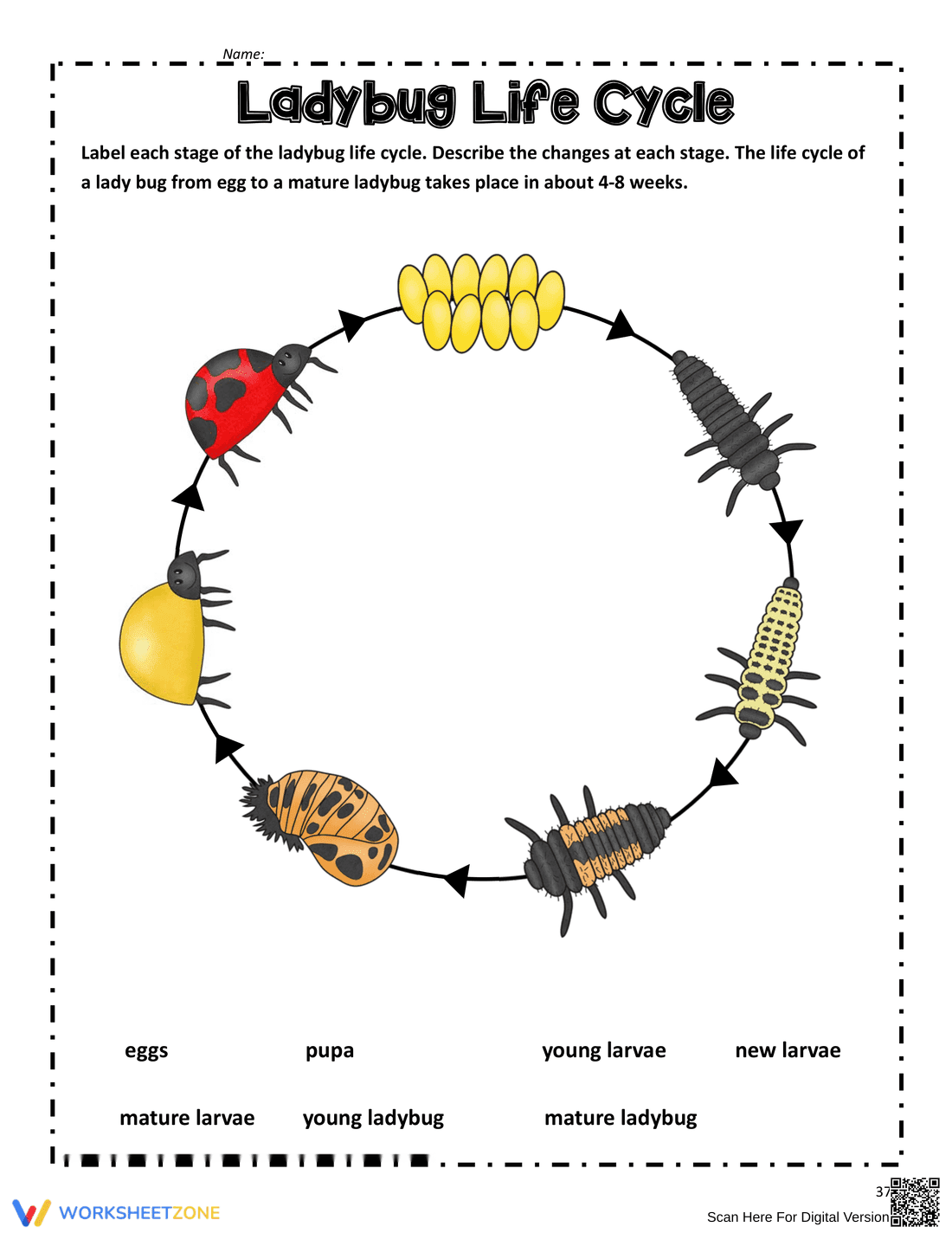
This Grade 3 science worksheet provides a comprehensive look at the ladybug life cycle, helping students visualize and articulate the complex metamorphosis of this common insect. By engaging with both visual labeling and descriptive writing, learners develop a concrete understanding of biological growth patterns and the specific stages from egg to mature adult.
At a Glance
- Grade: 3 · Subject: Science
- Standard:
3-LS1-1— Develop models to describe that organisms have unique and diverse life cycles- Skill Focus: Life cycle sequencing and descriptive writing
- Format: 1 page · 9 tasks · Answer key included · PDF
- Best For: Independent practice or science centers
- Time: 15–20 minutes
This single-page PDF features a high-quality circular diagram illustrating the eight distinct phases of a ladybug's development. It includes a clear word bank containing terms such as pupa, larvae, and mature ladybug to support vocabulary acquisition. Below the diagram, students are prompted to describe the physical changes occurring at each stage, bridging the gap between simple identification and scientific observation.
The zero-prep design allows for immediate classroom implementation. First, print the single-page document (30 seconds). Second, distribute to students as a standalone activity or part of a science journal (1 minute). Third, review the completed diagrams using the included answer key to provide instant feedback on sequencing accuracy (5 minutes). This streamlined workflow makes it an ideal resource for substitute folders or transition periods.
This resource is directly aligned with `3-LS1-1`, which requires students to develop models to describe that organisms have unique and diverse life cycles but all have in common birth, growth, reproduction, and death. By modeling the ladybug's specific path, students can later compare these stages to other organisms. This standard code can be copied directly into lesson plans, IEP goals, or district curriculum mapping tools.
Use this worksheet during the "Explain" phase of a 5E instructional model to solidify concepts after an initial observation of live specimens. It also serves as an effective formative assessment tool; teachers should observe if students can correctly distinguish between the different larval stages. Expect students to spend approximately 15 to 20 minutes completing both the labeling and the descriptive components.
While designed for Grade 3, the clear visuals and word bank support Grade 2 students and provide a solid review for Grade 4. It is particularly beneficial for English Language Learners (ELLs) who need visual anchors for scientific vocabulary. Pair this worksheet with a non-fiction text about beetles or an anchor chart detailing insect metamorphosis for a complete instructional unit.
According to the RAND AIRS 2024 report, high-quality visual models in elementary science significantly improve the retention of complex biological sequences. This worksheet addresses the 3-LS1-1 standard by requiring students to interact with a model of the ladybug life cycle, a fundamental skill in developing scientific literacy. Research from Fisher & Frey (2014) emphasizes that combining linguistic labeling with descriptive writing—as seen in this 9-task activity—scaffolds the transition from basic recall to higher-order analysis. By identifying specific stages like the pupa and various larval phases, students build a schema for metamorphosis that is transferable to other species. This resource provides the structured practice necessary for students to meet national science benchmarks while maintaining a low-barrier entry for diverse learners through its clear formatting and included word bank.


