


























Views
Downloads
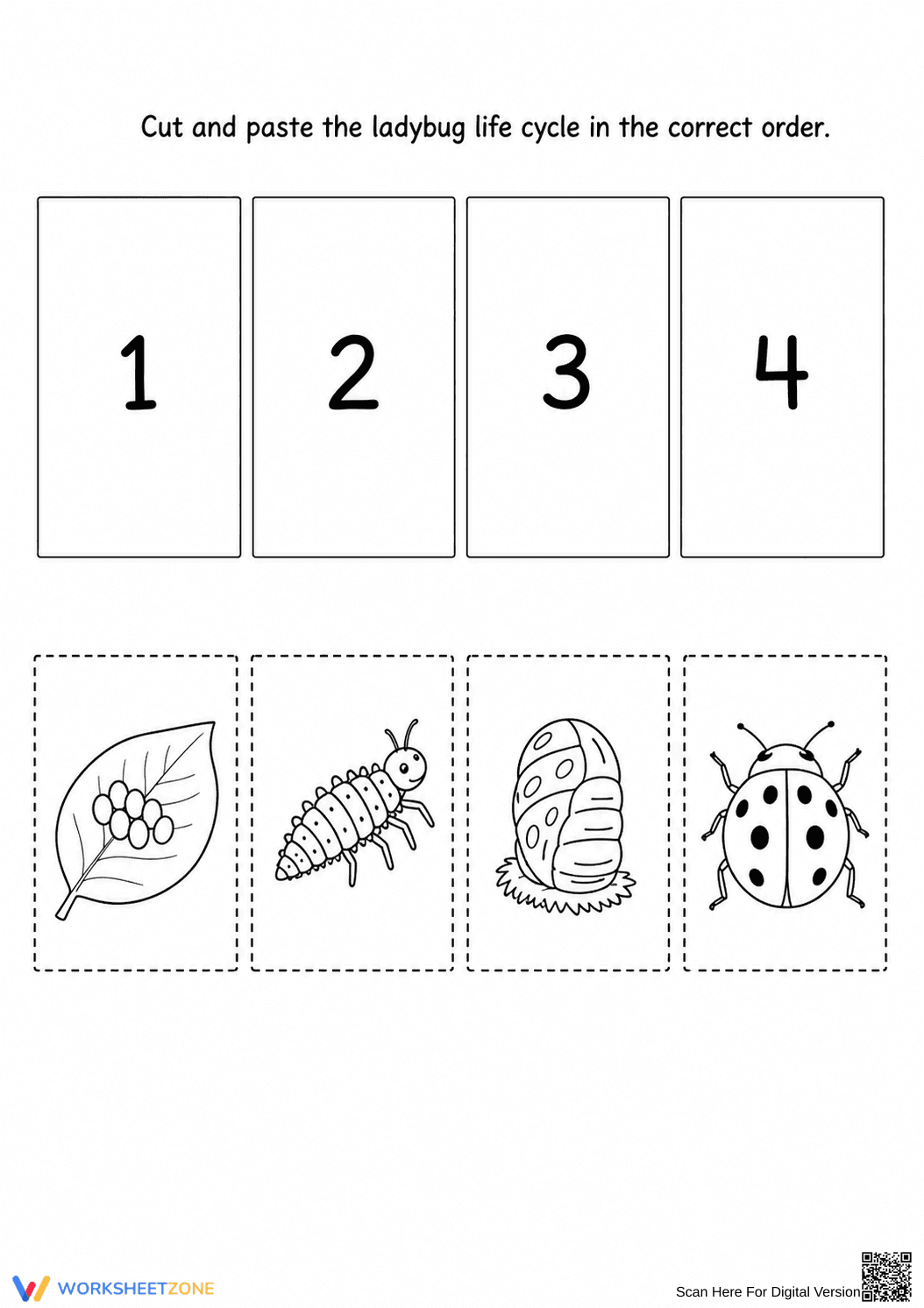

Grade 3 Ladybug Life Cycle — Printable No-Prep Worksheet
Paste this activity's link or code into your existing LMS (Google Classroom, Canvas, Teams, Schoology, Moodle, etc.).
Students can open and work on the activity right away, with no student login required.
You'll still be able to track student progress and results from your teacher account.
This Grade 3 science worksheet helps students master biological sequencing by organizing the four stages of a ladybug's development. By cutting and pasting the illustrations into the correct order, learners actively visualize the transformation from egg to adult beetle, reinforcing foundational concepts of organism growth and reproduction.
At a Glance
- Grade: 3 · Subject: Science
- Standard:
3-LS1-1— Describe that organisms have unique and diverse life cycles- Skill Focus: Sequencing Life Cycles
- Format: 1 page · 4 problems · Answer key included · PDF
- Best For: Independent practice
- Time: 10–15 minutes
Inside this single-page resource, educators will find a straightforward cut-and-paste activity featuring four distinct developmental stages: eggs on a leaf, larva, pupa, and adult ladybug. The layout includes four numbered blank boxes at the top and clearly outlined images at the bottom for easy cutting. A complete answer key is provided to ensure accurate grading and quick reference.
- Print (1 minute): Simply print the PDF. No special materials are required beyond standard scissors and glue sticks.
- Distribute (1 minute): Hand out the single-page activity to students. The visual instructions are intuitive and require minimal explanation.
- Review (3 minutes): Use the included answer key to quickly verify the correct sequence of the four life cycle stages.
With a total teacher prep time of under two minutes, this resource is an excellent addition to any emergency sub plan or quick science center.
Aligned to primary standard 3-LS1-1, this activity requires students to develop models to describe that organisms have unique and diverse life cycles but all have in common birth, growth, reproduction, and death. Both standard codes can be copied directly into lesson plans, IEP goals, or district curriculum mapping tools.
This worksheet is highly effective when used immediately after direct instruction on insect life cycles to solidify understanding. Alternatively, it serves as an engaging science center station where students can practice fine motor skills alongside biological sequencing. As a formative assessment tip, observe students while they arrange the pieces before gluing to check for misconceptions about the larva and pupa stages. Expected completion time is 10 to 15 minutes.
This activity is designed for third-grade science students, though it easily adapts for younger learners needing fine motor practice or older students reviewing basic biology. For students requiring extra support, pre-cutting the images can reduce physical barriers and focus attention purely on the sequencing task. It pairs perfectly with a read-aloud book about ladybugs or a classroom anchor chart detailing insect metamorphosis.
Integrating hands-on sequencing tasks into early science education significantly reinforces student comprehension of biological processes. Aligned with 3-LS1-1, this activity asks learners to describe that organisms have unique and diverse life cycles through active modeling. According to EdReports 2024, instructional materials that combine physical manipulation with core scientific concepts lead to higher retention rates and deeper conceptual understanding in elementary classrooms. By physically moving the stages of development into the correct chronological order, students bridge the gap between abstract biological vocabulary and concrete visual evidence. This tactile approach not only supports cognitive development in scientific reasoning but also provides a reliable formative measure of a student's ability to track chronological growth patterns in nature.


