


























Views
Downloads



Essential Synonyms, Antonyms & Punctuation Practice (Grades 1-3)
Paste this activity's link or code into your existing LMS (Google Classroom, Canvas, Teams, Schoology, Moodle, etc.).
Students can open and work on the activity right away, with no student login required.
You'll still be able to track student progress and results from your teacher account.
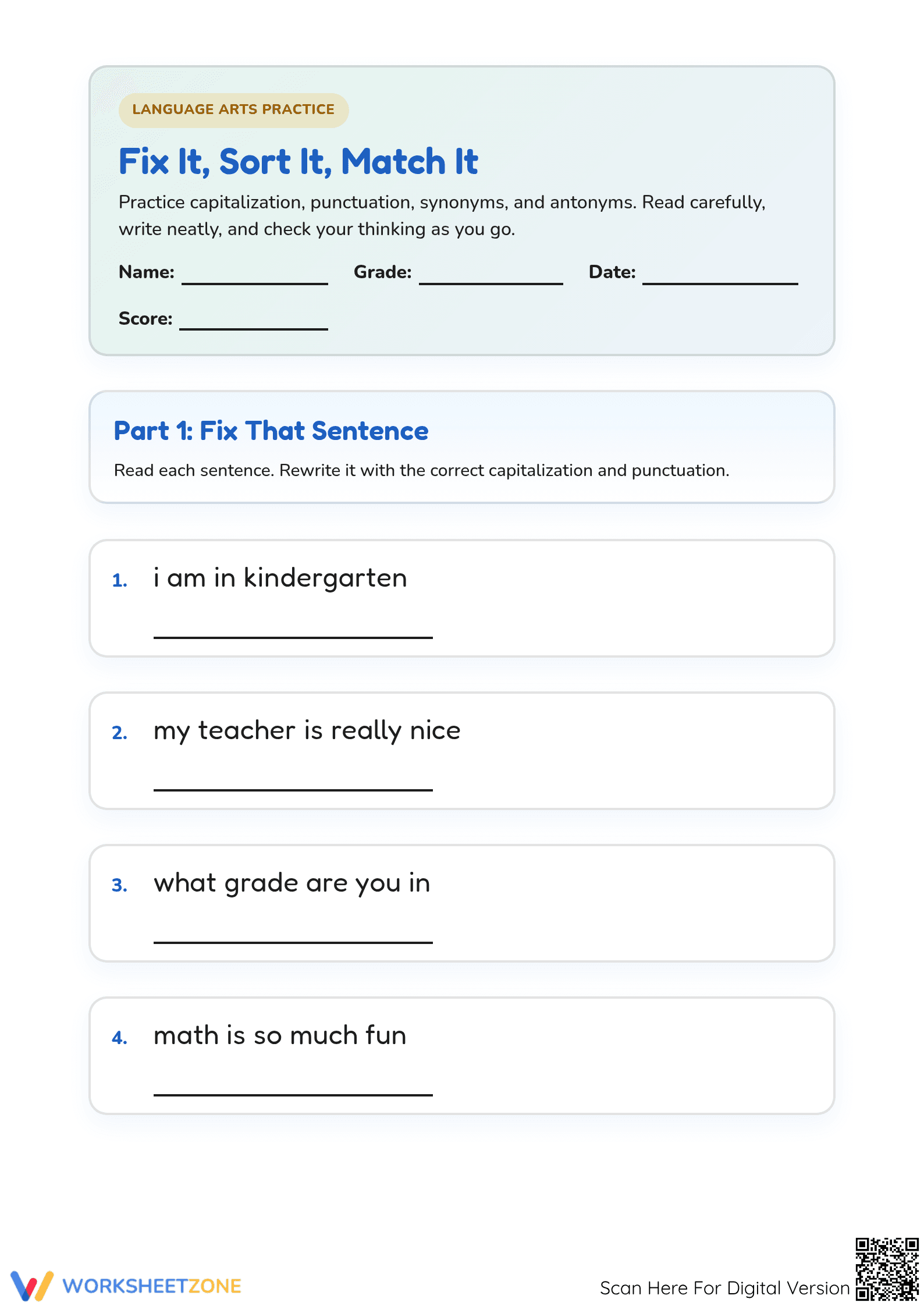
This versatile English Language Arts worksheet packet provides elementary students with targeted practice in lexical relationships and foundational grammar. Students engage with synonyms, antonyms, and sentence correction tasks designed to strengthen vocabulary acquisition and writing mechanics. The multi-page format ensures a comprehensive review of essential literacy skills required for early elementary success.
At a Glance
- Grade: 1-3 · Subject: ELA
- Standard:
CCSS.ELA-LITERACY.L.2.5.a— Identify real-life connections between words and their use including synonyms and antonyms- Skill Focus: Lexical Relationships & Grammar
- Format: 4 pages · 50 problems · Answer key included · PDF
- Best For: Weekly homework or literacy center rotation
- Time: 30–45 minutes
The packet includes four distinct instructional pages. Page one focuses on sentence correction, requiring students to fix capitalization and punctuation errors in four foundational sentences. Subsequent pages transition to lexical skills, featuring a synonym and antonym sorting table with twelve pairs, a fourteen-item matching exercise, and a final assessment with twenty completion items. The clear layout and varied task types maintain student engagement while providing rigorous practice.
This resource follows a zero-prep workflow designed for busy educators and parents. First, print the four-page PDF in less than sixty seconds. Second, distribute the materials to students during a literacy block or as a take-home assignment. Finally, review the completed work using the included answer key to identify specific areas of need. Total teacher preparation time is under two minutes, making it an ideal choice for sudden substitute plans or bell-ringer activities.
This resource is primarily aligned with CCSS.ELA-LITERACY.L.2.5.a, which focuses on identifying real-life connections between words. Additionally, it supports CCSS.ELA-LITERACY.L.1.2, regarding the command of standard English capitalization and punctuation. These standard codes can be copied directly into lesson plans, IEP goals, or district curriculum mapping tools to ensure instructional alignment across the primary grade levels.
Use this packet as a summative homework assignment following a unit on word relationships. It also functions effectively as a formative assessment during literacy centers; teachers can observe students as they sort synonyms and antonyms to gauge their grasp of nuances in meaning. Expected completion time ranges from thirty to forty-five minutes depending on the student's grade level and reading fluency.
This resource is designed for students in Grades 1 through 3, including English Language Learners and those receiving Tier 2 vocabulary support. The scaffolds provided, such as word boxes and guided rewriting lines, make it accessible for diverse learners. Pair this worksheet with a shared reading passage or an anchor chart on common synonyms to reinforce the lesson during direct instruction.
Research by Fisher & Frey (2014) emphasizes that vocabulary instruction is most effective when students manipulate words through sorting and matching tasks. This worksheet applies that principle by requiring students to categorize lexical pairs and apply knowledge in context. By integrating sentence-level editing with word-level analysis, the resource addresses the multi-faceted nature of literacy development in early grades. The structured repetition of CCSS.ELA-LITERACY.L.2.5.a through various modalities—matching, sorting, and completion—ensures students develop a robust mental lexicon. This approach aligns with evidence-based practices that advocate for frequent encounters with new vocabulary to move information to long-term memory. Educators can utilize these fifty tasks to provide the necessary volume of practice required for mastery in lexical relationships and standard grammar conventions.


