


























Views
Downloads
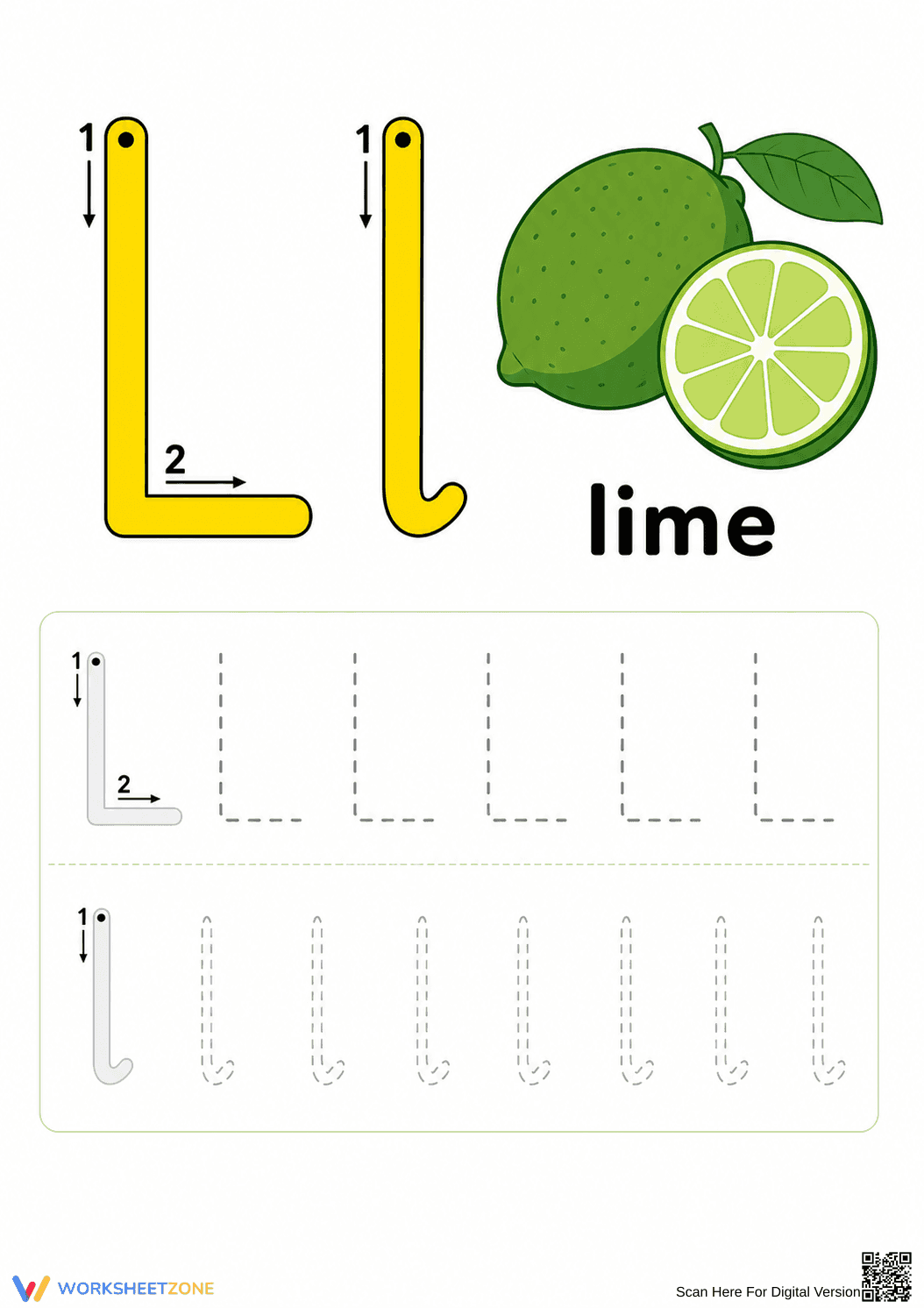

Printable Letter L Tracing Worksheet | Kindergarten ELA
Paste this activity's link or code into your existing LMS (Google Classroom, Canvas, Teams, Schoology, Moodle, etc.).
Students can open and work on the activity right away, with no student login required.
You'll still be able to track student progress and results from your teacher account.
This printable Kindergarten ELA worksheet helps early learners master uppercase and lowercase letter formation. By tracing the letter L, students develop fine motor skills and reinforce beginning sound recognition. The clear directional arrows guide proper handwriting technique, ensuring students build a strong foundation for future writing success.
At a Glance
- Grade: Kindergarten · Subject: ELA
- Standard:
CCSS.ELA-LITERACY.L.K.1.A— Print upper- and lowercase letters- Skill Focus: Letter L Tracing
- Format: 1 page · 14 problems · No answer key · PDF
- Best For: Independent practice
- Time: 5–10 minutes
This single-page resource features a large, clear illustration of a lime alongside guided examples of uppercase and lowercase L. Students are provided with numbered directional arrows to demonstrate the correct starting points and stroke order. The bottom half of the page contains two dedicated practice rows: one with six uppercase L tracing tasks and another with eight lowercase l tracing tasks, all presented on standard dashed handwriting lines.
Implementing this handwriting activity requires minimal effort.
- Print (1 minute): Generate the PDF and print a class set directly from your computer.
- Distribute (1 minute): Hand out the sheets along with pencils or crayons during morning work or literacy centers.
- Review (0 minutes): The visual guides make the task entirely self-explanatory for young learners.
Total teacher prep time is under two minutes, making this an excellent, reliable option for emergency sub plans or quick transitions.
This resource aligns directly with CCSS.ELA-LITERACY.L.K.1.A, requiring students to print many upper- and lowercase letters. It also supports foundational phonics skills by pairing the target letter with a familiar vocabulary word (lime) to reinforce beginning sounds. Both standard codes can be copied directly into lesson plans, IEP goals, or district curriculum mapping tools.
Use this worksheet as a focused morning work activity before formal direct instruction begins, allowing students to settle in while practicing fine motor control. Alternatively, place it in a literacy center for independent reinforcement after a whole-group lesson on the letter L. As a formative assessment tip, observe students while they trace to ensure they are starting their pencil strokes from the top down, rather than from the bottom up. Expected completion time ranges from five to ten minutes.
This activity is designed primarily for Kindergarten students and first graders who need targeted handwriting remediation. For differentiation, provide students who struggle with fine motor control a thicker crayon or marker to trace the dashed lines. This worksheet pairs perfectly with a read-aloud book featuring words that start with the letter L or a classroom alphabet anchor chart.
Mastering the physical act of writing is a critical precursor to expressive composition. According to Fisher & Frey (2014), explicit instruction in handwriting and letter formation significantly reduces the cognitive load required for early writing, allowing students to focus more on content and phonics rather than the mechanics of holding a pencil. This resource directly supports CCSS.ELA-LITERACY.L.K.1.A by helping students print upper- and lowercase letters accurately. By providing structured tracing paths with directional arrows, the worksheet ensures that early learners internalize the correct motor patterns for the letter L. Consistent practice with these foundational skills builds the automaticity necessary for fluent writing and reading development. Educators can rely on this targeted practice to bridge the gap between visual letter recognition and independent letter production in the primary classroom.


