




























Views
Downloads
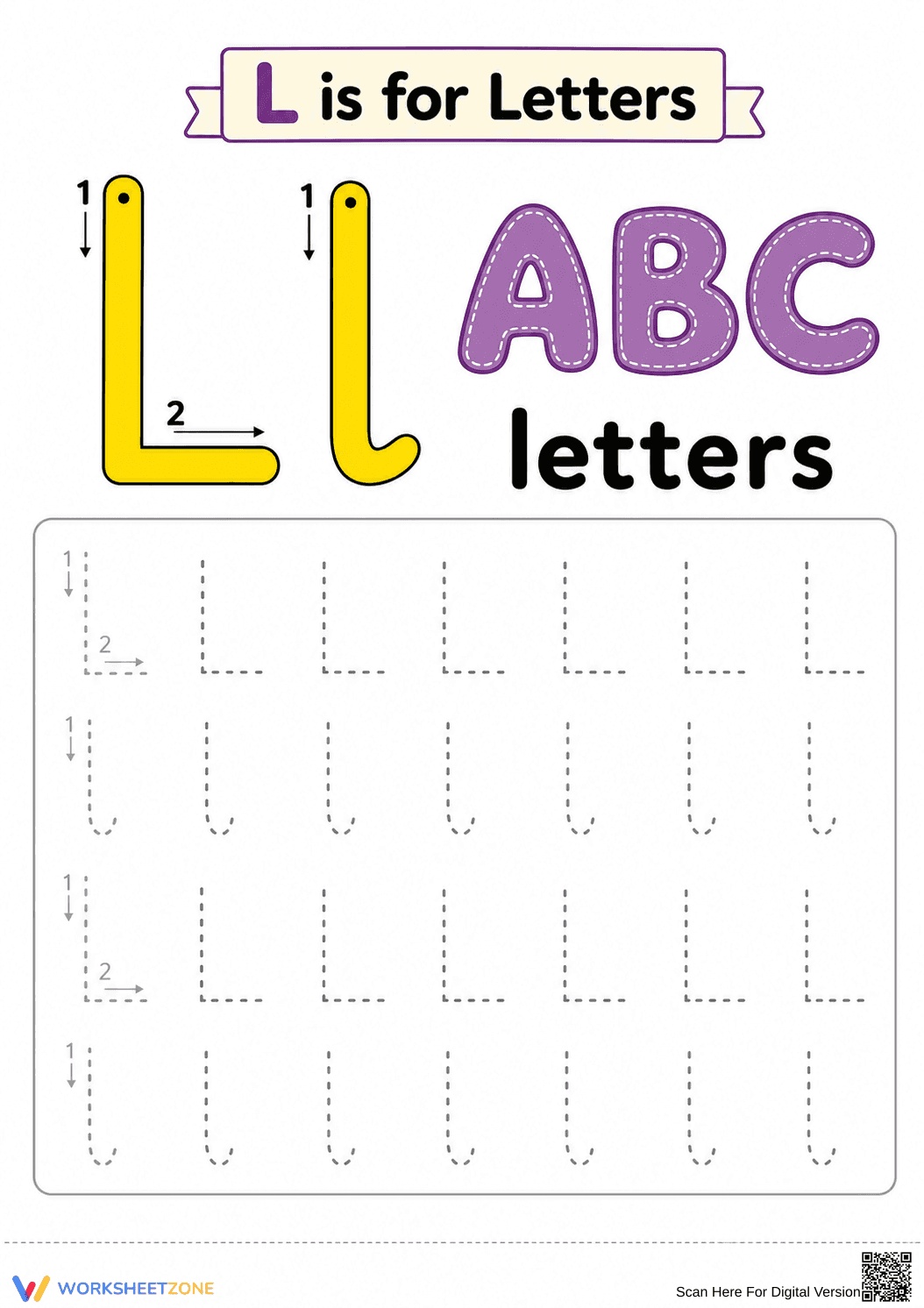

Printable Letter L Tracing Worksheet | Grade K ELA

Paste this activity's link or code into your existing LMS (Google Classroom, Canvas, Teams, Schoology, Moodle, etc.).
Students can open and work on the activity right away, with no student login required.
You'll still be able to track student progress and results from your teacher account.
This foundational handwriting worksheet provides Kindergarten and first-grade students with targeted practice forming the letter L. By tracing both uppercase and lowercase forms, early learners develop essential fine motor skills and letter recognition abilities necessary for fluent writing and reading readiness.
At a Glance
- Grade: K · Subject: ELA
- Standard:
CCSS.ELA-LITERACY.L.K.1.A— Print many upper- and lowercase letters- Skill Focus: Letter L Tracing
- Format: 1 page · 28 problems · No answer key · PDF
- Best For: Independent practice
- Time: 10–15 minutes
This single-page resource features clear, guided instruction for writing the letter L. The top section displays large models of both the uppercase and lowercase letter with numbered directional arrows to ensure proper stroke sequence. Below, students will find four rows of dashed letters for tracing practice. The grid includes 28 tracing opportunities, providing ample repetition to build muscle memory.
Designed for immediate use, this resource requires minimal preparation:
- Print (1 minute): The high-contrast PDF ensures crisp dashed lines.
- Distribute (1 minute): Hand out the sheets along with pencils or crayons. The visual guides at the top make the task self-explanatory.
- Review (1 minute): Quickly scan student work to check for proper stroke direction and pencil grip.
With under three minutes of total setup time, this worksheet serves as an excellent addition to emergency sub plans or morning work routines.
This material aligns directly with CCSS.ELA-LITERACY.L.K.1.A, requiring students to print many upper- and lowercase letters. It also supports foundational print concepts by reinforcing letter shapes and spatial orientation on the page. Both standard codes can be copied directly into lesson plans, IEP goals, or district curriculum mapping tools.
Teachers can integrate this tracing activity into daily literacy centers. Place the printed sheets in a designated handwriting station where students can work independently after a brief whole-group phonics lesson on the /l/ sound. Alternatively, use it as a targeted intervention tool for students struggling with fine motor control. While observing students complete the 28 tracing tasks, watch for correct top-to-bottom stroke formation and proper pencil grasp. The activity typically takes 10 to 15 minutes to complete.
This worksheet is primarily designed for Kindergarten students mastering the alphabet, but it also serves as a valuable review for first graders needing handwriting reinforcement. For differentiation, teachers can place the sheet in a dry-erase pocket, allowing students who need extra practice to trace the letters multiple times with a whiteboard marker. It pairs perfectly with an anchor chart featuring words that start with the letter L, such as "lion" or "leaf," to connect the physical writing task with phonemic awareness.
Developing automaticity in letter formation is a critical precursor to expressive writing in early education. According to Fisher & Frey (2014), explicit handwriting instruction combined with guided repetition significantly reduces the cognitive load required for transcription, allowing young writers to focus their mental energy on idea generation and spelling. This resource directly supports CCSS.ELA-LITERACY.L.K.1.A by helping students print many upper- and lowercase letters accurately. By providing numbered directional arrows and 28 distinct tracing opportunities, the worksheet ensures that students internalize the correct motor patterns for the letter L. Consistent practice with these foundational skills prevents the development of inefficient handwriting habits that can hinder academic progress in later grades. Integrating structured tracing tasks into early literacy instruction establishes the physical dexterity and visual-motor integration necessary for long-term writing success.


