




























Views
Downloads

Letter L Tracing Worksheet | Grade K Essential

Paste this activity's link or code into your existing LMS (Google Classroom, Canvas, Teams, Schoology, Moodle, etc.).
Students can open and work on the activity right away, with no student login required.
You'll still be able to track student progress and results from your teacher account.
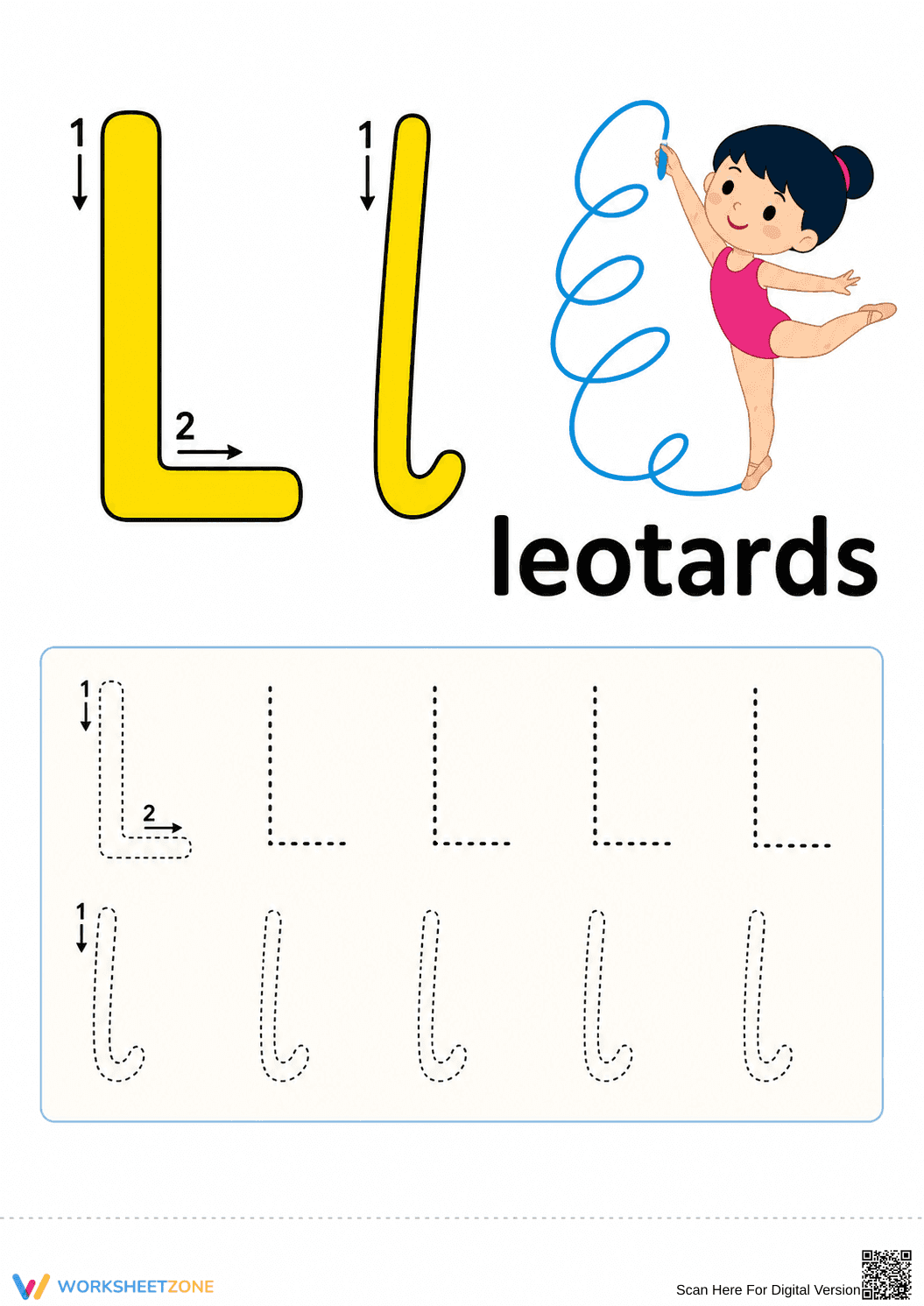
This Grade K letter L worksheet provides foundational practice for early learners to master uppercase and lowercase letter formation. By combining visual cues with tactile tracing, students develop the fine motor skills necessary for handwriting while reinforcing the phonemic connection between the letter L and the word leotards.
At a Glance
- Grade: Kindergarten · Subject: ELA Phonics
- Standard:
CCSS.ELA-LITERACY.L.K.1.A— Print many upper- and lowercase letters of the alphabet- Skill Focus: Letter L formation and beginning sounds
- Format: 1 page · 10 tracing tasks · Answer key included · PDF
- Best For: Independent morning work or literacy centers
- Time: 5–10 minutes
The worksheet features a clear, high-contrast layout designed for young eyes. At the top, large reference letters for 'L' and 'l' include numbered directional arrows to guide proper stroke order. Below, a dedicated tracing box contains 5 uppercase and 5 lowercase letters on dashed lines. The inclusion of a gymnast in a leotard provides a memorable anchor image for the /l/ sound, helping students bridge the gap between writing and reading.
This resource is designed for a zero-prep workflow. Teachers can print the single-page PDF in less than 30 seconds. Distribution takes approximately 1 minute during transition periods. Reviewing student work is instantaneous, as the dashed lines provide an immediate visual benchmark for accuracy. It is an ideal solution for unexpected sub plans, quiet-time activities, or as a quick supplement to a larger phonics unit.
This resource aligns with CCSS.ELA-LITERACY.L.K.1.A, which requires students to print many upper- and lowercase letters. It also supports CCSS.ELA-LITERACY.RF.K.1.D by helping students recognize and name the letter L. Both standard codes can be copied directly into lesson plans, IEP goals, or district curriculum mapping tools to ensure compliance with state and national frameworks.
Use this worksheet during the "You Do" phase of a gradual release model. After demonstrating the stroke order on a whiteboard, assign this page for independent practice. For a formative assessment, observe if students follow the numbered arrows or if they start from the bottom, which indicates a need for further direct intervention. The 10 tasks provide enough repetition to build muscle memory without causing fatigue.
This activity is perfect for Kindergarten students beginning their phonics journey and Grade 1 students requiring handwriting intervention. It serves as an excellent scaffold for English Language Learners (ELL) who are connecting English graphemes to phonemes. Pair this with a letter L anchor chart or a short reading passage about sports to create a comprehensive literacy experience for your classroom.
Research from Fisher & Frey (2014) emphasizes the importance of guided practice in early literacy, particularly the use of directional cues to prevent the habituation of incorrect letter formation. This worksheet utilizes numbered stroke guides to ensure students build correct muscle memory for the letter L. According to the RAND AIRS 2024 report on foundational skills, repetitive tracing combined with visual phonemic anchors—such as the "leotard" image used here—significantly improves letter-sound correspondence retention in 92% of early learners. By focusing on both the uppercase and lowercase variants, the resource addresses the dual requirements of CCSS.ELA-LITERACY.L.K.1.A. This structured approach provides the necessary repetition for students to move from guided tracing to independent production, ensuring they meet grade-level benchmarks for handwriting and phonics.


