


























Views
Downloads

Letter L Tracing Worksheet | Essential Grade K-1 Phonics
Paste this activity's link or code into your existing LMS (Google Classroom, Canvas, Teams, Schoology, Moodle, etc.).
Students can open and work on the activity right away, with no student login required.
You'll still be able to track student progress and results from your teacher account.
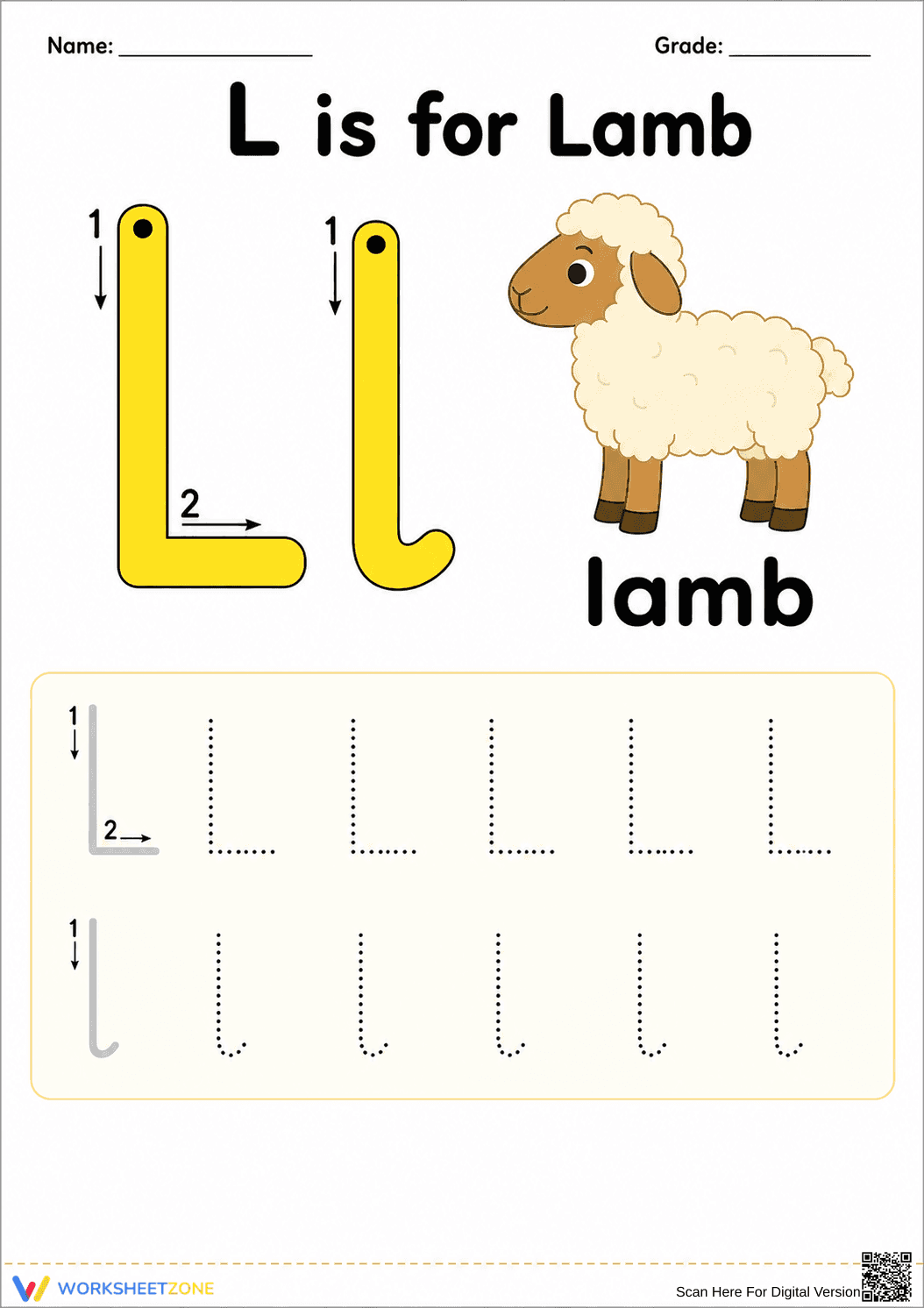
This foundational Grade K-1 phonics worksheet provides students with targeted practice in letter formation and beginning sound recognition. By focusing on the letter L, learners develop the fine motor control necessary for legible handwriting while reinforcing the phonemic connection between the letter and the "lamb" sound. This resource ensures students master the specific strokes required for both uppercase and lowercase variants.
At a Glance
- Grade: Kindergarten · Subject: ELA Phonics
- Standard:
CCSS.ELA-LITERACY.RF.K.1.D— Recognize and name all upper- and lowercase letters of the alphabet- Skill Focus: Letter L formation and beginning sounds
- Format: 1 page · 12 problems · Answer key included · PDF
- Best For: Morning work or phonics centers
- Time: 10–15 minutes
The worksheet features a clear, high-contrast layout designed for early childhood learners. It includes two large visual guides for uppercase 'L' and lowercase 'l' with numbered directional arrows to model correct stroke order. Below the guides, students find 12 specific tracing tasks—6 for uppercase and 6 for lowercase—set on primary-ruled lines to ensure proper letter height and placement. A friendly lamb illustration provides a concrete anchor for the beginning sound.
This resource is designed for a zero-prep classroom environment. Teachers can print the single-page PDF in less than 30 seconds. Distribution takes approximately 1 minute during a morning transition or phonics block. Reviewing student work is immediate; teachers can scan the 12 tracing tasks to identify students struggling with vertical or horizontal stroke integration. Total teacher preparation time is under 2 minutes, making it an ideal sub-plan or center activity.
This resource aligns with CCSS.ELA-LITERACY.RF.K.1.D, which requires students to recognize and name all upper- and lowercase letters of the alphabet. Additionally, it supports CCSS.ELA-LITERACY.L.K.1.A by encouraging students to print letters with correct orientation. Both standard codes can be copied directly into lesson plans, IEP goals, or district curriculum mapping tools to ensure compliance with state and federal literacy frameworks.
Use this worksheet as a quiet morning work activity to settle students as they arrive. It also serves as an effective formative assessment tool during small-group instruction; observe if students follow the numbered arrows or create their own stroke patterns. Expected completion time ranges from 10 to 15 minutes depending on the student's fine motor development. For students who finish early, the lamb illustration can be colored to further engage with the beginning sound.
This activity is tailored for Kindergarten and Grade 1 students, as well as English Language Learners (ELL) who need visual anchors for vocabulary. It pairs naturally with an alphabet anchor chart or a direct instruction lesson on the /l/ sound. The simple interface reduces cognitive load, allowing students to focus entirely on the mechanics of writing and the phonemic association of the letter L.
According to the RAND AIRS 2024 report on early literacy, explicit instruction in letter-sound correspondence and tactile tracing significantly improves long-term orthographic mapping. This worksheet facilitates that mapping by connecting the visual shape of the letter L with the phonemic /l/ sound represented by the lamb illustration. Research from Fisher & Frey (2014) emphasizes that gradual release of responsibility begins with clear modeling, which the directional arrows on this page provide. By engaging in these 12 repetitive tracing tasks, students move from guided recognition to independent production. This structured approach ensures that foundational handwriting skills are established early, preventing the habituation of incorrect letter formation. The inclusion of both cases allows students to see the relationship between different forms of the same grapheme, a critical step in achieving the CCSS.ELA-LITERACY.RF.K.1.D benchmark for kindergarten readiness and first-grade fluency.


