


























Views
Downloads

Kindergarten Pumpkin Life Cycle Printable Worksheet
Paste this activity's link or code into your existing LMS (Google Classroom, Canvas, Teams, Schoology, Moodle, etc.).
Students can open and work on the activity right away, with no student login required.
You'll still be able to track student progress and results from your teacher account.
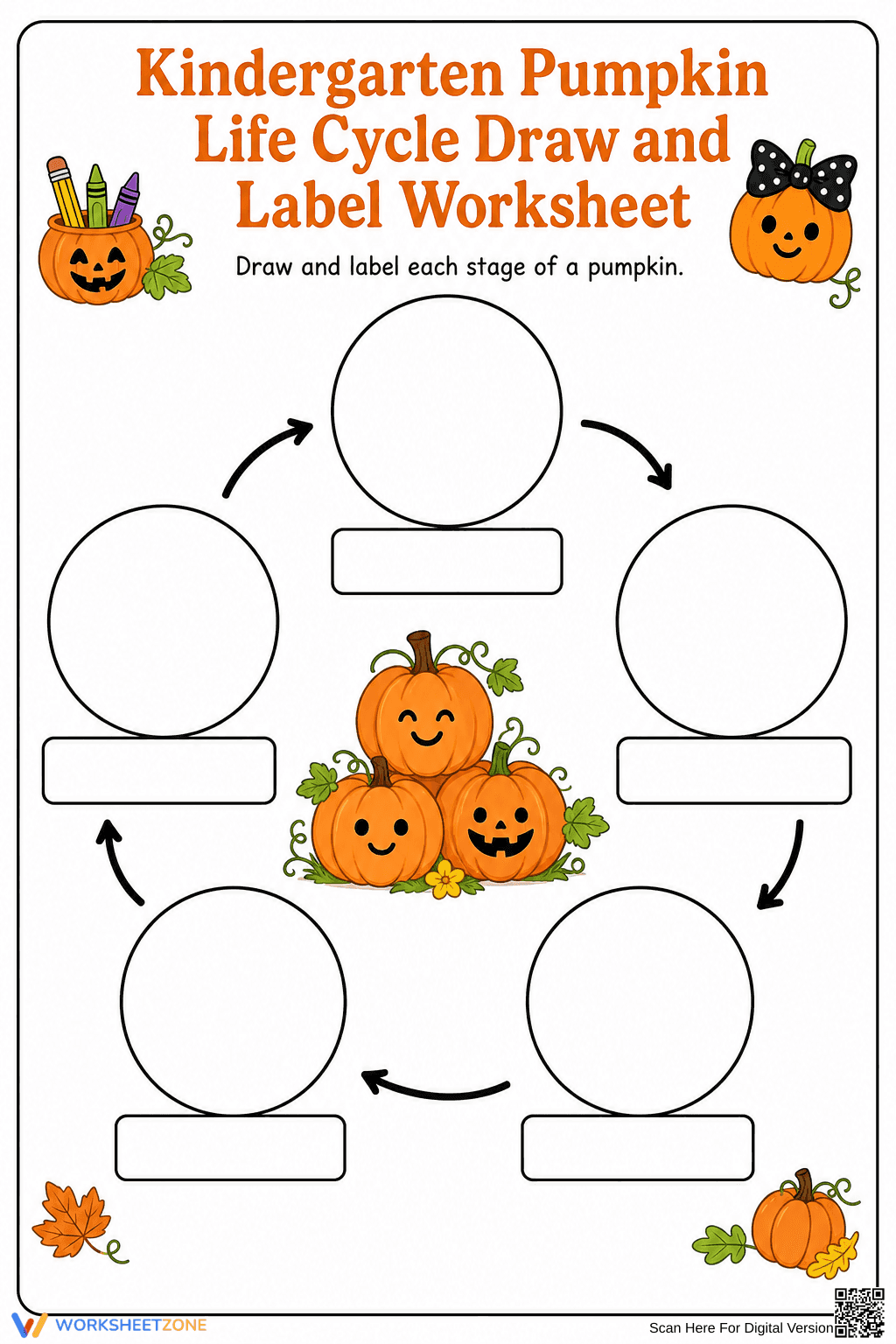
This Kindergarten pumpkin life cycle worksheet provides a hands-on way for students to visualize and document the growth of a plant. By drawing and labeling the five distinct stages, learners develop a concrete understanding of biological sequences and scientific vocabulary. It transforms a standard science lesson into an engaging creative exercise.
At a Glance
- Grade: Kindergarten · Subject: Science
- Standard:
K-LS1-1— Use observations to describe patterns of what plants need to survive and grow- Skill Focus: Life cycle sequencing
- Format: 1 page · 10 tasks · Answer key not included · PDF
- Best For: Fall science centers or Halloween activities
- Time: 15–20 minutes
The resource features a circular flow diagram with five dedicated drawing spaces and corresponding labeling boxes. Students are prompted to illustrate the seed, sprout, vine, flower, and pumpkin stages. The layout includes festive seasonal illustrations to engage young learners and provides ample space for early handwriting practice and artistic expression.
This worksheet follows a zero-prep workflow designed for busy educators. First, print the single-page PDF, which takes approximately 30 seconds for a full class set. Second, distribute the sheets along with crayons or colored pencils, requiring about 1 minute of transition time. Finally, review the completed diagrams for a quick formative check on sequencing logic. Total teacher prep time is under two minutes, making this an ideal sub plan or morning work option.
Standards Alignment: Primary standard `K-LS1-1`: "Use observations to describe patterns of what plants and animals (including humans) need to survive." This worksheet supports the standard by requiring students to observe and represent the developmental stages of a plant. Both standard codes can be copied directly into lesson plans, IEP goals, or district curriculum mapping tools.
Use this during a "Life on the Farm" or "Autumn Harvest" unit after reading a mentor text about pumpkins. It serves as an excellent formative assessment; observe if students can correctly sequence the flower before the fruit. Expected completion time is 15 to 20 minutes depending on the level of drawing detail students choose to include.
Designed for Kindergarten students, this worksheet also supports Grade 1 learners who need a visual refresher on plant biology. It is a natural pairing for a real-world pumpkin carving activity or a classroom seed-planting experiment. The visual nature of the tasks makes it highly accessible for English Language Learners and students with diverse learning needs.
According to the RAND AIRS 2024 report, multi-modal learning—combining drawing with labeling—significantly improves vocabulary retention in early childhood science. This worksheet targets the K-LS1-1 standard by asking students to identify the sequential patterns of plant growth. By engaging in the "draw and label" process, students move beyond passive listening to active scientific modeling. Research from Fisher & Frey (2014) suggests that visual representations help bridge the gap between abstract concepts and concrete understanding for English Language Learners and early readers. This resource provides a structured framework for that cognitive transition, ensuring that the five stages of the pumpkin life cycle are reinforced through both artistic expression and literacy-based labeling. Using 10 specific tasks, the worksheet builds a foundation for future biological studies.


