


























Views
Downloads
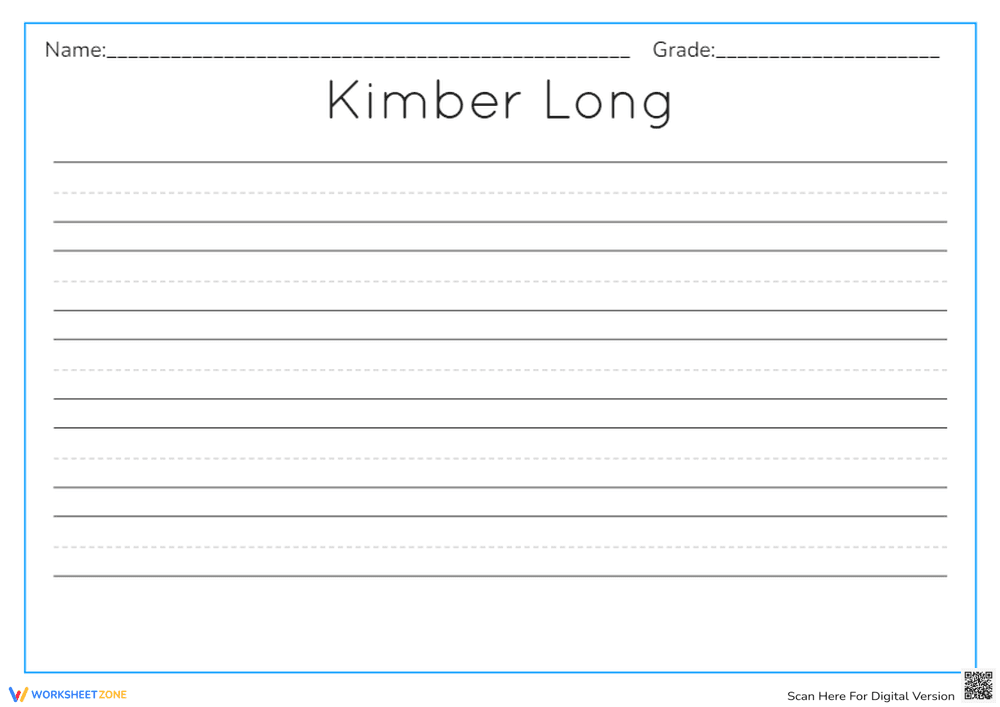

Kimber Long Name Tracing: Printable Handwriting Practice
Paste this activity's link or code into your existing LMS (Google Classroom, Canvas, Teams, Schoology, Moodle, etc.).
Students can open and work on the activity right away, with no student login required.
You'll still be able to track student progress and results from your teacher account.
This printable handwriting worksheet helps elementary students master name writing and letter formation. Focusing on the name Kimber Long, learners practice uppercase and lowercase letters on structured primary lines. This targeted exercise builds fine motor control and muscle memory, helping young writers transition to independent print writing.
At a Glance
- Grade: Grade 1 · Subject: Handwriting
- Standard:
CCSS.ELA-LITERACY.L.1.1.A— Print all upper- and lowercase letters correctly- Skill Focus: Name tracing and letter formation
- Format: 1 page · 6 practice lines · No answer key · PDF
- Best For: Daily morning work and fine motor practice
- Time: 10–15 minutes
What's Inside
This single-page resource features a clean layout designed for early writers. The name Kimber Long is printed at the top as a visual model. Below, the page provides 6 sets of primary writing lines with solid outer lines and a dashed midline. This structure guides students in maintaining proper letter height and spacing.
Zero-Prep Workflow
This zero-prep worksheet integrates easily into daily routines. First, print the single-page PDF, taking under 1 minute. Second, distribute the sheets during morning arrival or writing centers. Third, review student work individually, providing immediate feedback on pencil grip. With a total teacher prep time under 2 minutes, this resource is ideal for emergency sub plans.
Standards Alignment
This worksheet aligns directly with the Common Core standard `CCSS.ELA-LITERACY.L.1.1.A`, which requires students to print all upper- and lowercase letters. Additionally, it supports basic print concepts and left-to-right progression. Both standard codes can be copied directly into lesson plans, IEP goals, or district curriculum mapping tools.
How to Use It
Use this worksheet during morning arrival as a quiet transition activity. Alternatively, assign it during small-group writing centers to target fine motor development. While students work, observe their pencil grip and stroke direction. This formative assessment helps identify students needing physical scaffolding. Expect completion in 10 to 15 minutes.
Who It's For
This resource is designed for Grade 1 and Grade 2 students needing handwriting support. It is highly beneficial for English language learners who require structured visual boundaries. Pair this worksheet with a letter formation anchor chart to provide additional visual support during independent practice.
This handwriting resource aligns with standard `CCSS.ELA-LITERACY.L.1.1.A`, focusing on the plain-English skill of printing letters accurately. Research from Fisher & Frey (2014) emphasizes that structured motor practice is essential for developing automaticity in letter production. When students master the physical mechanics of writing, they can dedicate more cognitive resources to higher-level composition tasks. This worksheet provides the necessary visual boundaries and repetitive practice to build that motor automaticity. By practicing a familiar name like Kimber Long, students connect personal identity with early literacy skills, increasing engagement. The clean layout ensures that young learners remain focused on the physical task of writing without visual distractions. Teachers can confidently integrate this tool into daily routines to support foundational writing development.


