


























Views
Downloads
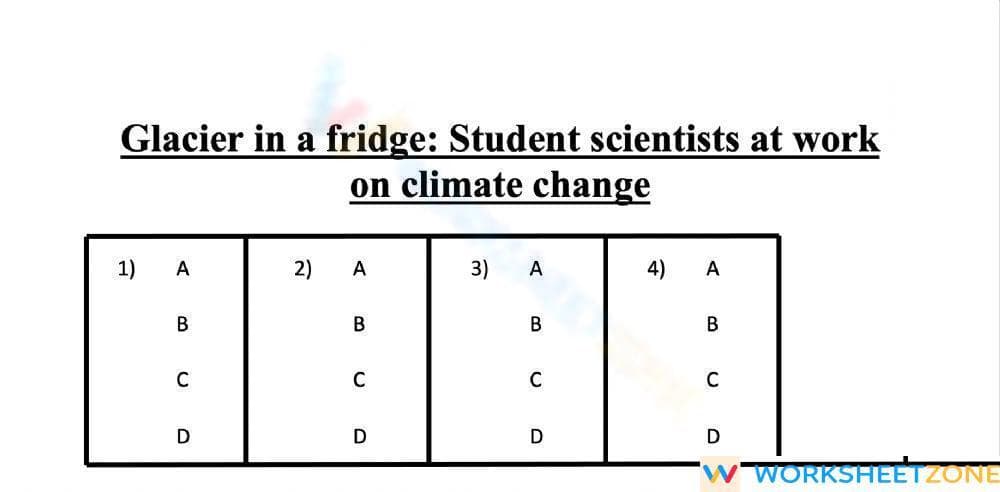

Printable Climate Change Reading Comprehension | Grade 4
Paste this activity's link or code into your existing LMS (Google Classroom, Canvas, Teams, Schoology, Moodle, etc.).
Students can open and work on the activity right away, with no student login required.
You'll still be able to track student progress and results from your teacher account.
This informational reading comprehension worksheet challenges students to analyze complex environmental concepts through the lens of young researchers. By engaging with the article "Glacier in a Fridge," learners develop critical evidence-based thinking skills required for academic success. This resource ensures students can identify explicit details and draw logical inferences from scientific texts effectively.
At a Glance
- Grade: 4 · Subject: ELA
- Standard:
CCSS.ELA-LITERACY.RI.4.1— Refer to details and examples in a text when explaining explicit meanings- Skill Focus: Informational Text Analysis
- Format: 1 page · 4 problems · Answer key included · PDF
- Best For: Independent practice and formative assessment
- Time: 15–20 minutes
This single-page document features four targeted multiple-choice questions designed to test deep understanding of the accompanying text. The layout is clean and professional, ensuring minimal distractions for students. A comprehensive answer key is provided to facilitate quick grading and immediate feedback, while the scientific theme makes it an excellent cross-curricular tool for science and literacy blocks.
Skill Progression
- Guided practice involves reviewing the "Glacier in a Fridge" title and predicting main ideas before tackling the first question.
- Supported practice continues as students eliminate incorrect multiple-choice options using textual evidence from the passage for two subsequent tasks.
- Independent practice culminates in the final assessment question where students must synthesize their understanding without teacher assistance.
This worksheet follows the gradual-release model, transitioning from basic identification to higher-order analysis.
Standards Alignment
The primary alignment is CCSS.ELA-LITERACY.RI.4.1, which requires students to refer to details and examples in a text when explaining what the text says explicitly and when drawing inferences. Additionally, this resource supports science literacy by introducing real-world climate change investigations. Both standard codes can be copied directly into lesson plans, IEP goals, or district curriculum mapping tools.
How to Use It
Use this worksheet as a "ticket out the door" after a direct instruction lesson on identifying evidence in informational texts. It also functions perfectly as a formative assessment during a science unit on climate or glaciers. For the best results, observe students as they complete the 4 questions and note which learners struggle to map their answers back to specific sentences in the text. Expect completion within 20 minutes.
Who It's For
This resource is ideal for Grade 4 students, though it is highly accessible for Grade 3 learners needing a challenge or Grade 5 students requiring a review of informational text structures. It pairs naturally with a short passage or video about Arctic research and provides the necessary scaffolding for diverse learners through clear, concise questioning.
Academic research highlights the importance of integrating scientific literacy into English Language Arts instruction to build robust background knowledge. According to Fisher & Frey (2014), students who engage with complex informational texts through structured questioning demonstrate significantly higher retention of both vocabulary and conceptual frameworks. This worksheet leverages those findings by focusing on CCSS.ELA-LITERACY.RI.4.1, guiding students to extract precise evidence from a text about climate change. By answering 4 targeted questions, learners practice the essential skill of text-dependent analysis, a core competency identified in recent NAEP assessments as a predictor of long-term reading proficiency. The "Glacier in a Fridge" theme provides a concrete, relatable context for abstract environmental issues, making it a proven tool for classroom engagement. Educators can confidently implement this resource knowing it aligns with the rigorous demands of state standards while reducing administrative prep time through a ready-to-use PDF format and answer key.


