




























Views
Downloads
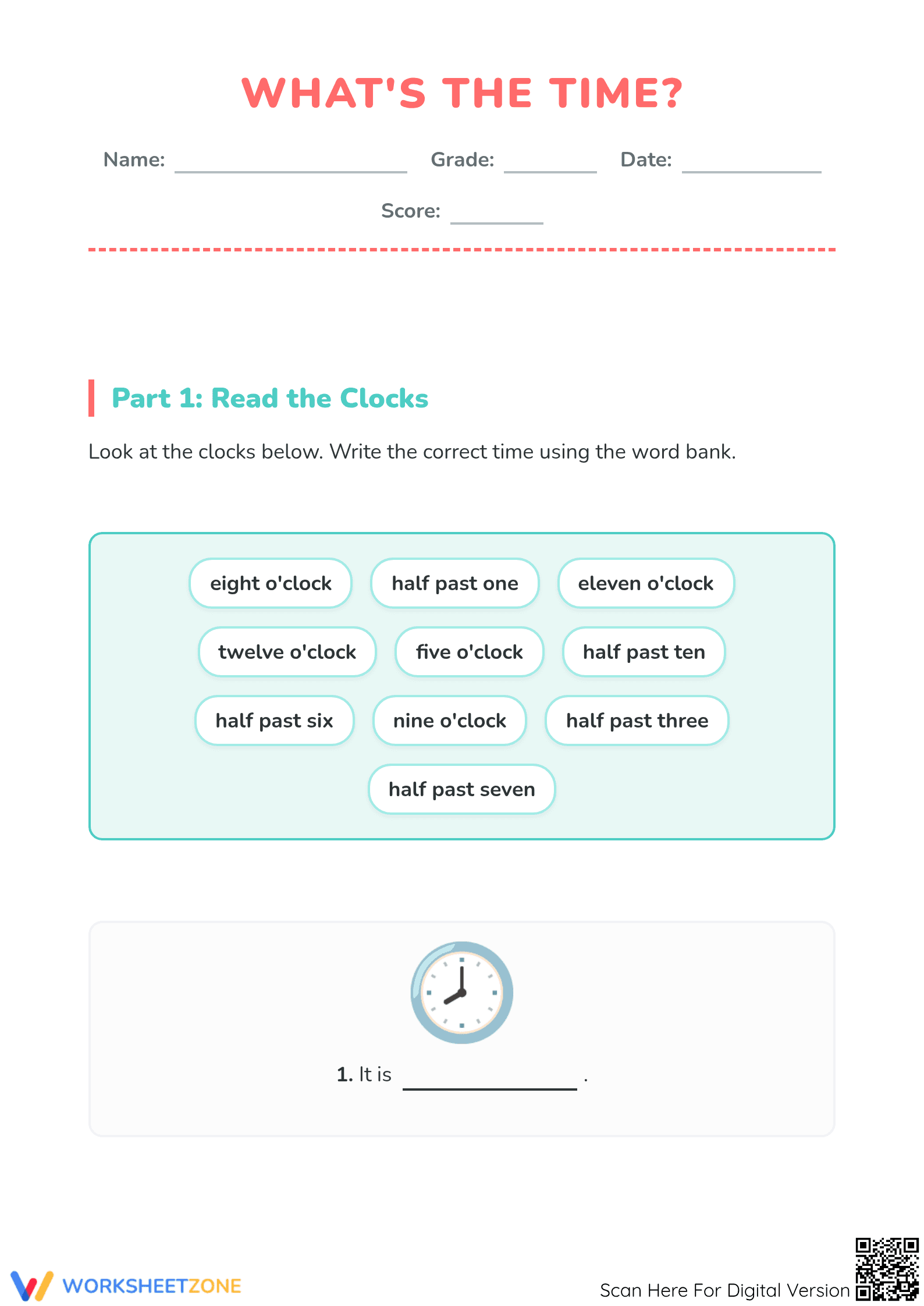



Printable Telling Time Worksheet | Grade 1 Essential

Paste this activity's link or code into your existing LMS (Google Classroom, Canvas, Teams, Schoology, Moodle, etc.).
Students can open and work on the activity right away, with no student login required.
You'll still be able to track student progress and results from your teacher account.
This Grade 1 telling time worksheet provides essential practice for students learning to read analog and digital clocks. By matching visual representations to written time and translating digital numerals into words, learners build a solid foundation in temporal literacy. This printable resource ensures students master the skill of identifying hours and half-hours with confidence and accuracy.
At a Glance
- Grade: 1 · Subject: Math
- Standard:
CCSS.MATH.CONTENT.1.MD.B.3— Tell and write time in hours and half-hours using clocks- Skill Focus: Analog and digital time telling
- Format: 5 pages · 18 problems · Answer key included · PDF
- Best For: Independent math center or homework practice
- Time: 20–30 minutes
What's Inside
This comprehensive 5-page PDF contains two distinct sections designed to reinforce time-telling concepts. Part 1 features 10 analog clock faces where students must identify the time using a provided word bank, facilitating vocabulary development. Part 2 shifts the focus to 8 digital clocks, requiring students to write out the time in words. A full answer key is included, making it a complete instructional package.
Zero-Prep Workflow
This resource is designed for immediate classroom implementation. First, print the 5-page document (30 seconds). Next, distribute the packets to your students (1 minute). Finally, review the completed work using the provided answer key to identify any student misconceptions (2 minutes). This streamlined process allows you to focus on direct instruction rather than tedious preparation.
Standards Alignment
The primary focus of this worksheet is `CCSS.MATH.CONTENT.1.MD.B.3`, which requires Grade 1 students to tell and write time in hours and half-hours using both analog and digital clocks. The exercises specifically target the ability to distinguish between the hour hand and the minute hand, a critical sub-skill of this standard. This standard code can be copied directly into lesson plans, IEP goals, or district curriculum mapping tools to ensure instructional alignment.
How to Use It
This worksheet is ideal for use after direct instruction on clock hands. Use the first page as a guided practice session, then assign the remaining pages for independent practice. During the activity, observe if students are correctly identifying "half past" vs "o'clock". Most students will complete the 18-task sequence within a 25-minute period.
Who It's For
This resource is designed for Grade 1 students, but also serves as an excellent intervention for Grade 2 or 3 students. The clear visual layout and word bank provide necessary scaffolding for English Language Learners. Pair this worksheet with a physical manipulative clock to provide a tactile component for kinesthetic learners during small-group instruction.
The mastery of telling time to the hour and half-hour is a pivotal milestone in early elementary mathematics that bridges abstract number sense with real-world application. According to the RAND AIRS 2024 report, consistent exposure to multiple clock formats—both analog and digital—significantly improves a student's ability to conceptualize elapsed time and daily schedules. This worksheet addresses the common challenge of distinguishing hand lengths by providing 18 high-quality, focused practice items. By aligning directly with CCSS.MATH.CONTENT.1.MD.B.3, this resource ensures that Grade 1 students develop the precision required for more advanced measurement standards in subsequent grades. Educational research from NAEP suggests that early fluency with temporal concepts correlates with improved mathematical reasoning in upper elementary school. This printable tool provides the structured repetition necessary to move from initial recognition to fluent recall, making it a vital component of any balanced measurement and data curriculum.


