


























Views
Downloads

Is That Really a Monkey? Worksheet | Grade 3 Printable
Paste this activity's link or code into your existing LMS (Google Classroom, Canvas, Teams, Schoology, Moodle, etc.).
Students can open and work on the activity right away, with no student login required.
You'll still be able to track student progress and results from your teacher account.
This printable Grade 3 reading comprehension worksheet helps students distinguish between prosimians, monkeys, and apes through a detailed informational text. By analyzing the provided passage, learners identify shared characteristics such as forward-facing eyes and opposing thumbs while discovering key differences in activity cycles and physical features. This resource ensures students can cite specific evidence to support their answers.
At a Glance
- Grade: 3 · Subject: ELA Literature
- Standard:
CCSS.ELA-LITERACY.RI.3.1— Ask and answer questions to demonstrate understanding of a text, referring to text evidence.- Skill Focus: Informational Text Analysis
- Format: 3 pages · 10 problems · Answer key included · PDF
- Best For: Independent practice or science-literacy integration
- Time: 20–30 minutes
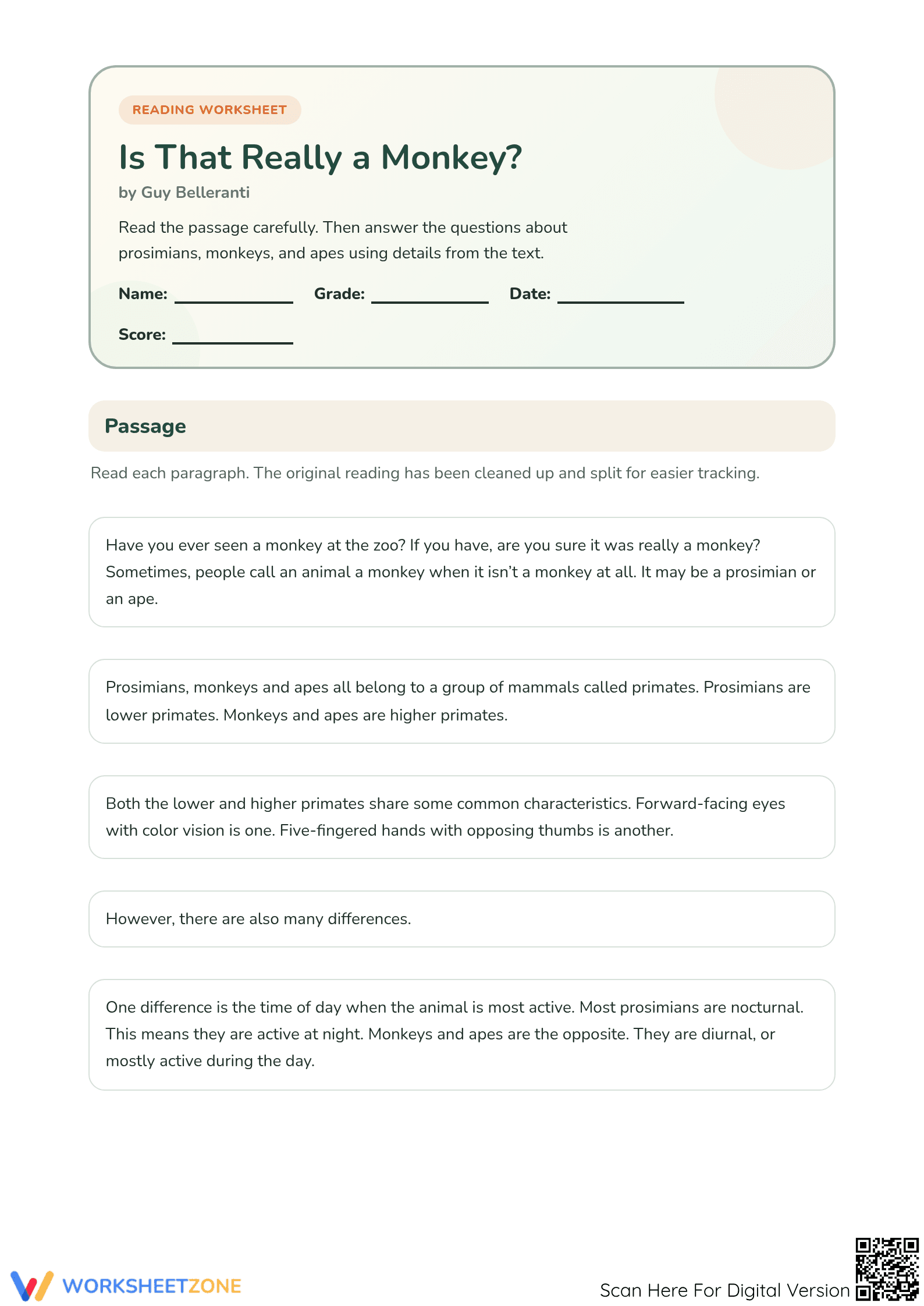
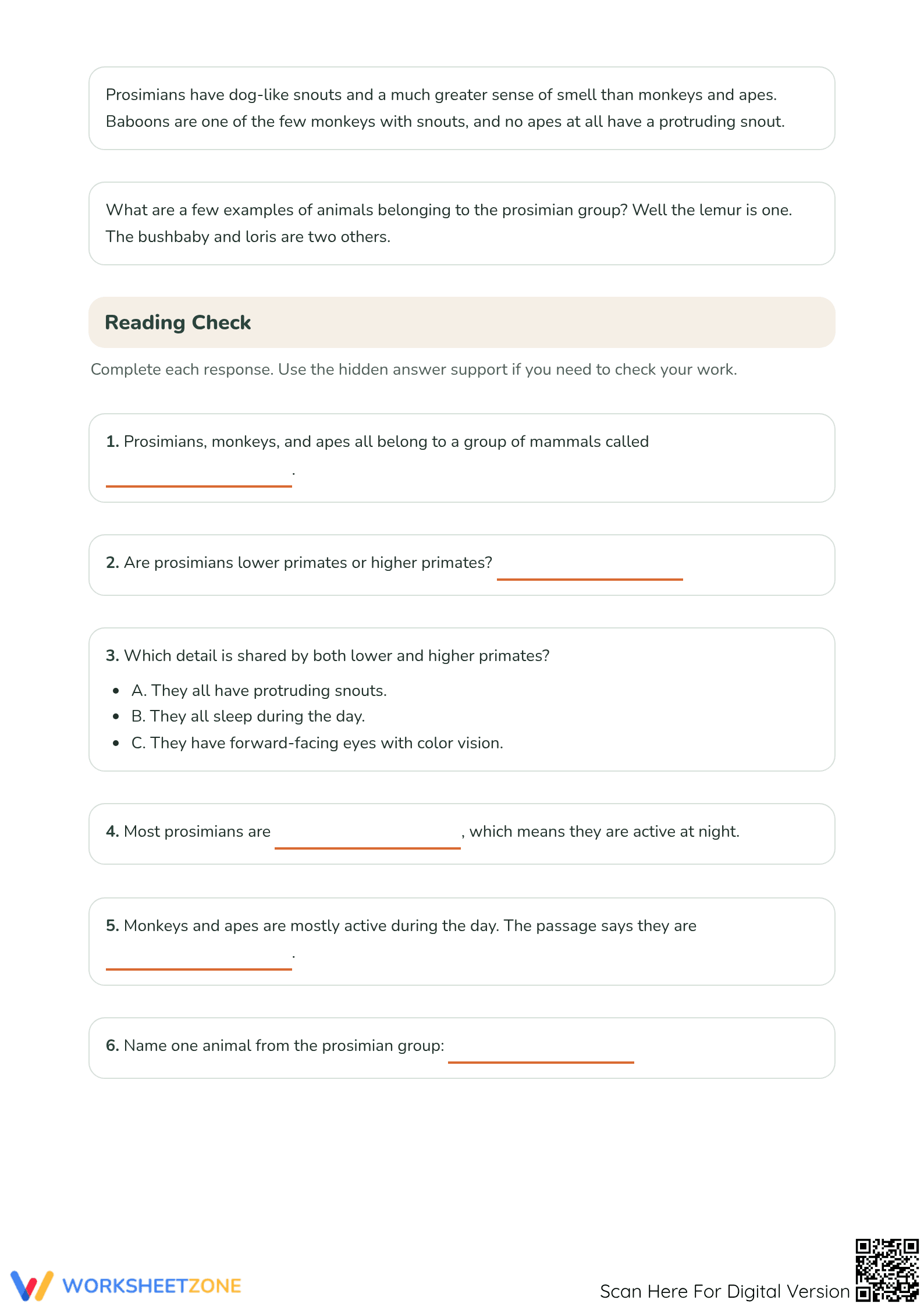
The "Is That Really a Monkey?" packet includes three comprehensive pages designed for maximum student engagement. The first page features an accessible reading passage by Guy Belleranti that breaks down complex biological concepts into student-friendly paragraphs. The second and third pages provide ten structured tasks, including a "Reading Check" with six evidence-based questions and a "Word Work" section that focuses on four critical vocabulary terms and cross-textual synthesis. A full answer key is provided for immediate feedback.
This resource utilizes a Zero-Prep Workflow to save teacher time. First, print the three-page document in under 30 seconds. Second, distribute the materials to students for 15 to 20 minutes of independent reading and critical thinking. Third, review the responses using the included answer key in less than 2 minutes. This streamlined approach makes it an ideal choice for substitute plans, morning work, or quick formative assessments during a science-integrated ELA block.
The worksheet is strictly aligned to CCSS.ELA-LITERACY.RI.3.1. Students are required to "ask and answer questions to demonstrate understanding of a text, referring explicitly to the text as the basis for the answers." By prompting students to find specific details about primate snouts, color vision, and nocturnal behaviors, the activity reinforces the habit of looking back at the source material. This standard code can be copied directly into lesson plans, IEP goals, or district curriculum mapping tools.
Teachers can use this worksheet during the "You Do" phase of a gradual release model. After modeling how to annotate a text for key details, assign this passage to verify that students can identify main ideas independently. One effective formative-assessment observation tip is to watch for students flipping back to the first page while answering question four; this behavior indicates they are successfully applying text-evidence strategies. Expect most third-grade learners to complete the full sequence in 25 minutes.
This resource is designed for Grade 3 students but remains accessible for Grade 2 enrichment or Grade 4 intervention. It is particularly effective for English Language Learners who benefit from the clear headings and structured response boxes. Naturally pair this worksheet with a short video clip of primates or an anchor chart detailing the differences between nocturnal and diurnal animals to provide a multi-sensory learning experience that supports varied learner profiles.
According to the RAND AIRS 2024 report on literacy instructional materials, structured informational texts like this primate study are essential for building the domain-specific knowledge required for long-term reading success. By focusing on the CCSS.ELA-LITERACY.RI.3.1 standard, students practice the foundational skill of answering questions through direct text citation rather than general intuition. This worksheet targets the specific informational text comprehension abilities that NAEP identifies as critical for third-grade proficiency levels. Educators can rely on this 10-task set to provide consistent, high-quality practice that bridges the gap between simple reading and analytical thought, ensuring that learners are prepared for the increasing complexity of upper-elementary literature and science assessments.


