


























Views
Plays


Grade 4 Mindfulness — Printable No-Prep Worksheet
Paste this activity's link or code into your existing LMS (Google Classroom, Canvas, Teams, Schoology, Moodle, etc.).
Students can open and work on the activity right away, with no student login required.
You'll still be able to track student progress and results from your teacher account.
This Grade 4 social-emotional learning worksheet gives students a structured introduction to mindfulness, helping them understand its meaning, benefits, and practical applications. By completing this quiz, learners will identify positive coping strategies and recognize how mindful breathing affects brain functions like the amygdala and prefrontal cortex.
At a Glance
- Grade: 4 · Subject: SEL
- Standard:
CCSS.ELA-LITERACY.RI.4.4— Determine the meaning of domain-specific words- Skill Focus: Mindfulness and Emotional Regulation
- Format: 3 pages · 11 problems · Answer key included · PDF
- Best For: Formative assessment or morning work
- Time: 15–20 minutes
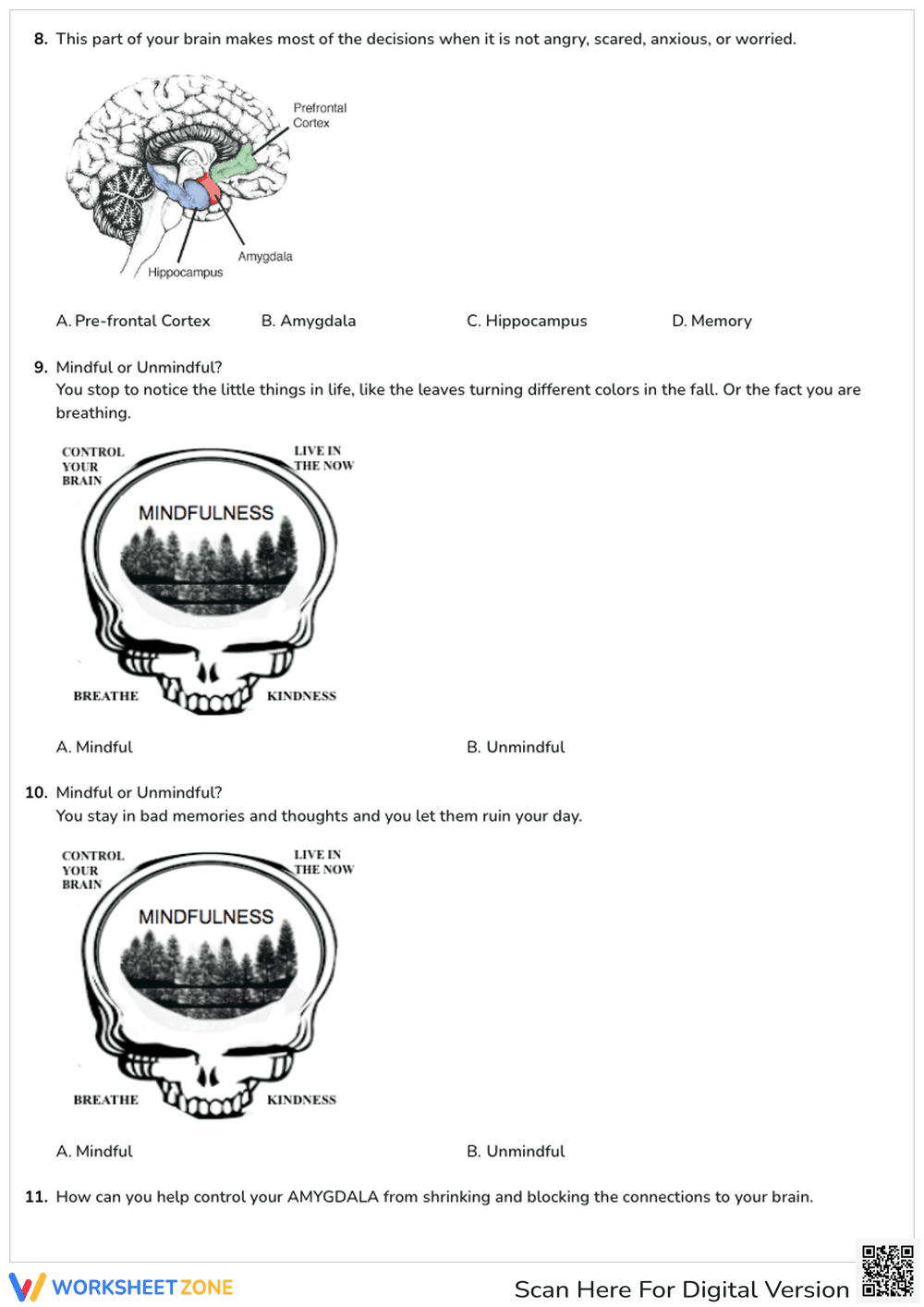
This comprehensive resource features 11 carefully designed questions, including multiple-choice and true/false formats, spread across three pages. Students will encounter scenario-based questions that ask them to distinguish between mindful and unmindful behaviors. The quiz also includes basic brain anatomy diagrams to help students visualize where emotional regulation happens, alongside a complete answer key for easy grading.
Designed for immediate classroom implementation, this resource follows a simple three-step workflow. First, print the PDF copies (1 minute). Next, distribute the quiz to students during your morning meeting or SEL block (1 minute). Finally, review the answers together as a class to reinforce the concepts (5 minutes). Total teacher preparation time is under two minutes, making this an excellent, self-explanatory option for emergency sub plans or quick transitions.
This worksheet is aligned to CCSS.ELA-LITERACY.RI.4.4, requiring students to determine the meaning of general academic and domain-specific words or phrases in a text relevant to a grade 4 topic or subject area. It supports vocabulary acquisition related to mental health and self-regulation. Both standard codes can be copied directly into lesson plans, IEP goals, or district curriculum mapping tools.
Teachers can utilize this quiz as a pre-assessment before beginning a broader unit on emotional regulation or as a reflective activity after direct instruction on mindfulness techniques. During the activity, observe which students struggle to identify the function of the amygdala; this provides an excellent formative-assessment opportunity to reteach how stress impacts the brain. Expected completion time ranges from 15 to 20 minutes.
This resource is primarily designed for third through fifth-grade students developing their social-emotional competencies. The clear formatting and visual aids make it accessible for students who benefit from concrete examples of abstract concepts. It pairs perfectly with a guided breathing exercise or a direct instruction lesson on managing classroom anxiety.
Integrating explicit vocabulary instruction into social-emotional learning helps students articulate their internal experiences and manage stress. By addressing CCSS.ELA-LITERACY.RI.4.4, students learn to determine the meaning of domain-specific words like "mindfulness" and "amygdala" in context. According to a recent EdReports 2024 analysis, embedding academic vocabulary within SEL contexts significantly improves both reading comprehension and behavioral outcomes across elementary grades. When students possess the precise language to describe their emotional states and understand the biological mechanisms behind their feelings, they are better equipped to employ self-regulation strategies effectively. This foundational knowledge reduces classroom disruptions, fosters a more supportive learning environment, and builds long-term resilience. Providing structured opportunities to practice this vocabulary ensures that abstract concepts become concrete, actionable tools for young learners navigating complex social dynamics.


