


























Views
Downloads


Printable Grade 5 Integer Addition Worksheet | -50 to 50
Paste this activity's link or code into your existing LMS (Google Classroom, Canvas, Teams, Schoology, Moodle, etc.).
Students can open and work on the activity right away, with no student login required.
You'll still be able to track student progress and results from your teacher account.
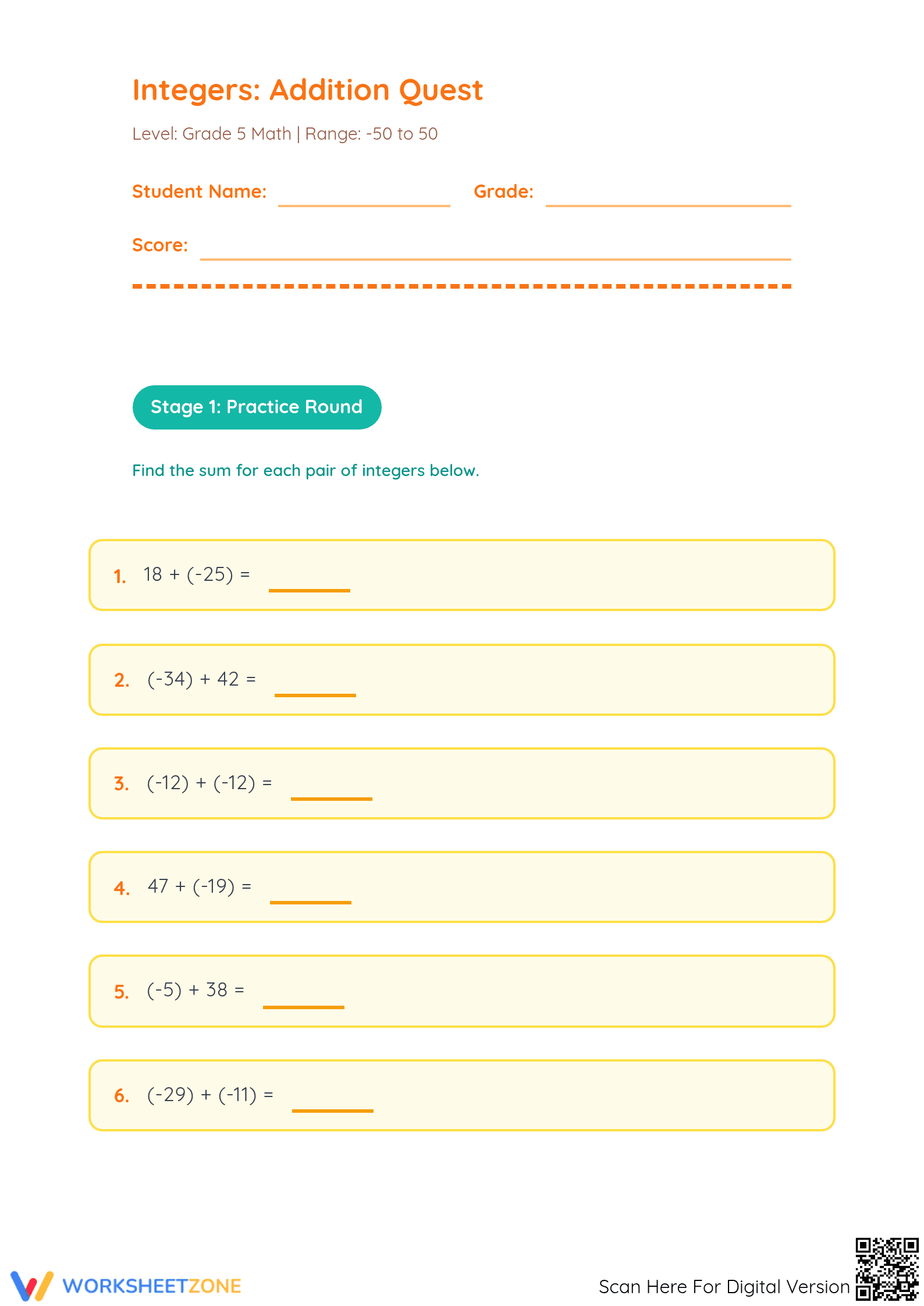
This Grade 5 math worksheet provides a structured approach to mastering integer addition within the range of -50 to 50. By engaging with 40 carefully sequenced problems, students develop a deep understanding of how positive and negative values interact. This resource ensures learners move from basic computation to expert-level fluency in integer operations.
At a Glance
- Grade: 5 · Subject: Math
- Standard:
CCSS.MATH.CONTENT.7.NS.A.1— Apply and extend previous understandings of addition to add and subtract rational numbers- Skill Focus: Adding integers within -50 to 50
- Format: 5 pages · 40 problems · Answer key included · PDF
- Best For: Independent skill reinforcement and formative assessment
- Time: 35–50 minutes
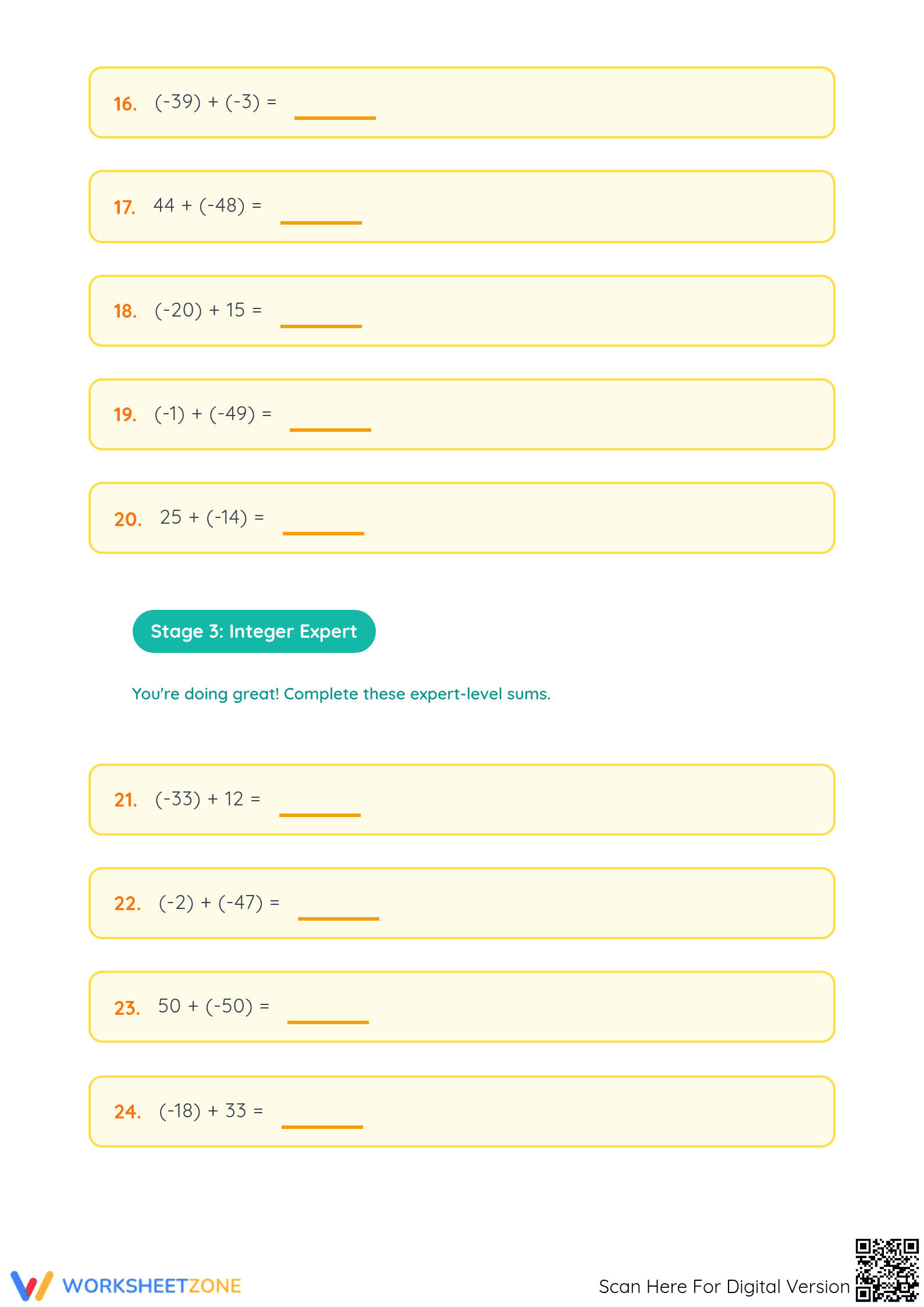
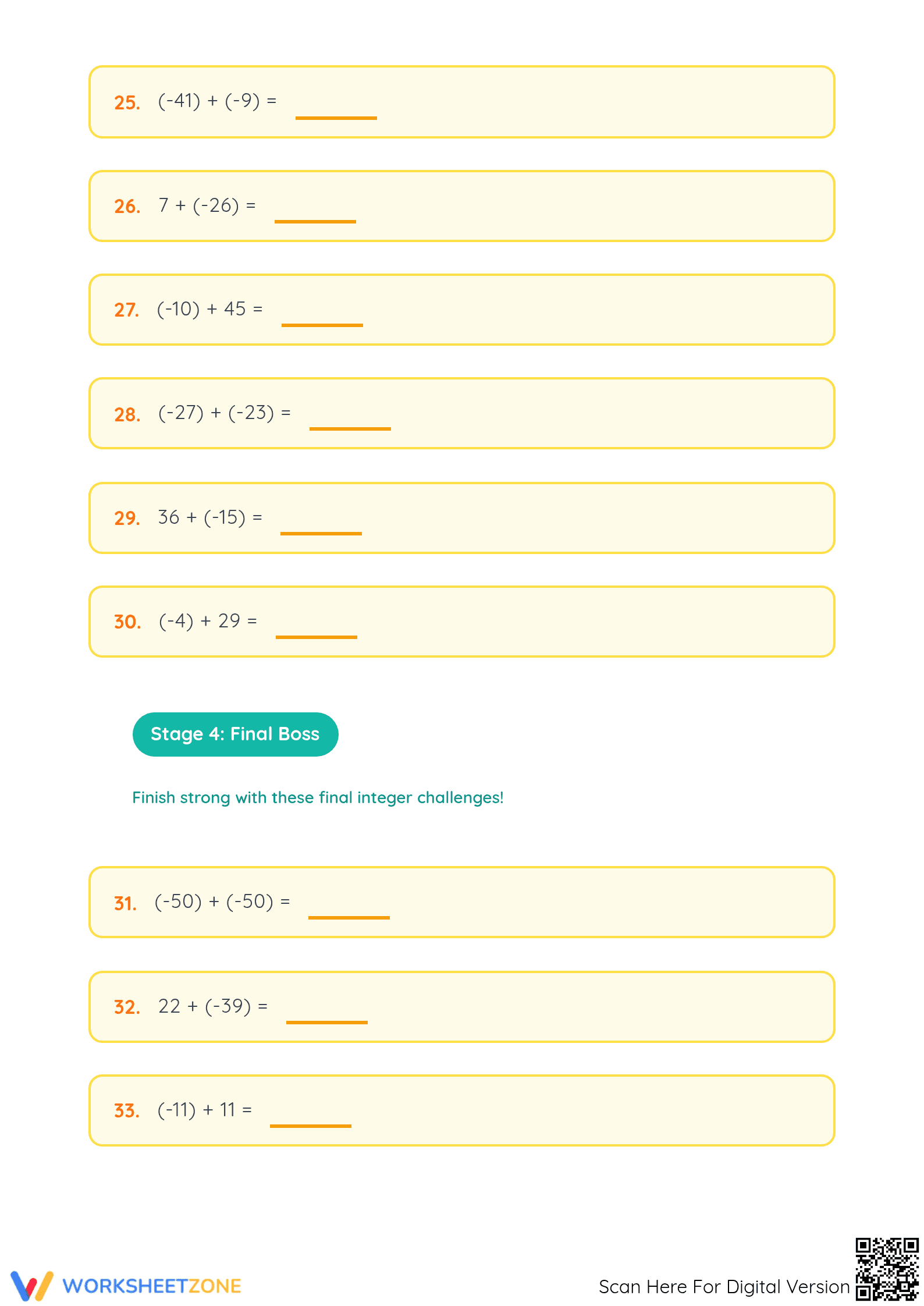
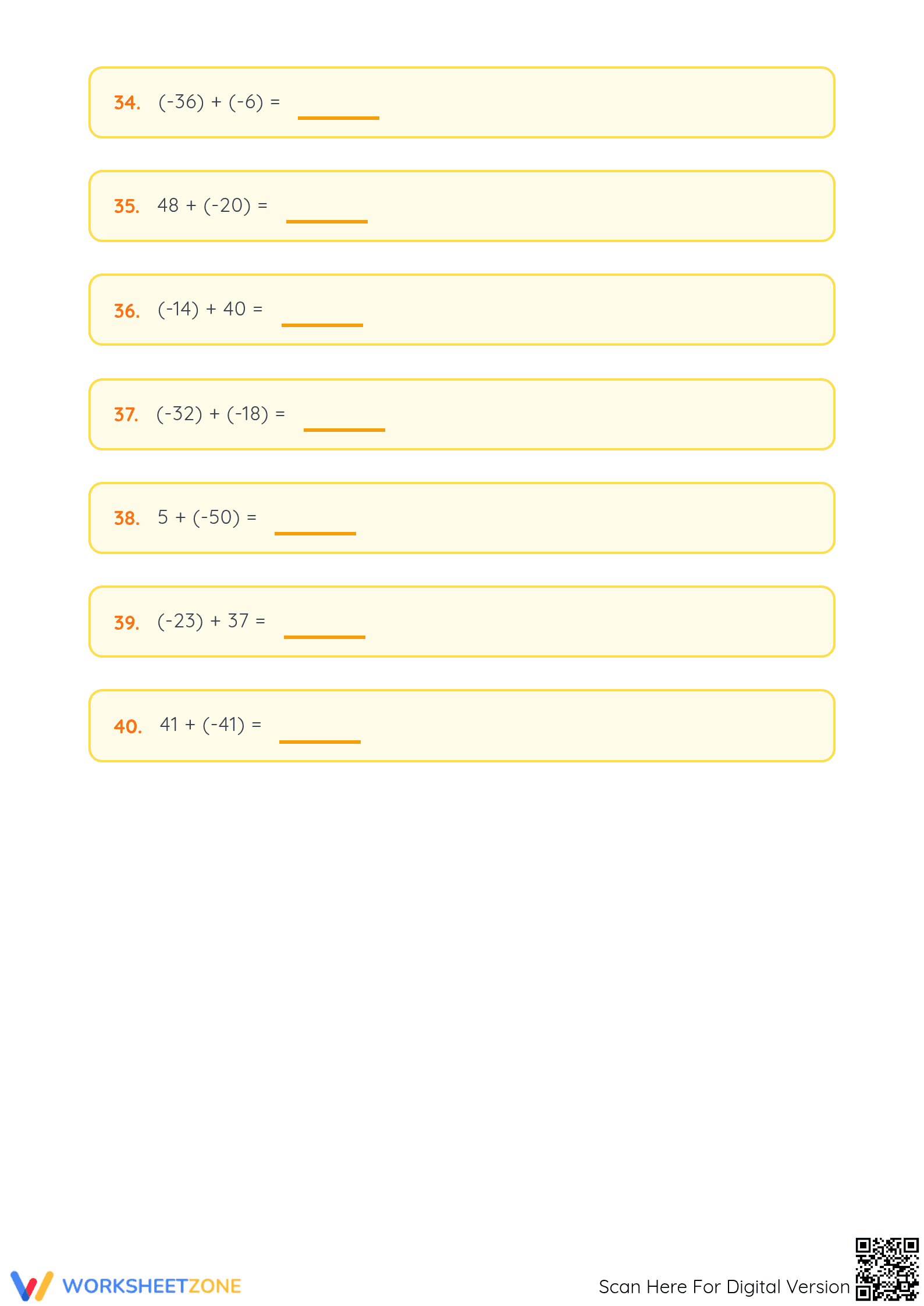
The "Integers: Addition Quest" is a comprehensive 5-page PDF document featuring 40 horizontal addition problems. The worksheet is organized into four distinct stages: Practice Round, Stepping Up, Integer Expert, and Final Boss. This quest-themed layout keeps students motivated as they work through increasing complexity. A full, two-page answer key is provided for immediate grading or student self-correction.
Skill Progression
- Guided Practice: The first 15 problems focus on basic integer pairings, allowing students to stabilize their understanding of the number line and sign rules through high-repetition success.
- Supported Practice: Problems 16 through 24 introduce larger absolute values and more frequent sign changes, requiring students to apply mental strategies with greater precision.
- Independent Practice: The final 16 problems, culminating in the "Final Boss" stage, present the most challenging combinations of negative and positive integers to verify complete conceptual mastery.
This structure facilitates a gradual release of responsibility, ensuring that students are not overwhelmed by early complexity while still reaching rigorous end-of-unit goals.
Standards Alignment
This resource is directly aligned with `CCSS.MATH.CONTENT.7.NS.A.1`, which requires students to represent addition and subtraction on a horizontal or vertical number line diagram. It provides essential enrichment for Grade 5 students ready for early algebraic concepts. The standard code can be copied directly into lesson plans, IEP goals, or district curriculum mapping tools.
How to Use It
Use this worksheet during the independent practice phase of a lesson after direct instruction on the rules for adding integers with like and unlike signs. Teachers can use the first page as a formative assessment check; if a student correctly completes the Practice Round in under 5 minutes, they are ready for the more advanced expert stages.
Who It's For
This resource is ideal for Grade 5 students requiring enrichment, Grade 6 students following standard curriculum paths, and Grade 7 students needing a refresher. It pairs naturally with a vertical number line anchor chart or a digital integer manipulation tool to provide visual support for struggling learners.
According to the research conducted by Fisher & Frey (2014) on the gradual release of responsibility, structured practice sets that categorize tasks by difficulty levels significantly enhance student self-efficacy and long-term retention of mathematical concepts. This worksheet applies these principles by utilizing a stage-based "quest" framework to guide students through the complexities of `CCSS.MATH.CONTENT.7.NS.A.1`. By breaking the 40 problems into manageable cognitive loads, the resource prevents cognitive overload while ensuring that learners achieve mastery of adding integers between -50 and 50. The inclusion of an answer key further supports this by providing the immediate feedback necessary for correcting misconceptions before they become habituated. This design reflects current evidence-based pedagogical standards for middle-grade numeracy development, making it an essential component for teachers seeking to align their classroom activities with rigorous national standards while maintaining high student engagement levels.


