


























Views
Downloads

Essential Insects Jar Worksheet | Kindergarten Science
Paste this activity's link or code into your existing LMS (Google Classroom, Canvas, Teams, Schoology, Moodle, etc.).
Students can open and work on the activity right away, with no student login required.
You'll still be able to track student progress and results from your teacher account.
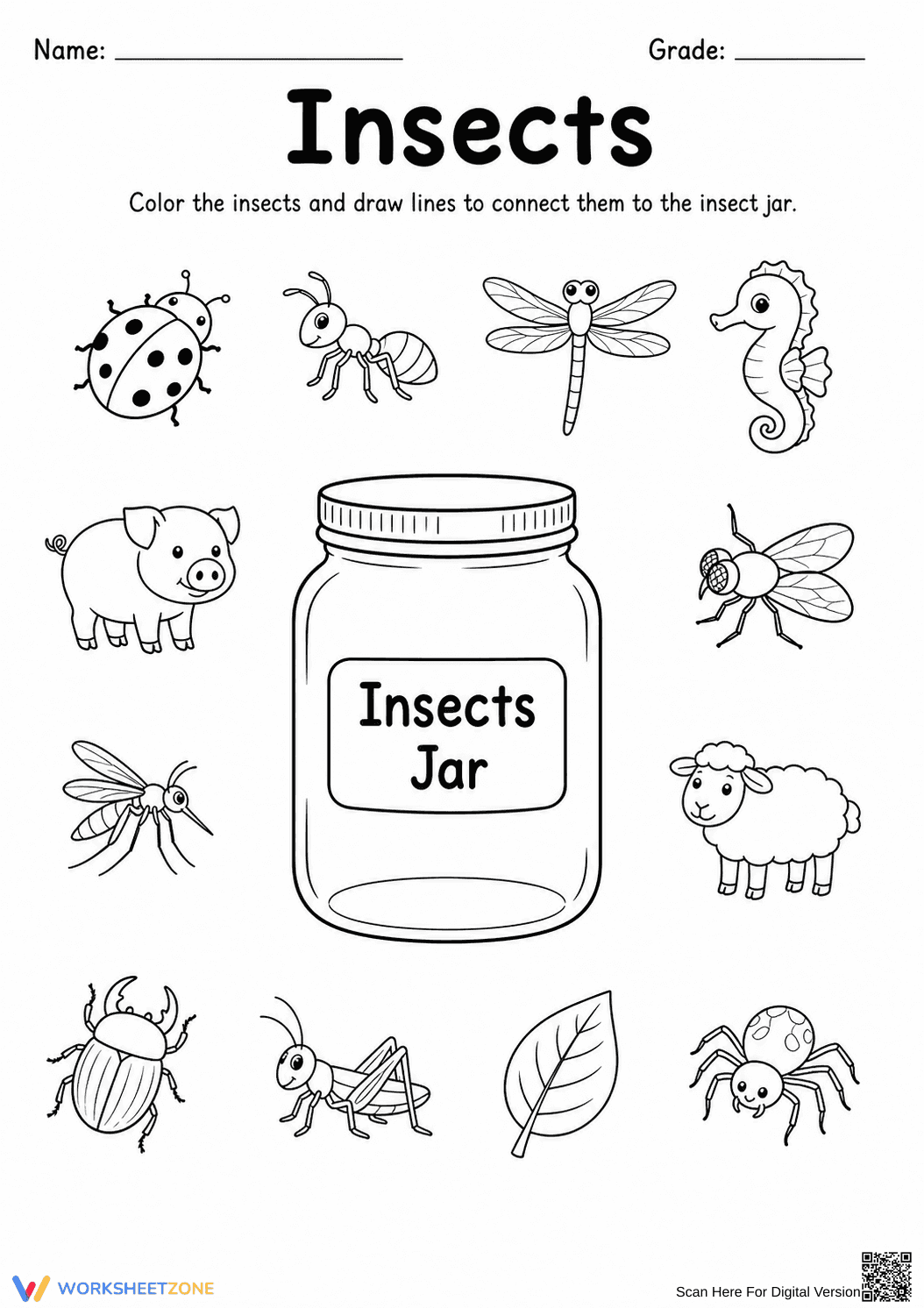
This Kindergarten science worksheet helps young learners identify and classify living things by distinguishing insects from other animals. Students observe physical characteristics to sort 12 different creatures, reinforcing foundational biological concepts through engaging visual practice. It is a perfect tool for developing early observation skills and scientific vocabulary in an interactive, hands-on format.
At a Glance
- Grade: PK–1 · Subject: Science
- Standard:
K-LS1-1— Use observations to describe patterns of what animals need and how they look- Skill Focus: Insect identification and biological classification
- Format: 1 page · 12 tasks · Answer key included · PDF
- Best For: Early science centers and sub plans
- Time: 10–15 minutes
What's Inside
This single-page PDF features a central "Insects Jar" surrounded by 12 distinct illustrations, including ladybugs, ants, seahorses, and sheep. The activity includes clear, student-friendly instructions that guide learners to color valid insects and draw lines to "capture" them in the jar. A complete answer key is provided to ensure quick and accurate grading or self-correction.
Zero-Prep Workflow
This resource is designed for a quick classroom experience. Educators can move from discovery to distribution in under two minutes: simply print the required number of copies and hand them out during a life science unit. The self-contained nature of the tasks makes it an ideal "grab-and-go" option for substitute teachers or as a quiet morning-work activity that requires no additional materials besides crayons and pencils.
Standards Alignment
The activity is aligned to K-LS1-1, which requires students to use observations to describe patterns in the natural world. By requiring learners to distinguish between insects and non-insects based on observable traits, it builds the prerequisite knowledge for more complex taxonomic studies. This standard code can be copied directly into lesson plans, IEP goals, or district curriculum mapping tools.
How to Use It
Introduce the activity during a direct instruction lesson on "Living Things" to verify student understanding of insect characteristics. For a formative assessment moment, observe whether students correctly identify the "distractors" like the seahorse or the sheep, as this reveals their grasp of defining biological traits. Expected completion time is approximately 15 minutes, making it perfect for independent station rotations.
Who It's For
Designed for Preschool, Kindergarten, and Grade 1 students, this worksheet is particularly effective for English Language Learners (ELL) due to its heavy reliance on visual cues rather than dense text. It pairs naturally with an insect-themed anchor chart or a reading of a non-fiction text about bugs to provide a comprehensive, multi-modal learning experience.
According to the RAND AIRS 2024 report on early childhood science education, structured visual classification tasks are critical for developing cognitive schemas in young learners. This Insects Jar worksheet aligns with best practices in biological science instruction by encouraging active observation and pattern recognition—skills that NAEP identifies as fundamental to scientific literacy. By isolating the specific skill of insect identification through a "sort-and-match" methodology, the resource provides the repetitive exposure necessary for long-term retention of scientific concepts. Research from Fisher & Frey (2014) supports this gradual release of responsibility, where simple identification tasks serve as the bridge to higher-order ecological analysis. This worksheet ensures students meet the K-LS1-1 standard through evidence-based design and classroom-tested engagement strategies suitable for various educational settings.


