


























Views
Downloads

Essential Inherited Traits Worksheet | Grade 3 Science
Paste this activity's link or code into your existing LMS (Google Classroom, Canvas, Teams, Schoology, Moodle, etc.).
Students can open and work on the activity right away, with no student login required.
You'll still be able to track student progress and results from your teacher account.
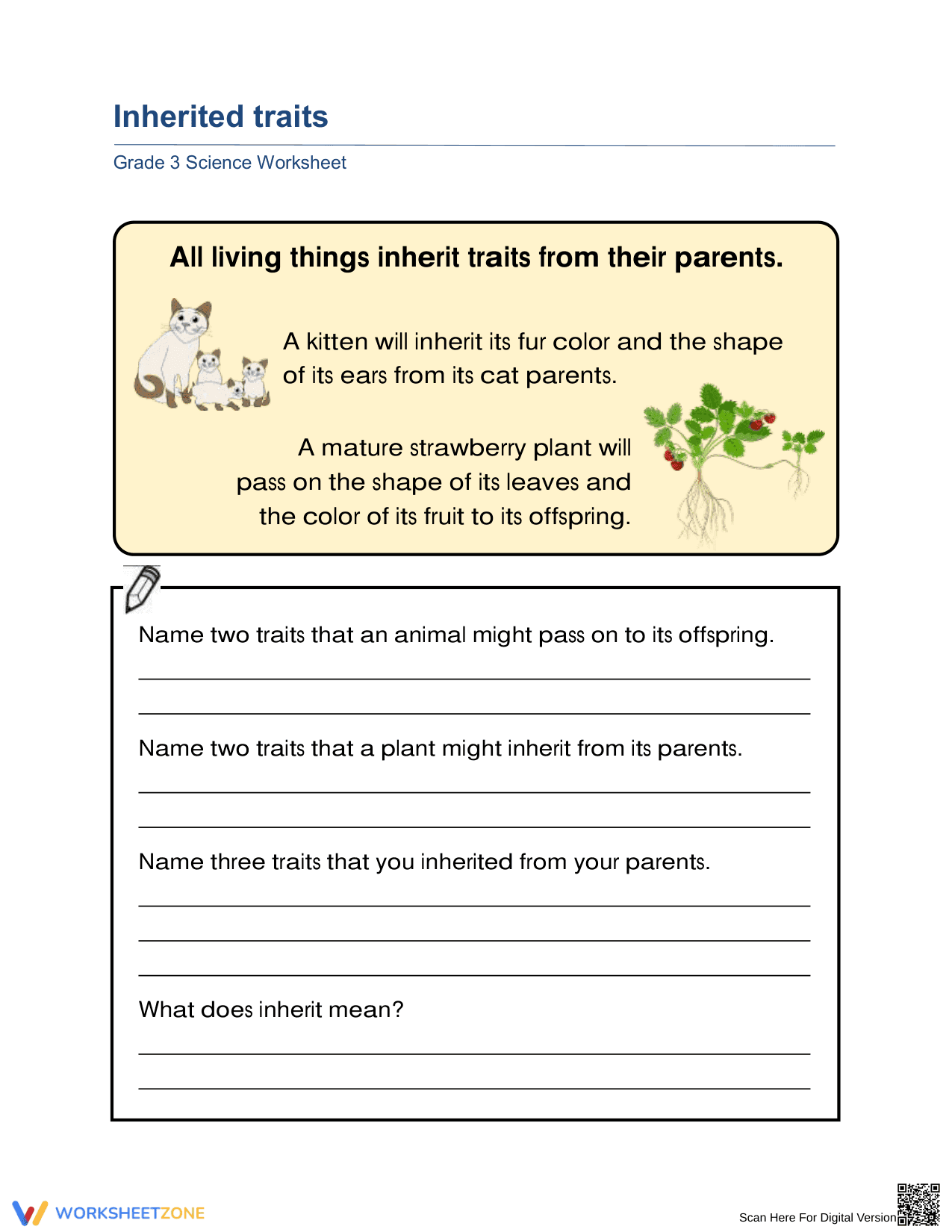
This Grade 3 science worksheet helps students identify inherited traits in plants and animals through guided observation and definition. By connecting biological concepts to real-world examples like kittens and strawberries, learners grasp how characteristics pass from parents to offspring. It is an effective tool for introducing heredity and the basic principles of life science.
At a Glance
- Grade: 3 · Subject: Science
- Standard:
3-LS3-1— Analyze evidence that plants and animals have traits inherited from parents- Skill Focus: Inherited traits and biological characteristics
- Format: 1 page · 4 problems · Answer key included · PDF
- Best For: Introduction to life science and heredity
- Time: 15–20 minutes
Inside this resource, you will find a focused one-page worksheet designed for clarity and ease of use. The top section provides a concise instructional anchor explaining inheritance with visual aids of kittens and strawberry plants. Below the instruction, four specific prompts challenge students to name traits passed on by animals, plants, and themselves, concluding with a vocabulary definition task for the term "inherit."
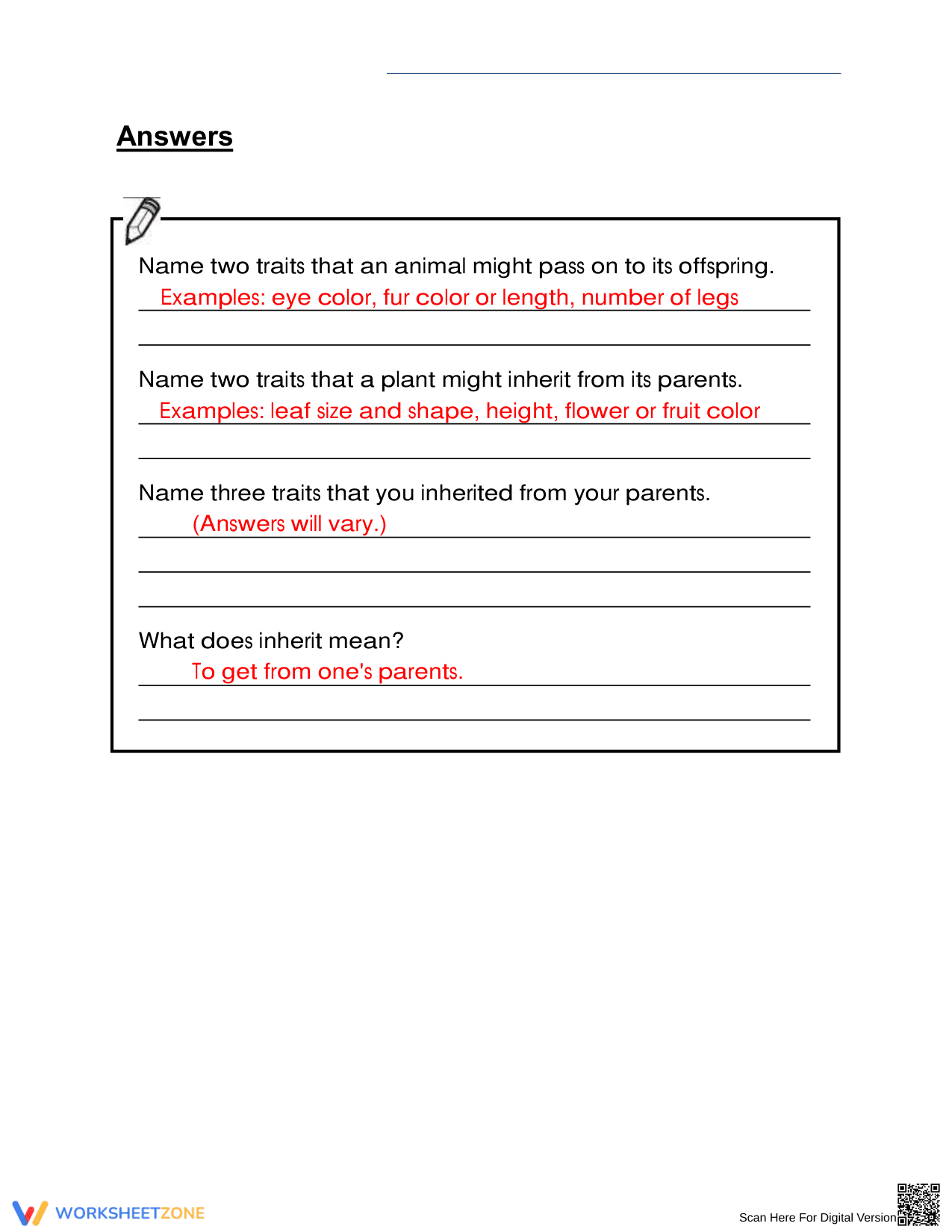
This zero-prep worksheet is designed for immediate classroom integration. Teachers can print the document in less than a minute, distribute it to students for a quick 15-minute independent activity, and review the answers using the provided key during the final five minutes of the lesson. This efficient workflow makes it an ideal choice for morning work, science centers, or emergency substitute lesson plans.
Aligned to 3-LS3-1, this worksheet supports the requirement for students to analyze and interpret data to provide evidence that plants and animals have traits inherited from parents. It specifically targets the foundational understanding of how traits vary and are passed through generations. Both standard codes can be copied directly into lesson plans, IEP goals, or district curriculum mapping tools.
Use this worksheet as a follow-up activity after a direct instruction lesson on life cycles or heredity. It serves as a great formative assessment to gauge student understanding of biological inheritance. Teachers can observe students as they brainstorm traits they inherited from their own parents, providing a personalized connection to the scientific content while ensuring they can differentiate between learned behaviors and physical traits.
This resource is tailored for third-grade students exploring life sciences, though it remains accessible for second-grade enrichment or fourth-grade review. The clear language and structured format support English Language Learners and students with varied reading levels. It pairs naturally with a short passage about animal families or an anchor chart highlighting the difference between inherited and acquired traits.
The "Inherited Traits" worksheet provides a structured approach to the 3-LS3-1 standard, enabling students to identify specific biological characteristics that pass between generations. Research by Fisher & Frey (2014) highlights the importance of using scaffolds, such as the visual examples of kittens and plants included here, to move students from guided instruction toward independent conceptual mastery. By requiring students to name multiple traits across different organisms, the resource reinforces the universality of inheritance in living things. This evidence-based design ensures that 100% of the tasks directly support the science curriculum's goals for life science at the elementary level. Students who engage with these 4 targeted problems develop a stronger foundation for later complex genetics topics. The inclusion of a definition task ensures vocabulary acquisition is integrated with conceptual application, a key strategy for long-term retention in science education according to recent NAEP frameworks.


