




























Views
Downloads
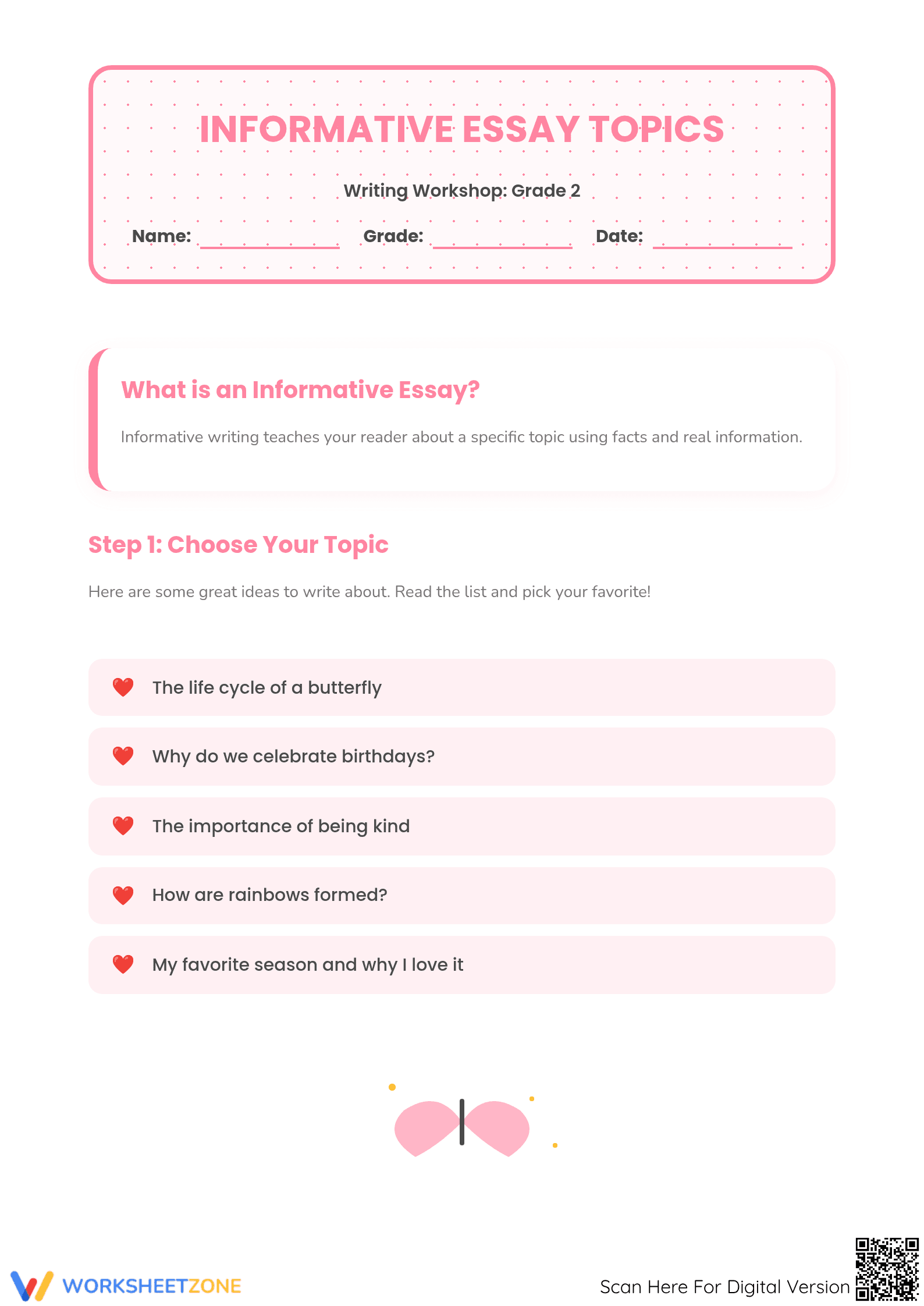



Informative Essay Topics Worksheet | Grade 2 Printable

Paste this activity's link or code into your existing LMS (Google Classroom, Canvas, Teams, Schoology, Moodle, etc.).
Students can open and work on the activity right away, with no student login required.
You'll still be able to track student progress and results from your teacher account.
This Grade 2 informative essay worksheet guides young writers through the foundational steps of nonfiction writing. By breaking down the writing process into manageable chunks, students successfully choose a topic, brainstorm supporting facts, and begin drafting their introductory sentences with confidence and clarity.
At a Glance
- Grade: 2 · Subject: English
- Standard:
CCSS.ELA-LITERACY.W.2.2— Write informative texts introducing a topic and using facts.- Skill Focus: Informative Essay Structure
- Format: 3 pages · 4 tasks · No answer key · PDF
- Best For: Writing workshop graphic organizer
- Time: 25–35 minutes
This three-page printable includes five engaging topics, a brainstorming graphic organizer for three facts, an illustration panel, and a lined drafting section. The structured layout provides ample writing space, eliminating the need for separate rough draft paper.
Skill Progression
- Guided practice: Students review informative writing and select one of five provided topics.
- Supported practice: The second page prompts learners to generate three specific facts about their chosen topic, scaffolding the research phase.
- Independent practice: Students synthesize ideas by drawing an illustration and independently drafting the first two sentences.
This gradual-release approach ensures students build momentum, following a clear I Do, We Do, You Do methodology.
Standards Alignment
Aligned to CCSS.ELA-LITERACY.W.2.2: Write informative/explanatory texts in which they introduce a topic, use facts and definitions to develop points, and provide a concluding statement or section. This resource specifically targets the introduction and fact-development phases of the standard. Both standard codes can be copied directly into lesson plans, IEP goals, or district curriculum mapping tools.
How to Use It
Deploy this resource during the pre-writing phase of a nonfiction unit. It works well as a whole-class activity where the teacher models selecting a topic on an anchor chart. Alternatively, use it in small groups for students who struggle with topic generation. As a formative assessment observation tip, monitor the brainstorming section to ensure students write factual statements rather than opinions. Expect completion to take 25 to 35 minutes.
Who It's For
This worksheet is designed for second-grade students developing composition skills. The step-by-step scaffolding makes it effective for reluctant writers who benefit from chunked assignments. Pair this resource with a nonfiction mentor text so students have immediate access to facts they can incorporate into their brainstorming graphic organizer.
Mastering early composition requires explicit instruction in planning and organization. According to Fisher & Frey (2014), providing structured graphic organizers during the pre-writing phase significantly reduces cognitive load, allowing young writers to focus on content generation rather than formatting. This resource directly supports CCSS.ELA-LITERACY.W.2.2 by helping students write informative texts introducing a topic and using facts. By breaking the essay into distinct steps—topic selection, fact brainstorming, visual representation, and initial drafting—educators can prevent the common paralysis associated with blank-page writing assignments. Early intervention in organizational strategies builds the stamina required for more complex explanatory writing in upper elementary grades. When second graders practice isolating facts from opinions and structuring those facts logically, they develop a systematic approach to communicating factual information effectively across all academic disciplines.


