


























Views
Plays
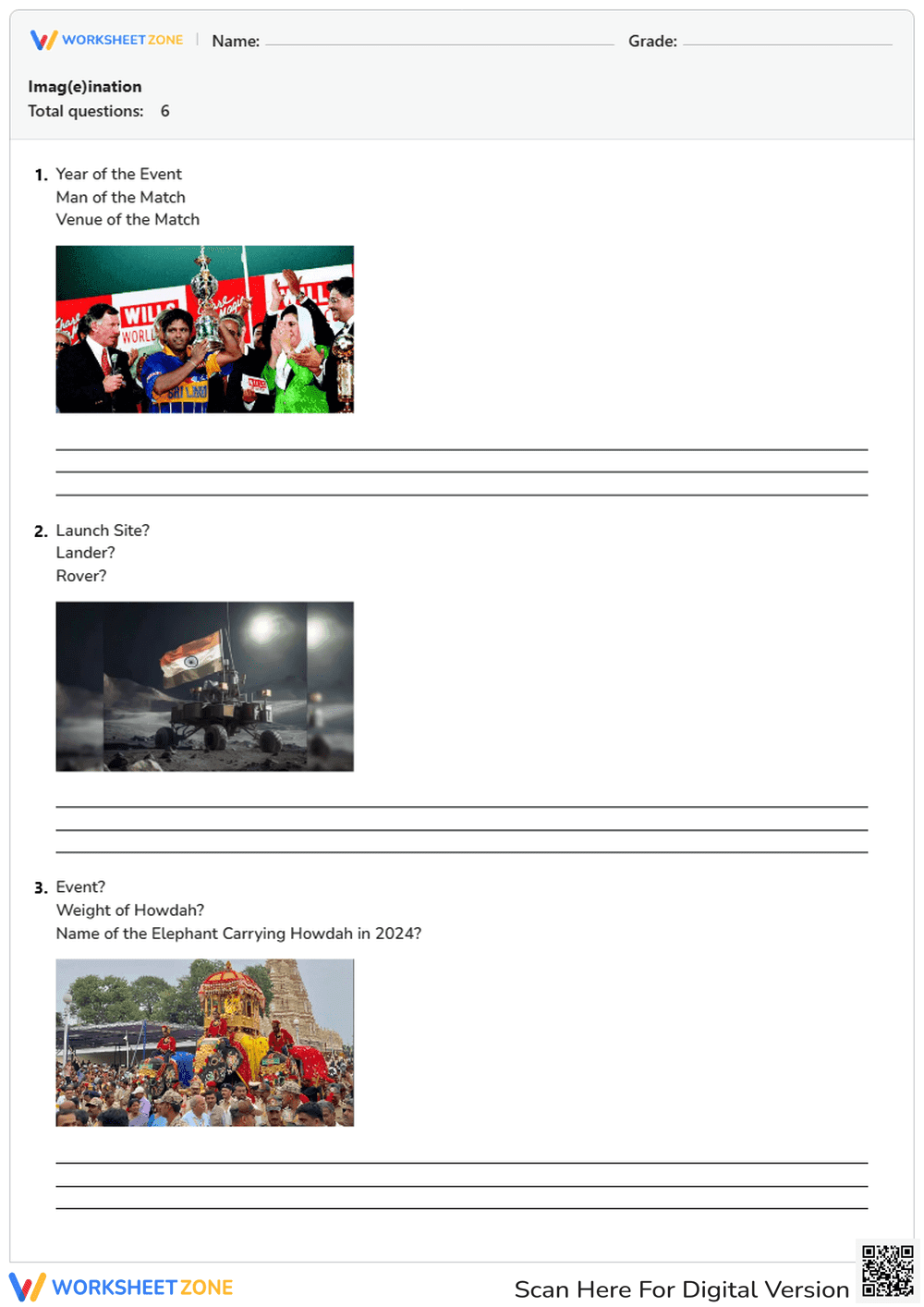


Imag(e)ination Geography Worksheet | Grade 3 Essential
Paste this activity's link or code into your existing LMS (Google Classroom, Canvas, Teams, Schoology, Moodle, etc.).
Students can open and work on the activity right away, with no student login required.
You'll still be able to track student progress and results from your teacher account.
This Grade 3 geography and social studies worksheet uses high-quality visual prompts to build critical thinking and global awareness. Students analyze six distinct images ranging from historical sports moments to international landmarks, answering specific questions to demonstrate their understanding of cultural and geographical contexts. It is an effective tool for developing visual literacy and research skills.
At a Glance
- Grade: 3 · Subject: Social Studies
- Standard:
CCSS.ELA-LITERACY.RI.3.7— Use information gained from illustrations to demonstrate understanding of the text- Skill Focus: Visual Analysis & Cultural Literacy
- Format: 3 pages · 18 problems · Answer key included · PDF
- Best For: Independent research or social studies centers
- Time: 25–35 minutes
What's Inside: This three-page PDF features six primary image-based prompts. Each prompt includes three targeted questions that require students to identify specific details such as locations, historical dates, and cultural significance. The layout provides ample writing space for student responses, and the diverse range of topics—including space exploration, world landmarks, and wildlife—ensures high student engagement across different interest areas.
Zero-Prep Workflow: This resource is designed for immediate classroom implementation. First, print the three-page document (1 minute). Second, distribute the sheets to students as a standalone activity or a guided research task (1 minute). Third, review the answers using the provided key to facilitate a class discussion on global diversity (5 minutes). This workflow requires less than two minutes of teacher preparation time, making it an ideal choice for busy educators or emergency sub plans.
Standards Alignment: This worksheet is primarily aligned with `CCSS.ELA-LITERACY.RI.3.7`, which requires students to use information gained from illustrations (e.g., maps, photographs) and the words in a text to demonstrate understanding of where, when, why, and how key events occur. By requiring students to extract specific data from visual cues, the activity reinforces evidence-based reasoning. This standard code can be copied directly into lesson plans, IEP goals, or district curriculum mapping tools.
How to Use It: This worksheet is best utilized during the "independent practice" phase of a geography unit. It serves as an excellent formative assessment to gauge how well students can synthesize visual information. Alternatively, use it as a "Mystery Image" bell ringer where students research one image per day. Expected completion time for the full set is approximately 30 minutes, depending on whether students have access to reference materials for the more specific historical questions.
Who It's For: This resource is tailored for Grade 3 students but is highly adaptable for Grade 4 or Grade 2 enrichment. It is particularly beneficial for visual learners who struggle with dense text-based social studies materials. It pairs naturally with a world atlas or a digital mapping tool, allowing students to locate the countries mentioned, such as Brazil, India, and Sri Lanka, on a physical map.
According to research by Fisher & Frey (2014), visual literacy is a foundational component of modern comprehension, as students must learn to decode non-linguistic representations to achieve full content mastery. This worksheet addresses this need by presenting 18 specific tasks that bridge the gap between simple observation and academic inquiry. By engaging with the `CCSS.ELA-LITERACY.RI.3.7` standard through diverse imagery—including the Christ the Redeemer statue and space exploration rovers—students develop the ability to quote visual evidence accurately. This approach is supported by the NAEP framework, which emphasizes the importance of interpreting diverse media in social studies. The structured format ensures that students remain focused on factual extraction while building a broader schema of global events and landmarks. This resource provides a reliable method for teachers to document student progress in visual analysis and informational text standards within a compact, printable format.


