


























Views
Downloads

Identifying Action Verbs Worksheet | Grade 2-3 Essential
Paste this activity's link or code into your existing LMS (Google Classroom, Canvas, Teams, Schoology, Moodle, etc.).
Students can open and work on the activity right away, with no student login required.
You'll still be able to track student progress and results from your teacher account.
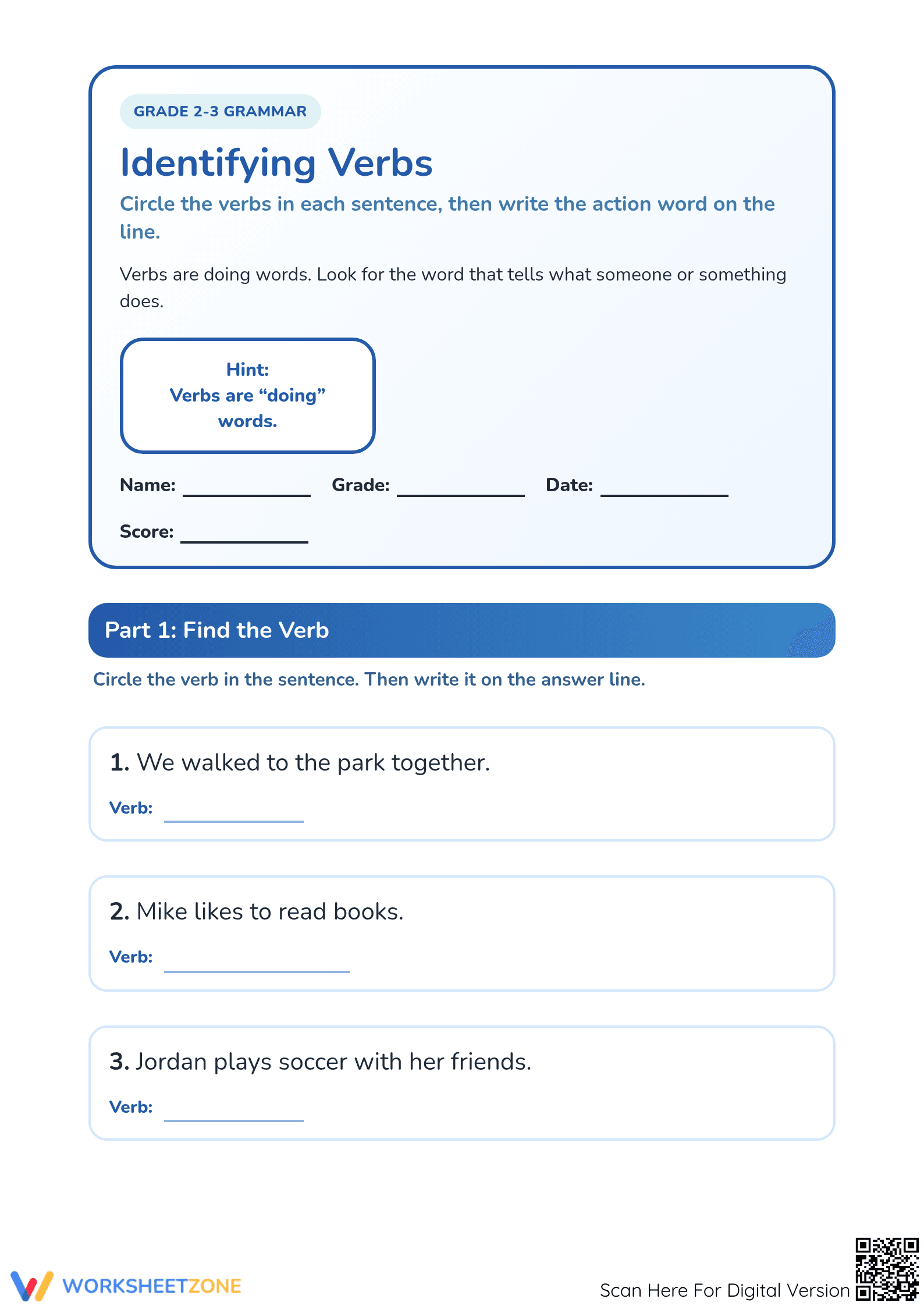
Students master the core concept of "doing words" with this comprehensive action verb practice set. By identifying verbs within context and applying them in original sentences, learners build the grammatical foundation necessary for clear communication. This resource ensures students can distinguish between subjects and actions with high accuracy.
At a Glance
- Grade: 2-3 · Subject: ELA Grammar
- Standard:
CCSS.ELA-LITERACY.L.2.1— Demonstrate command of standard English grammar and identify verbs- Skill Focus: Action verb identification
- Format: 3 pages · 13 problems · Answer key included · PDF
- Best For: Independent practice and formative assessment
- Time: 15–20 minutes
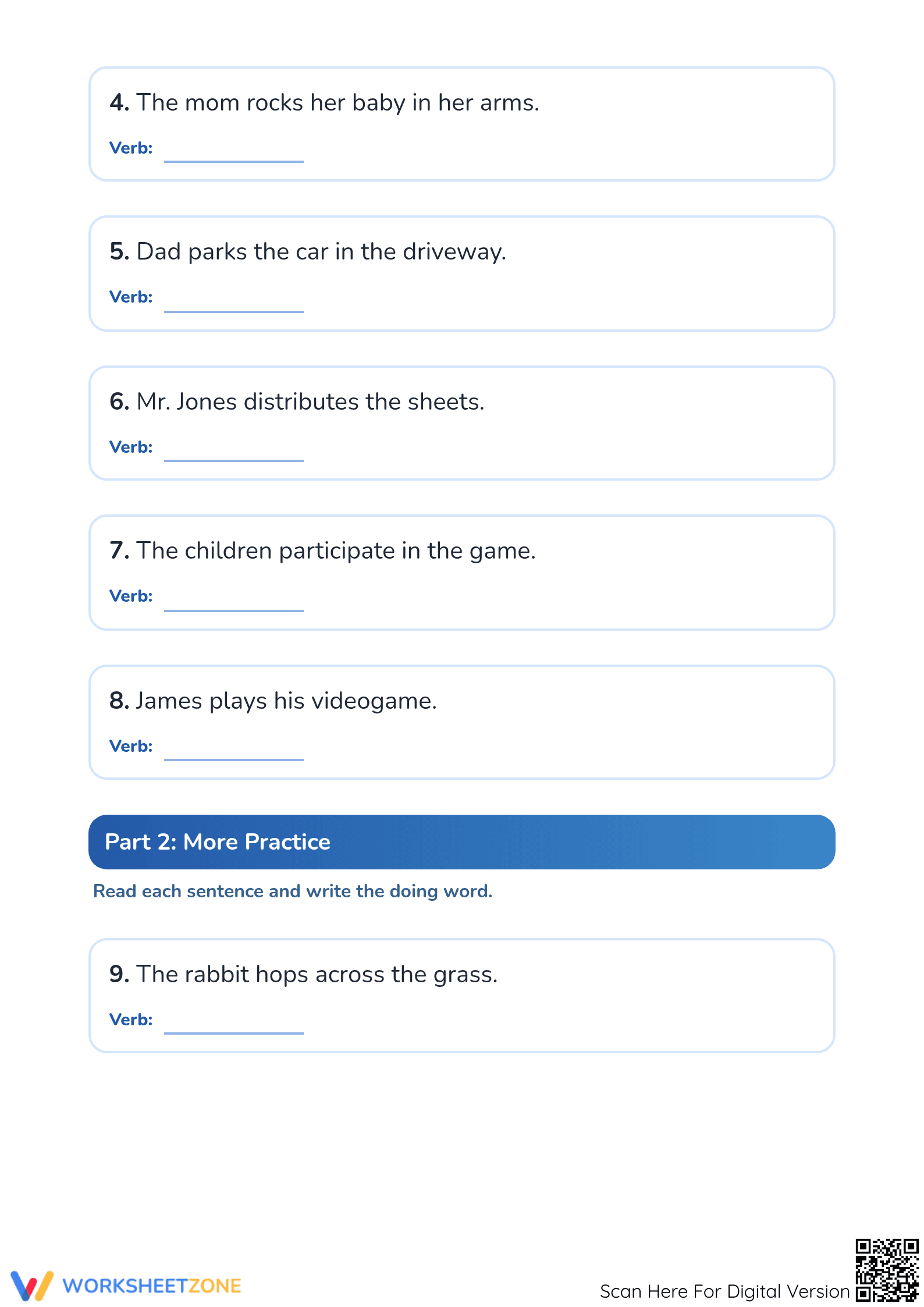
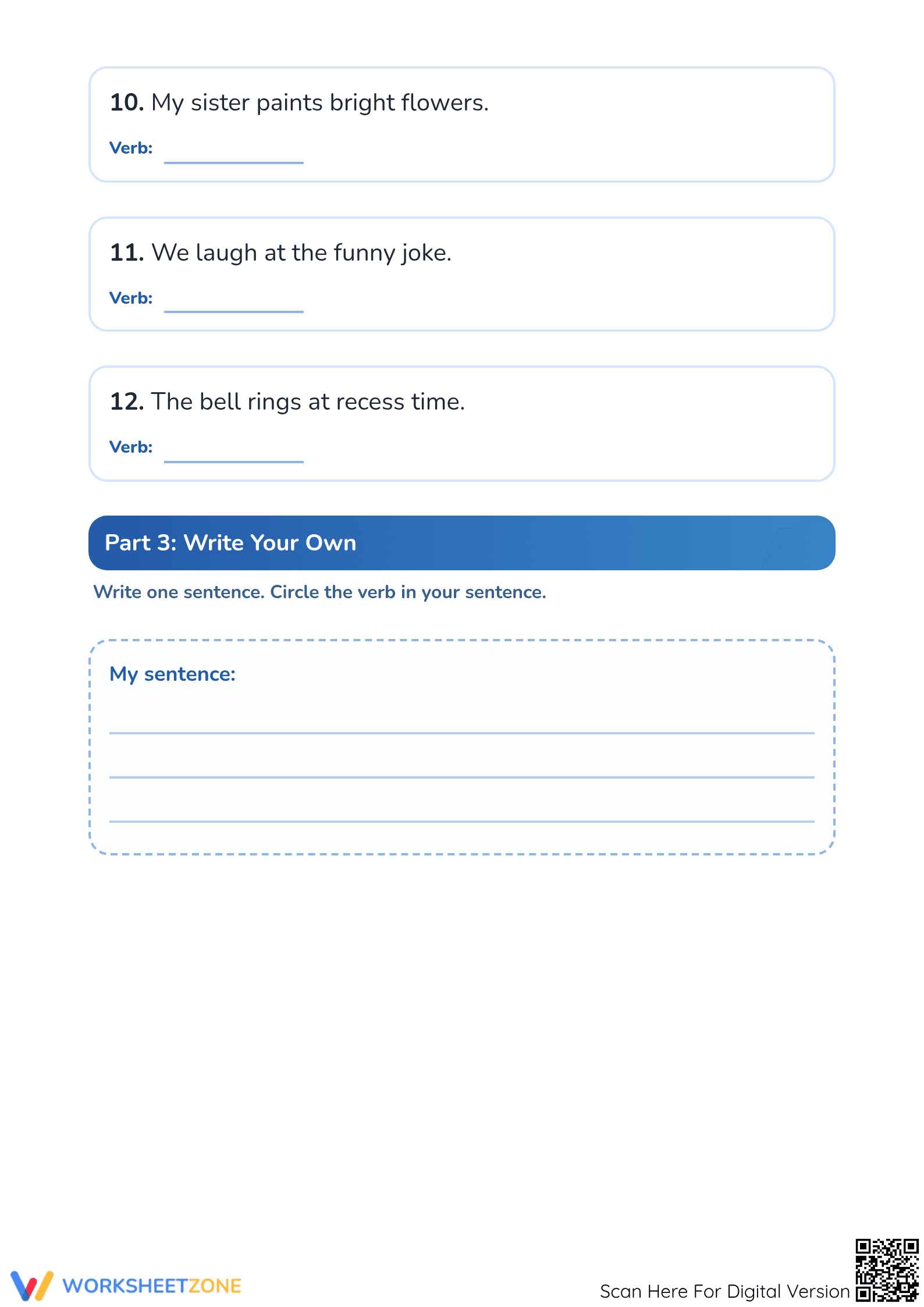
This 3-page PDF contains 12 structured sentence-based problems and one open-ended writing prompt. Each identification task requires students to circle the verb and then transcribe it onto a dedicated answer line, reinforcing spelling and recognition. The final page includes a "Write Your Own" section where students apply their knowledge by composing an original sentence and self-identifying the action word.
The zero-prep workflow for this resource is designed for maximum efficiency in busy classrooms. First, print the pages needed and copy for your roster in under 30 seconds. Second, distribute the worksheets as a bell-ringer or during your grammar block. Third, use the included answer key for rapid grading or peer-review sessions. Total teacher preparation time is under 2 minutes, making this an ideal solution for unexpected sub plans or quick reinforcement.
This resource aligns primarily with `CCSS.ELA-LITERACY.L.2.1`, which requires students to demonstrate command of the conventions of standard English grammar and usage. Specifically, it targets the ability to identify and use verbs correctly within the structure of a sentence. It also supports `CCSS.ELA-LITERACY.L.3.1.A`, which focuses on explaining the function of nouns, pronouns, verbs, adjectives, and adverbs in general. Both standard codes can be copied directly into lesson plans, IEP goals, or district curriculum mapping tools.
Use this worksheet during the "You Do" phase of a gradual release lesson on parts of speech. After introducing verbs as "doing words," assign the first page as guided practice. The second and third pages serve as an excellent formative assessment to check for individual mastery. Teachers should observe if students are mistakenly circling nouns or adjectives, which provides a clear signal for immediate corrective feedback. Completion typically takes 15 to 20 minutes.
This resource is designed for second and third-grade students who are beginning to categorize parts of speech. It is particularly effective for English Language Learners (ELLs) who benefit from the repetitive structure and clear "Hint" box provided on the first page. Pair this worksheet with a verb-focused anchor chart or a short reading passage where students can hunt for additional action words.
According to the RAND AIRS 2024 report, structured grammar practice that combines identification with application significantly improves long-term retention of linguistic conventions. This worksheet utilizes a dual-response method—circling and writing—to engage multiple cognitive pathways. By focusing on CCSS.ELA-LITERACY.L.2.1, the material ensures that students are meeting national benchmarks for Grade 2 and Grade 3 literacy. Research from Fisher & Frey (2014) emphasizes that the gradual release of responsibility, moving from guided identification to independent sentence construction, is the most effective way to foster student agency in writing. This 3-page resource provides exactly that progression, ensuring that the 13 tasks lead to measurable skill acquisition. Educators can rely on this evidence-based approach to bridge the gap between recognizing a part of speech and using it fluently in original compositions, which is a critical milestone in elementary ELA development.


