


























Views
Downloads

Printable Identifying Rhymes Worksheet: Grades 1-3 Phonics
Paste this activity's link or code into your existing LMS (Google Classroom, Canvas, Teams, Schoology, Moodle, etc.).
Students can open and work on the activity right away, with no student login required.
You'll still be able to track student progress and results from your teacher account.
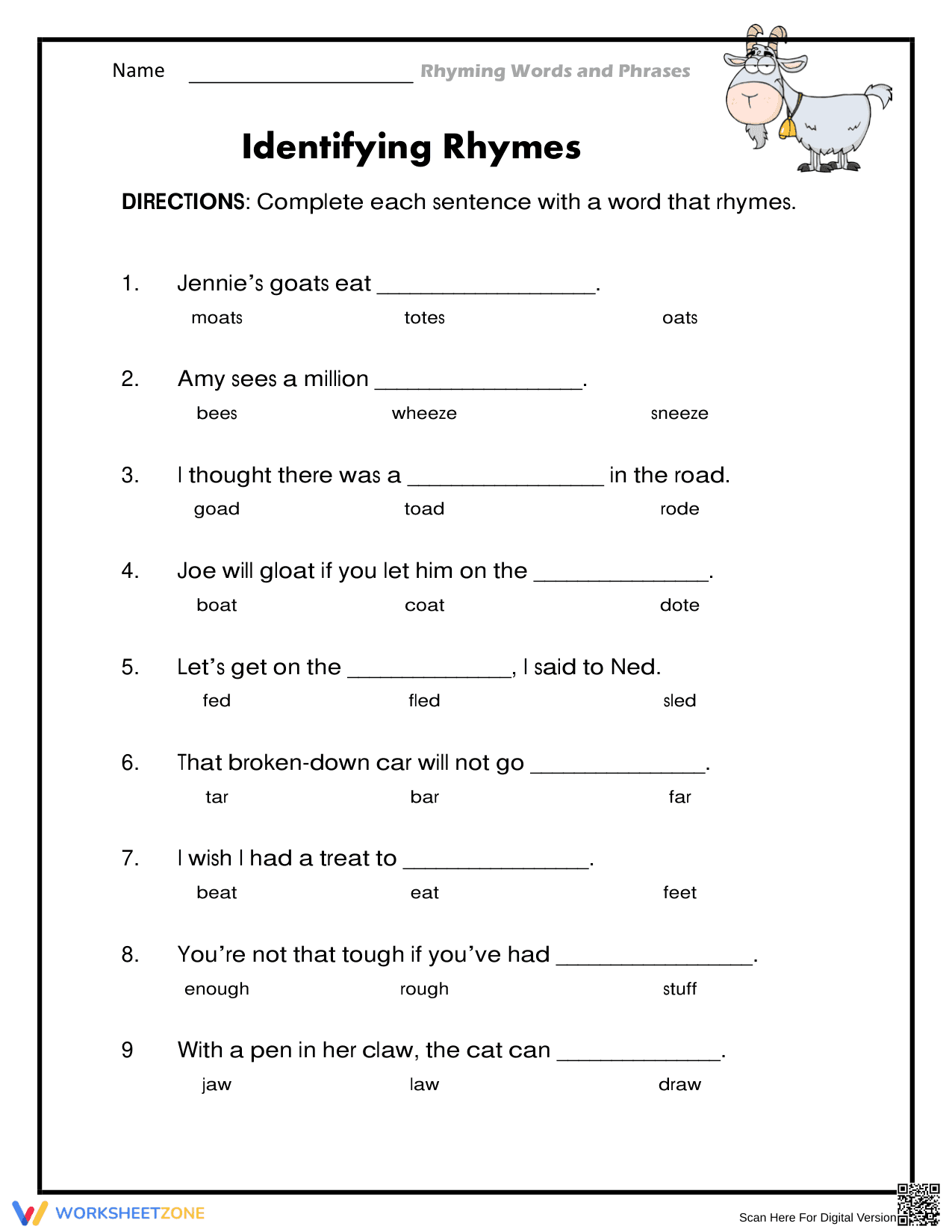
This Identifying Rhymes worksheet helps students in Grades 1 through 3 master phonological awareness by selecting words that rhyme within a sentence context. By choosing from multiple options to complete sentences, learners strengthen their ability to recognize sound patterns and improve reading fluency. This engaging activity ensures students develop a deep understanding of word relationships.
At a Glance
- Grade: 1-3 · Subject: ELA
- Standard:
CCSS.ELA-LITERACY.RF.1.2— Demonstrate understanding of spoken words, syllables, and sounds.- Skill Focus: Identifying rhyming words
- Format: 1 page · 9 problems · Answer key included · PDF
- Best For: Independent phonics practice and literacy centers
- Time: 10–15 minutes
The worksheet features nine carefully crafted sentences, each requiring a rhyming word to complete the thought. Students are provided with three multiple-choice options for each sentence, such as choosing between "moats," "totes," and "oats" to rhyme with "goats." This single-page PDF includes a clear layout, a playful goat illustration, and a corresponding answer key for quick evaluation.
The zero-prep design allows teachers to implement this activity in under two minutes. Simply print the single-page document and distribute it to students for immediate engagement. Because the instructions are self-explanatory, students can work through the nine problems independently, making it an ideal choice for emergency sub plans, morning work, or quick formative assessments during literacy rotations.
This resource is primary aligned to CCSS.ELA-LITERACY.RF.1.2, which requires students to demonstrate an understanding of spoken words, syllables, and sounds. Specifically, it targets the ability to recognize and produce rhyming words within a functional sentence structure. This standard code can be copied directly into lesson plans, IEP goals, or district curriculum mapping tools to track student progress.
Incorporate this worksheet during the independent practice phase of a phonics lesson after reviewing common rhyming patterns. It also serves as an excellent formative assessment tool; observe if students are reading the sentences aloud to hear the rhyme or relying purely on visual cues. The expected completion time is 10 to 15 minutes, depending on the student's reading level.
This activity is designed for first, second, and third-grade students who need targeted practice with phonemic awareness. It is particularly effective for English Language Learners (ELLs) who are developing their ear for English vowel sounds. Pair this worksheet with a rhyming picture book or an anchor chart displaying common word families to provide additional scaffolding for struggling readers.
The systematic identification of rhyming words is a cornerstone of early literacy development, as established in the RAND AIRS 2024 report on foundational reading skills. By requiring students to select the correct phonological match within a sentence, this CCSS.ELA-LITERACY.RF.1.2 aligned resource moves beyond rote memorization into applied language use. Research from Fisher & Frey (2014) emphasizes that rhyming awareness is a high-yield predictor of later reading success, and providing structured, multiple-choice opportunities like these nine tasks reduces cognitive load for early learners. This worksheet allows educators to gather actionable data on student mastery of word families and sound-symbol relationships. It is an essential tool for any Grade 1-3 classroom focused on building robust phonics foundations and ensuring that every student can accurately identify rhymes in various contexts.


