


























Views
Downloads

Printable Letter I Beginning Sound Worksheet | Grade K
Paste this activity's link or code into your existing LMS (Google Classroom, Canvas, Teams, Schoology, Moodle, etc.).
Students can open and work on the activity right away, with no student login required.
You'll still be able to track student progress and results from your teacher account.
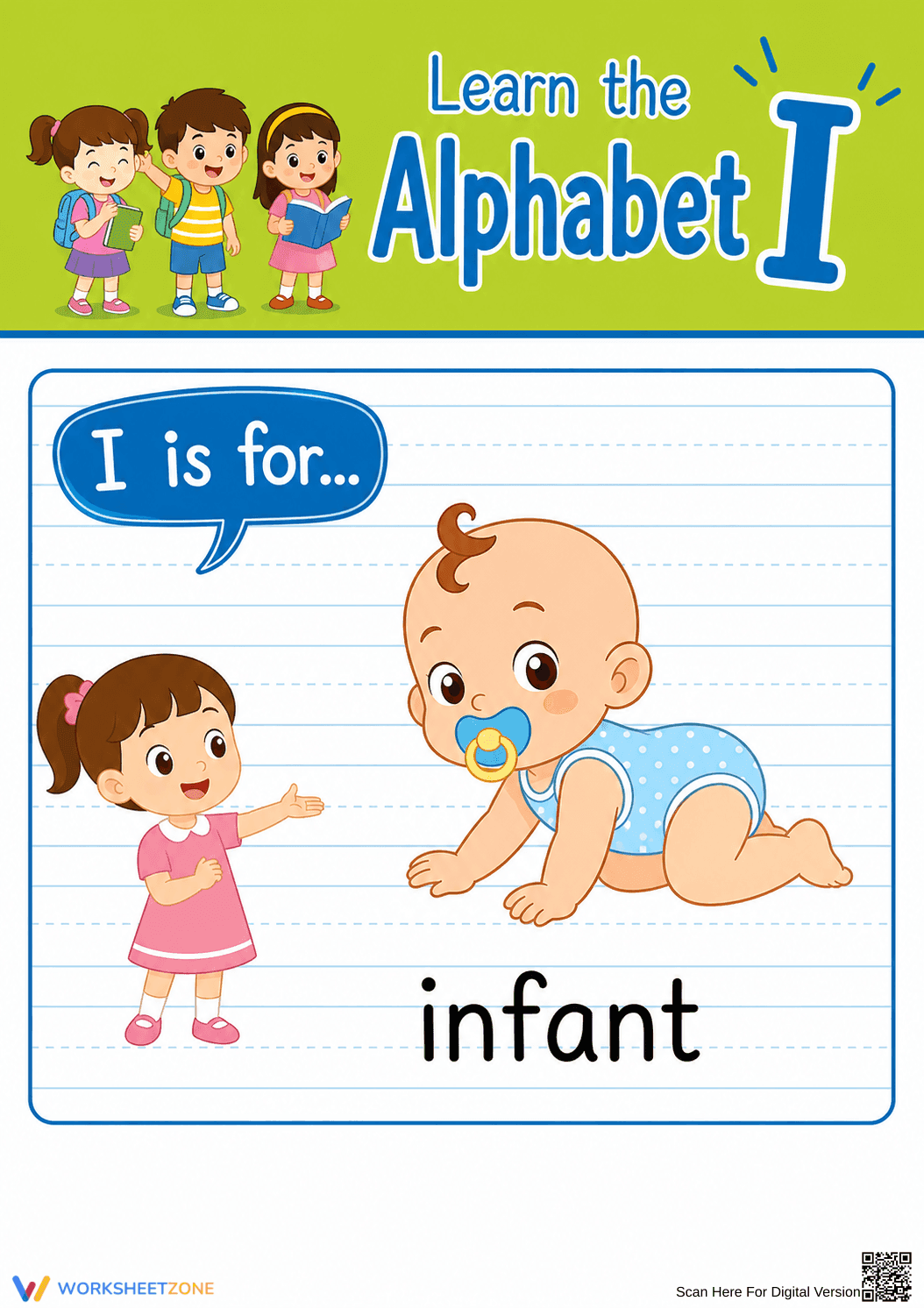
This printable Kindergarten phonics worksheet introduces early readers to the short vowel sound of the letter I. By connecting the visual letter to the familiar word "infant," students build foundational phonemic awareness and letter-sound correspondence. Use this clear, engaging visual aid to reinforce beginning sounds in your early literacy curriculum.
At a Glance
- Grade: K · Subject: ELA
- Standard:
CCSS.ELA-LITERACY.RF.K.3.B— Associate short vowel sounds with common spellings- Skill Focus: Letter I Beginning Sound
- Format: 1 page · 1 visual task · No answer key needed · PDF
- Best For: Whole group phonics introduction
- Time: 5–10 minutes
Inside this single-page resource, teachers will find a vibrant, full-color visual poster or introductory worksheet focused on the letter I. The page features clear, primary-friendly typography displaying both uppercase and lowercase letter forms, alongside an engaging illustration of an infant. A speech bubble explicitly connects the letter to the target word, providing a strong visual scaffold for early readers learning to isolate initial phonemes.
Zero-Prep Workflow
Designed for immediate classroom application:
- Print (1 minute): Simply download the PDF and print in color or display directly on a smartboard.
- Distribute (1 minute): Hand out to students as a reference sheet or post it at a literacy center.
- Review (3 minutes): Guide students through choral reading of the text and practice isolating the short /i/ sound.
With under two minutes of total prep time, this material is highly suitable for emergency sub plans or quick phonics mini-lessons.
Standards Alignment
This resource aligns directly with CCSS.ELA-LITERACY.RF.K.3.B, requiring students to associate the long and short sounds with the common spellings (graphemes) for the five major vowels. By isolating the initial short /i/ sound in "infant," early learners practice critical phonemic decoding skills. Both standard codes can be copied directly into lesson plans, IEP goals, or district curriculum mapping tools.
How to Use It
This visual worksheet functions perfectly during direct instruction as an anchor chart or introductory focal point for a "Letter of the Week" routine. Alternatively, place it in an independent literacy center where students can reference the image while sorting objects by their beginning sounds. As a formative assessment observation tip, ask individual students to point to the letter I and produce its short vowel sound before transitioning to the next activity. Expected completion time is a brief 5 to 10 minutes.
Who It's For
This material is primarily designed for Kindergarten students developing basic phonemic awareness and letter recognition. It also serves as an excellent review tool for first-grade students or English Language Learners needing visual vocabulary support. For differentiation, pair this visual aid with tactile letter-tracing activities or a direct instruction lesson on short vowel sounds to support multisensory learning.
Effective phonics instruction relies on clear visual anchors connecting abstract graphemes to familiar vocabulary. According to Fisher & Frey (2014), providing students with explicit visual scaffolds significantly increases their ability to retain and retrieve foundational literacy skills. This resource directly supports CCSS.ELA-LITERACY.RF.K.3.B by helping early learners associate short vowel sounds with common spellings. By isolating the beginning sound of the letter I through the word "infant," educators can facilitate stronger phonemic awareness and decoding automaticity. Consistent exposure to targeted letter-sound correspondences in early childhood settings builds the necessary cognitive pathways for fluent reading. Such visually engaging materials ensure young learners successfully map spoken sounds to written text.


