


























Views
Downloads

Printable Letter I Beginning Sound Worksheet | Grade K
Paste this activity's link or code into your existing LMS (Google Classroom, Canvas, Teams, Schoology, Moodle, etc.).
Students can open and work on the activity right away, with no student login required.
You'll still be able to track student progress and results from your teacher account.
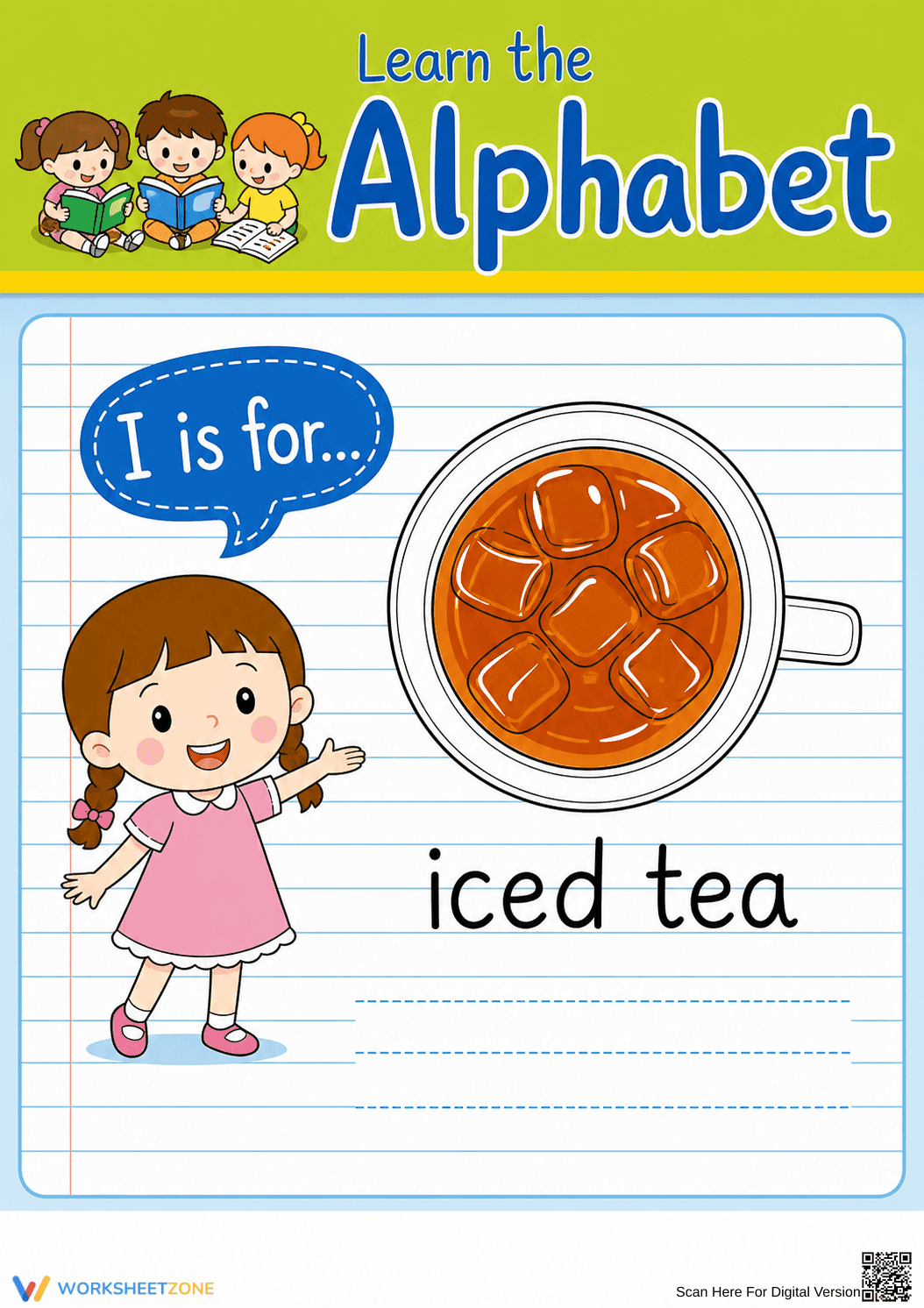
This foundational phonics worksheet helps early learners master the long vowel sound for the letter I. Students connect the visual representation of the letter with a familiar vocabulary word, "iced tea," while practicing proper letter formation on guided handwriting lines to build essential early literacy and fine motor skills.
At a Glance
- Grade: K · Subject: ELA
- Standard:
CCSS.ELA-LITERACY.RF.K.3.B— Associate long and short sounds with common vowel spellings- Skill Focus: Beginning Sounds & Letter Formation
- Format: 1 page · 1 handwriting task · No answer key needed · PDF
- Best For: Independent practice or morning work
- Time: 5–10 minutes
This single-page resource features a clear illustration of iced tea alongside the target vocabulary word to reinforce visual-auditory connections. The top section introduces the concept with friendly character graphics. The bottom section provides standard primary handwriting lines where students practice writing the target word or letter, supporting phonemic awareness and handwriting development.
Designed for immediate classroom implementation, this resource requires zero teacher preparation:
- Print (1 min): Download the PDF and print copies. The design ensures clear reproduction.
- Distribute (1 min): Hand out pages with pencils. The intuitive layout means students understand the task.
- Review (2 min): Circulate to check pencil grip and letter formation.
With total prep time under two minutes, this worksheet serves as an excellent sub plan or morning work activity.
This worksheet aligns directly with CCSS.ELA-LITERACY.RF.K.3.B: "Associate the long and short sounds with common spellings (graphemes) for the five major vowels." By focusing on the long "I" sound in "iced tea," students build crucial phonics foundations. It also supports basic print concepts and handwriting standards. Both standard codes can be copied directly into lesson plans, IEP goals, or district curriculum mapping tools.
Teachers can utilize this worksheet during morning arrival as a focused activity reinforcing the letter of the week. It also functions as an independent literacy center station after direct instruction. While students work, teachers should observe pencil grip and stroke order, offering immediate feedback. Expected completion time ranges from five to ten minutes.
This resource is designed for Kindergarten students developing early phonics and handwriting skills, though it serves as remedial practice for first graders. For differentiation, teachers can provide textured materials for tactile learners to trace large letters. This worksheet pairs naturally with a whole-group read-aloud or alphabet anchor chart.
Effective phonics instruction requires explicit connections between graphemes and phonemes, supported by immediate application in writing. This worksheet targets CCSS.ELA-LITERACY.RF.K.3.B, helping students associate long and short sounds with common vowel spellings. According to a recent RAND AIRS 2024 report on early literacy interventions, integrating handwriting practice directly with phonemic awareness tasks significantly increases letter-sound retention rates in primary grade students compared to isolated auditory drills. By combining the visual cue of the iced tea, the auditory reinforcement of the beginning sound, and the kinesthetic action of writing on guided lines, this resource provides a multimodal approach to alphabet mastery. Early childhood educators can rely on this structured, evidence-based format to build automaticity in letter recognition, which is a critical precursor to fluent decoding and reading comprehension in later grades.


