




























Views
Downloads
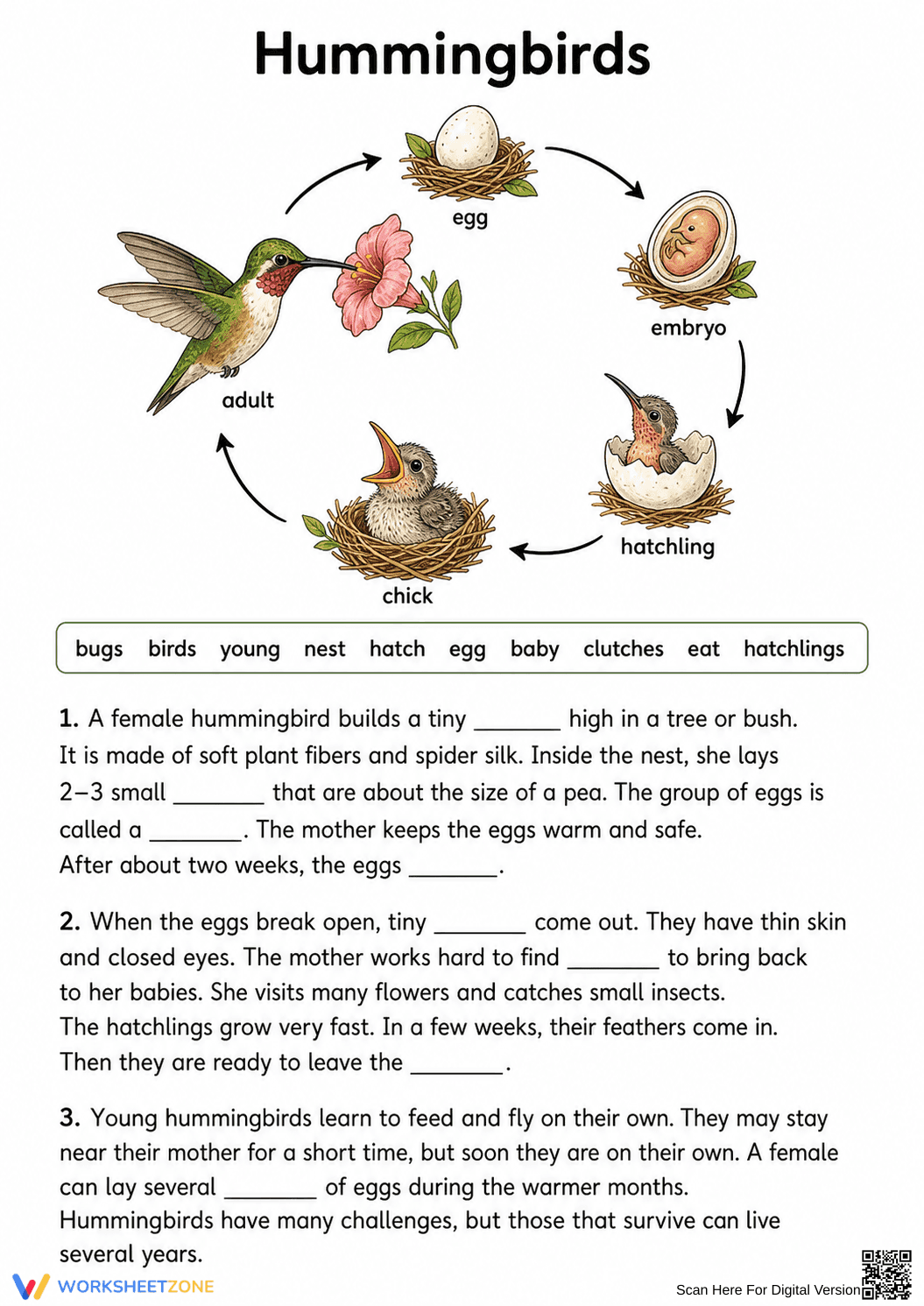

Grade 3 Hummingbird Life Cycle — Printable No-Prep Worksheet

Paste this activity's link or code into your existing LMS (Google Classroom, Canvas, Teams, Schoology, Moodle, etc.).
Students can open and work on the activity right away, with no student login required.
You'll still be able to track student progress and results from your teacher account.
This printable science worksheet helps Grade 3 students identify and describe the stages of a hummingbird's life cycle. By combining a clear visual diagram with a reading comprehension passage, learners connect scientific concepts to informational text to reinforce key vocabulary and biological processes.
At a Glance
- Grade: 3 · Subject: Science
- Standard:
3-LS1-1— Describe that organisms have unique and diverse life cycles- Skill Focus: Animal life cycles and vocabulary
- Format: 1 page · 8 problems · Answer key included · PDF
- Best For: Independent practice or science centers
- Time: 15–20 minutes
This single-page resource features a detailed, illustrated diagram showing the progression from egg to embryo, hatchling, chick, and adult hummingbird. Below the diagram, students will find a word bank containing ten vocabulary words. The main activity consists of three informational paragraphs with eight fill-in-the-blank spaces. A complete answer key is provided to ensure accurate grading and quick reference.
Zero-Prep Workflow
This resource is designed for immediate classroom implementation with minimal teacher setup.
- Print (1 minute): Generate copies of the single-page PDF for your entire class.
- Distribute (1 minute): Hand out the worksheets along with pencils. No scissors, glue, or extra materials are required.
- Review (3 minutes): Briefly read the word bank together and point out the directional arrows on the life cycle diagram.
Total teacher prep time is under two minutes, making this excellent for emergency sub plans.
Standards Alignment
This activity aligns with Next Generation Science Standard 3-LS1-1: Develop models to describe that organisms have unique and diverse life cycles but all have in common birth, growth, reproduction, and death. It also supports cross-curricular reading skills by requiring students to use context clues to complete informational text. Both standard codes can be copied directly into lesson plans, IEP goals, or district curriculum mapping tools.
How to Use It
Use this worksheet as an independent practice activity after direct instruction on animal life cycles. It works perfectly as a quiet desk activity while the teacher works with small groups. Alternatively, place it in a science center where students can collaborate to decode the text and fill in the blanks. As a formative assessment tip, observe which students rely heavily on the diagram versus the text context clues to select their answers. Expected completion time is 15 to 20 minutes.
Who It's For
This worksheet is primarily designed for second, third, and fourth-grade students studying biological sciences. The inclusion of a word bank provides built-in differentiation for emerging readers and English Language Learners who might struggle with vocabulary recall. Pair this activity with a short nonfiction video about hummingbirds or a broader unit on bird habitats to provide additional context and engagement.
Understanding biological progressions is fundamental to elementary science. When students describe that organisms have unique and diverse life cycles, they build a foundational schema for more complex biological concepts introduced in middle school. According to the RAND AIRS 2024 report on elementary science instruction, integrating visual models with informational text significantly improves vocabulary retention and conceptual understanding in young learners. This worksheet directly supports standard 3-LS1-1 by requiring students to synthesize information from both a diagram and a written passage. By actively engaging with the material through fill-in-the-blank exercises, learners move beyond passive observation into active comprehension. This dual-modal approach ensures that students not only memorize the stages of development but also understand the chronological and biological relationships between them, fostering long-term scientific literacy.


