


























Views
Downloads

Hummingbird Life Cycle Writing | Grade 4-5 Essential
Paste this activity's link or code into your existing LMS (Google Classroom, Canvas, Teams, Schoology, Moodle, etc.).
Students can open and work on the activity right away, with no student login required.
You'll still be able to track student progress and results from your teacher account.
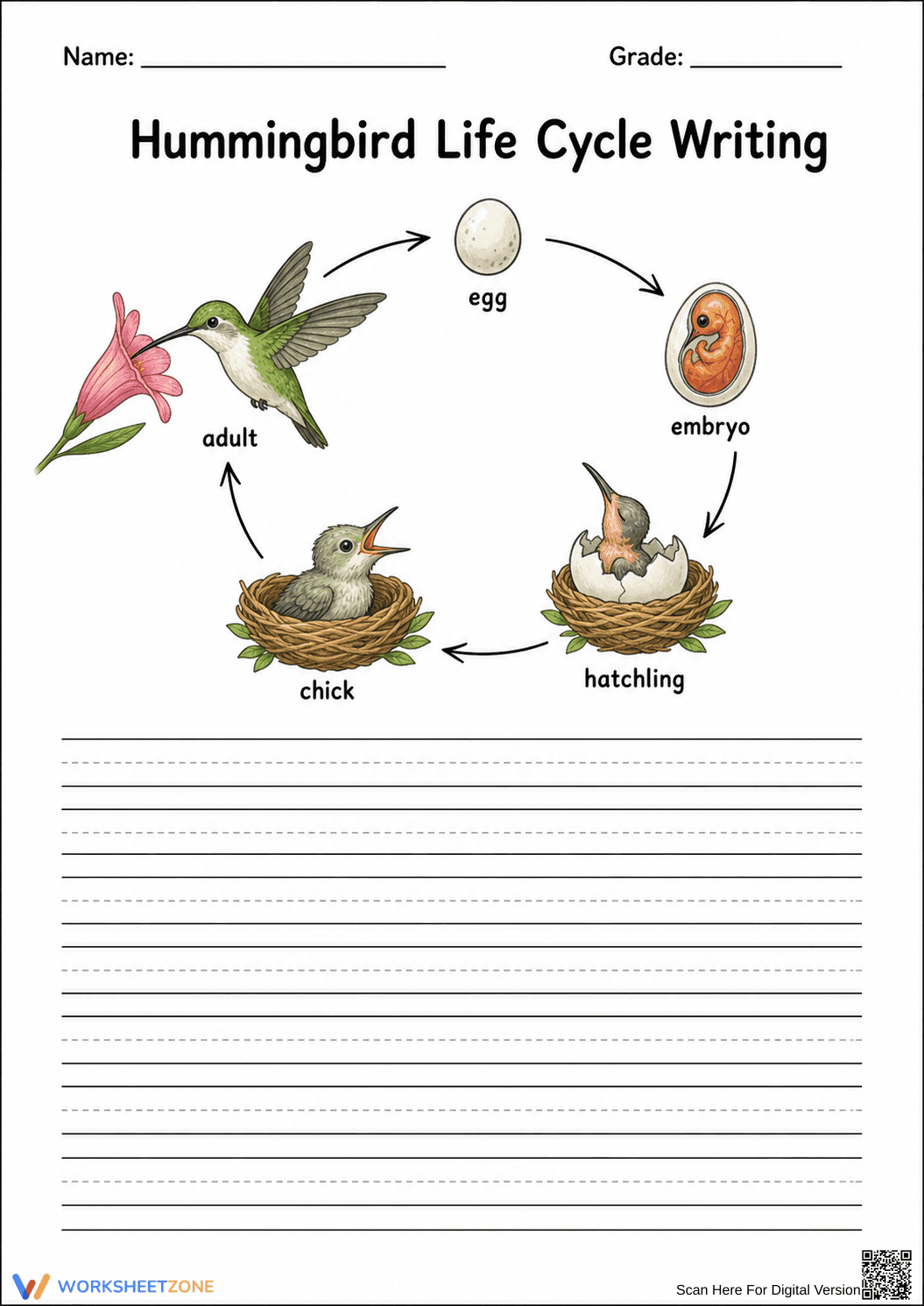
This Grade 4 and 5 science-integrated writing worksheet helps students master the biological stages of a bird while refining their informative writing skills. Students observe a detailed visual model of a hummingbird's development and translate those observations into a cohesive paragraph. This resource ensures students can explain complex natural processes with clarity and precision.
At a Glance
- Grade: 4-5 · Subject: Science & ELA
- Standard:
3-LS1-1— Develop models to describe that organisms have unique and diverse life cycles- Skill Focus: Informative Writing & Life Cycles
- Format: 1 page · 1 writing task · No answer key · PDF
- Best For: Science-integrated writing and literacy centers
- Time: 20–30 minutes
What's Inside
This single-page PDF features a high-quality circular diagram illustrating five distinct stages: egg, embryo, hatchling, chick, and adult. Below the visual model, students are provided with ten primary-ruled lines designed to support neat handwriting and paragraph structure. The clear labeling on the diagram acts as a built-in word bank, helping students incorporate domain-specific vocabulary into their writing without additional teacher assistance.
Zero-Prep Workflow
- Print: Select the single page and print enough copies for your cohort (approx. 30 seconds).
- Distribute: Hand out the sheets during your science block or ELA writing rotation (approx. 1 minute).
- Review: Use the completed paragraphs as a formative assessment of both scientific understanding and sentence structure (approx. 5 minutes).
Total teacher preparation time is under 2 minutes, making this an ideal resource for substitute folders or last-minute lesson supplements.
Standards Alignment
This worksheet aligns primarily with `3-LS1-1`, which requires students to develop models to describe that organisms have unique and diverse life cycles. It also supports `CCSS.ELA-LITERACY.W.4.2` by tasking students with writing informative/explanatory texts to examine a topic and convey ideas and information clearly. Both standard codes can be copied directly into lesson plans, IEP goals, or district curriculum mapping tools.
How to Use It
Assign this worksheet during the "Independent Practice" phase of a lesson on avian biology or life cycles. It works exceptionally well as a bridge between a science lecture and a literacy block. For a formative assessment tip, walk around while students are writing and check if they are using transitional words (e.g., first, next, then, finally) to describe the chronological progression of the hummingbird. Completion typically takes 20 to 30 minutes depending on the depth of detail required.
Who It's For
This resource is designed for Grade 4 and 5 students, but it is also highly effective for English Language Learners (ELLs) who benefit from the strong visual support of the diagram. It pairs naturally with a non-fiction passage about hummingbirds or a classroom anchor chart detailing bird anatomy. The primary-ruled lines make it accessible for students still working on consistent letter height and spacing.
According to Fisher & Frey (2014), the use of visual models like life cycle diagrams provides a critical scaffold for students as they transition from observation to technical writing. This Hummingbird Life Cycle Writing worksheet leverages this research by providing a clear, five-stage visual anchor—egg, embryo, hatchling, chick, and adult—to support Grade 4 and 5 students in organizing their informative paragraphs. By aligning with standard 3-LS1-1, the resource ensures that students are not just practicing handwriting, but are actively synthesizing biological concepts into written form. Studies from the RAND AIRS 2024 report suggest that integrated ELA and Science tasks improve retention of domain-specific vocabulary. This printable serves as a high-utility tool for teachers looking to maximize instructional time through cross-curricular application. The structured layout encourages neatness while allowing for the independent expression of scientific observations, making it a reliable asset for diverse classroom settings.


