


























Views
Downloads
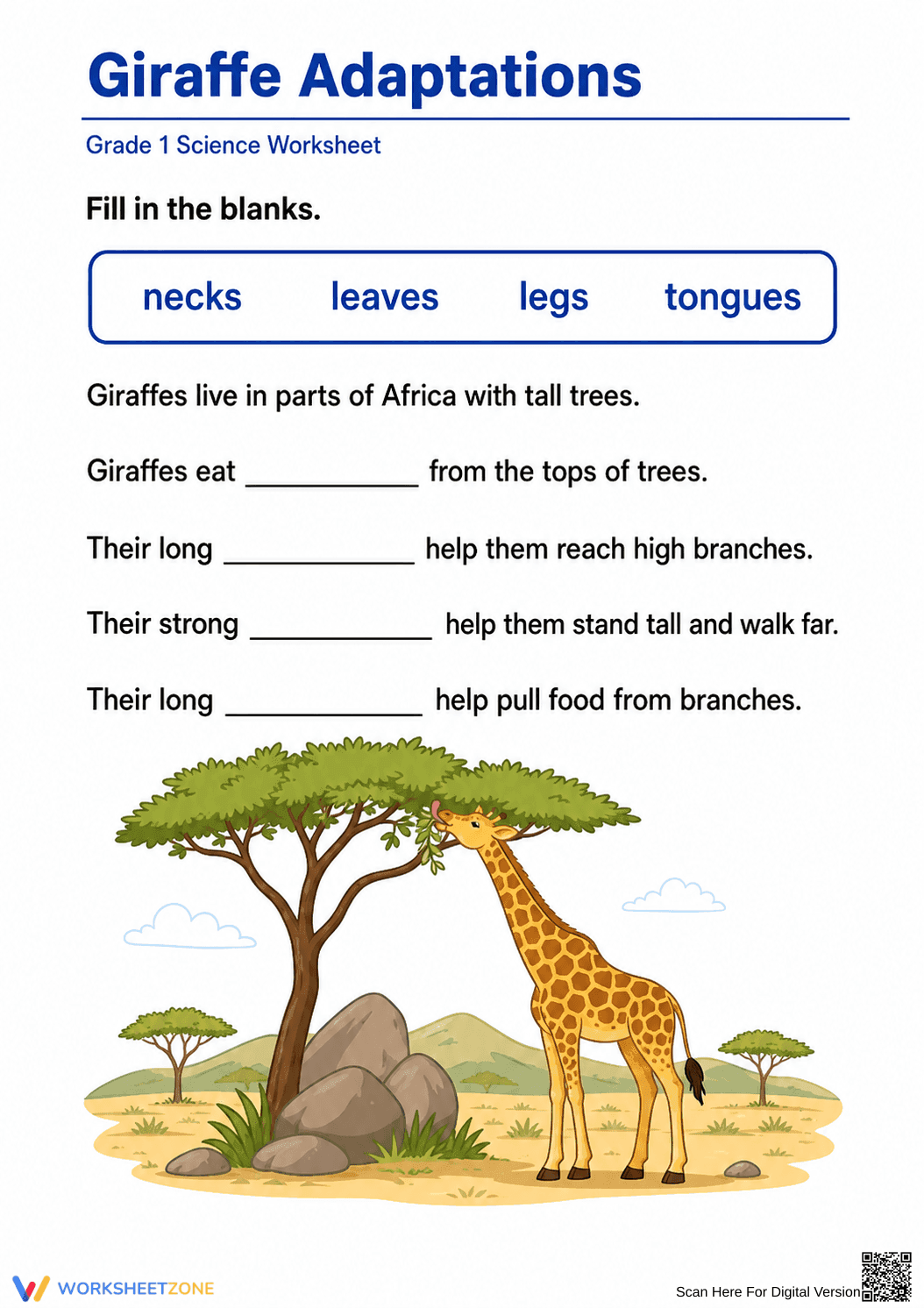


Essential Grade 1 Giraffe Adaptations Worksheet
Paste this activity's link or code into your existing LMS (Google Classroom, Canvas, Teams, Schoology, Moodle, etc.).
Students can open and work on the activity right away, with no student login required.
You'll still be able to track student progress and results from your teacher account.
This Grade 1 science worksheet introduces students to physical adaptations by focusing on the unique anatomy of giraffes. Students identify how specific body parts like long necks and tongues allow these animals to thrive in their habitat. This activity builds a foundational understanding of biological structures and their functional roles in survival.
At a Glance
- Grade: 1 · Subject: Science
- Standard:
1-LS1-1— Use external animal parts to explain how organisms meet essential survival needs- Skill Focus: Animal Physical Adaptations
- Format: 2 pages · 4 problems · Answer key included · PDF
- Best For: Introduction to habitats and living things
- Time: 10–15 minutes
This single-page resource features a structured fill-in-the-blank exercise centered on a high-quality illustration of a giraffe in its natural African savanna environment. The worksheet includes a clear word bank containing key vocabulary terms such as necks, leaves, legs, and tongues. A comprehensive answer key is provided on a separate page to facilitate quick grading or student self-correction.
The zero-prep workflow for this resource is designed for maximum efficiency in the elementary classroom. First, print the single-page document in under 30 seconds. Second, distribute it immediately to students as a warm-up or exit ticket. Third, because the word bank and visual cues are self-explanatory, students can begin working with less than 1 minute of verbal instruction.
This worksheet is aligned to the NGSS standard `1-LS1-1`, which requires students to understand how plants and animals use their external parts to survive and grow. By identifying the relationship between a giraffe's long neck and its ability to reach food, students demonstrate mastery of the core disciplinary idea concerning structure and function. Both standard codes can be copied directly into lesson plans, IEP goals, or district curriculum mapping tools.
Use this worksheet during the "Explain" phase of a 5E lesson cycle after observing animal videos or photos. It serves as an excellent check for understanding to ensure students can connect a physical trait to a survival advantage. Teachers should observe whether students can explain the logic behind their choices, such as why a long tongue is necessary for pulling leaves from branches.
This resource is designed for first-grade learners but is also appropriate for kindergarten extension or second-grade review. It supports English Language Learners and students with IEPs by providing a visual word bank and focused sentence stems. Pair this worksheet with a short non-fiction passage about the African savanna or an anchor chart displaying various animal adaptations.
According to the RAND AIRS 2024 report on elementary science instruction, structured practice that connects physical attributes to survival functions is critical for developing early scientific literacy. This worksheet addresses the 1-LS1-1 standard by requiring students to identify how specific external body parts, such as long necks and tongues, serve the essential purpose of gathering food. By using a familiar and charismatic megafauna like the giraffe, the resource lowers the cognitive barrier to complex biological concepts, allowing six-year-olds to engage with the plain-English skill of explaining how animal structures support life. Research suggests that combining visual identification with vocabulary reinforcement in this format significantly increases long-term retention of NGSS core ideas. This document provides a complete solution for teachers seeking to align daily activities with rigorous national standards while maintaining high student engagement.


