


























Views
Downloads

Bee Life Cycle Worksheet | Grade 3 Printable
Paste this activity's link or code into your existing LMS (Google Classroom, Canvas, Teams, Schoology, Moodle, etc.).
Students can open and work on the activity right away, with no student login required.
You'll still be able to track student progress and results from your teacher account.
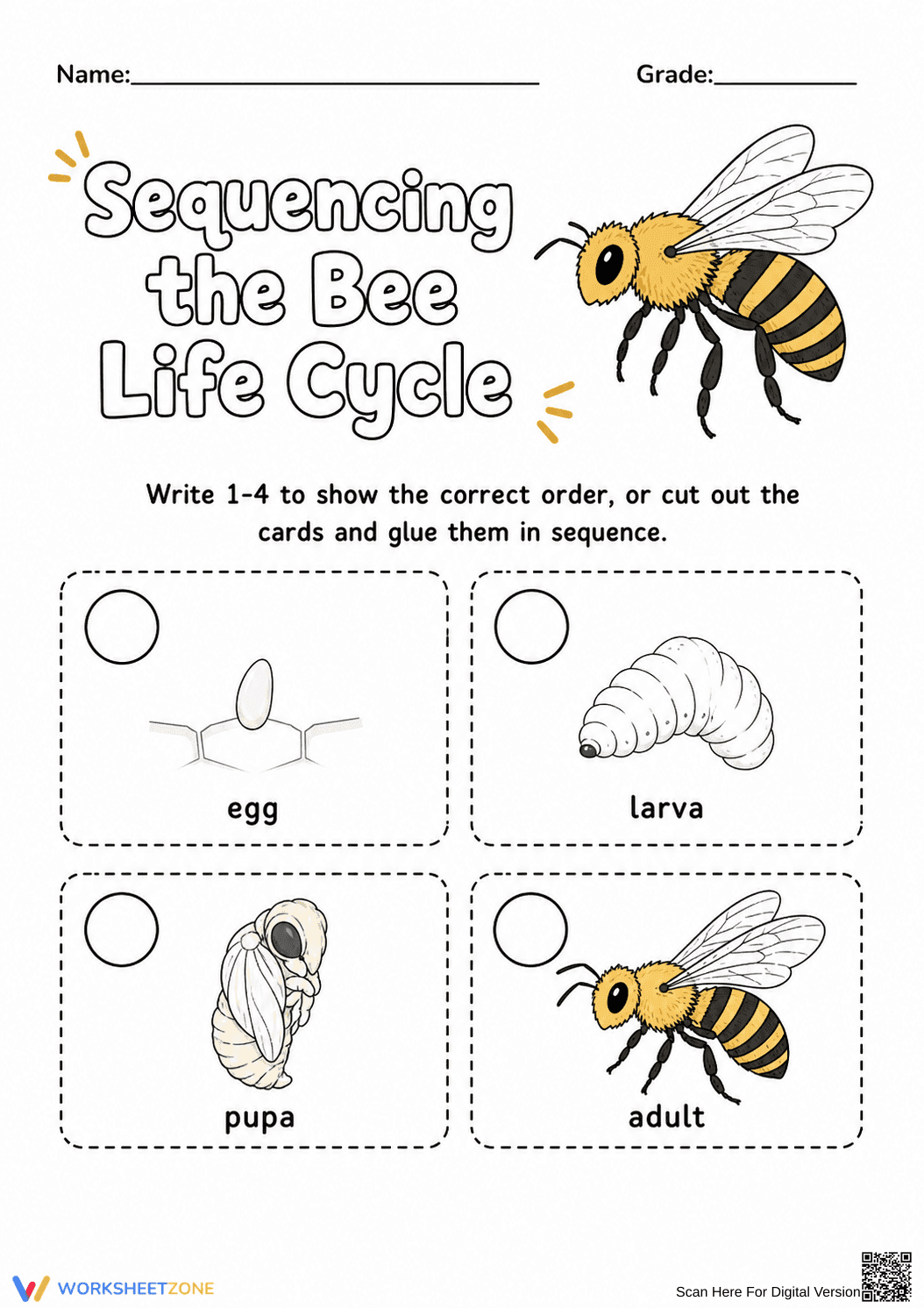
This Grade 3 bee life cycle worksheet helps students master biological sequencing by identifying the four distinct stages of honey bee development. Students practice ordering the egg, larva, pupa, and adult phases to understand growth patterns. It provides a clear, visual way to demonstrate comprehension of life science concepts before moving to complex ecosystems.
At a Glance
- Grade: 3 · Subject: Science
- Standard:
3-LS1-1— Develop models to describe that organisms have unique and diverse life cycles- Skill Focus: Bee life cycle sequencing
- Format: 1 page · 4 problems · Answer key included · PDF
- Best For: Quick formative assessment or science centers
- Time: 10–15 minutes
The resource contains a single-page activity featuring four labeled illustrations of a honey bee's development. Each stage—egg, larva, pupa, and adult—is housed in a dotted-line box, allowing for two different instructional approaches. A comprehensive answer key is included to facilitate rapid grading or student self-correction.
Zero-Prep Workflow
- Print: Select the single-page PDF and print enough copies for your class (30 seconds).
- Distribute: Hand out the sheets for a quick warm-up or as a supplement to a life cycle lesson (1 minute).
- Review: Use the provided answer key to check for sequencing accuracy immediately (1 minute). Total teacher prep time is under 3 minutes.
This worksheet aligns with 3-LS1-1: "Develop models to describe that organisms have unique and diverse life cycles but all have in common birth, growth, reproduction, and death." It specifically addresses the "growth" and "birth" components of the standard. Both standard codes can be copied directly into lesson plans, IEP goals, or district curriculum mapping tools.
Use this as a "ticket out the door" after a direct instruction lesson on insects to gauge individual student understanding of developmental stages. Alternatively, place it in a science center with scissors and glue for a tactile sequencing activity. Expect students to complete the numbering task in approximately 10 minutes.
This resource is designed for third-grade students but is adaptable for second-grade enrichment or fourth-grade review. It serves as an excellent pairing for a non-fiction passage about pollinators or an anchor chart depicting insect metamorphosis.
According to the RAND AIRS 2024 report, visual sequencing tasks significantly improve retention of biological processes in elementary learners. This worksheet utilizes the 3-LS1-1 standard to help students build a mental model of the honey bee life cycle, focusing on the transition from larva to pupa. By engaging with labeled illustrations, students move beyond rote memorization toward conceptual understanding of growth stages. Research from Fisher & Frey (2014) suggests that such scaffolded visual aids are essential for developing scientific literacy in early grades. This 1-page resource provides the necessary structure for students to demonstrate mastery of life science sequencing without overwhelming cognitive load. It is a reliable tool for educators seeking evidence-based materials that align with national science frameworks while maintaining high student engagement through clear, actionable tasks.


