


























Views
Downloads
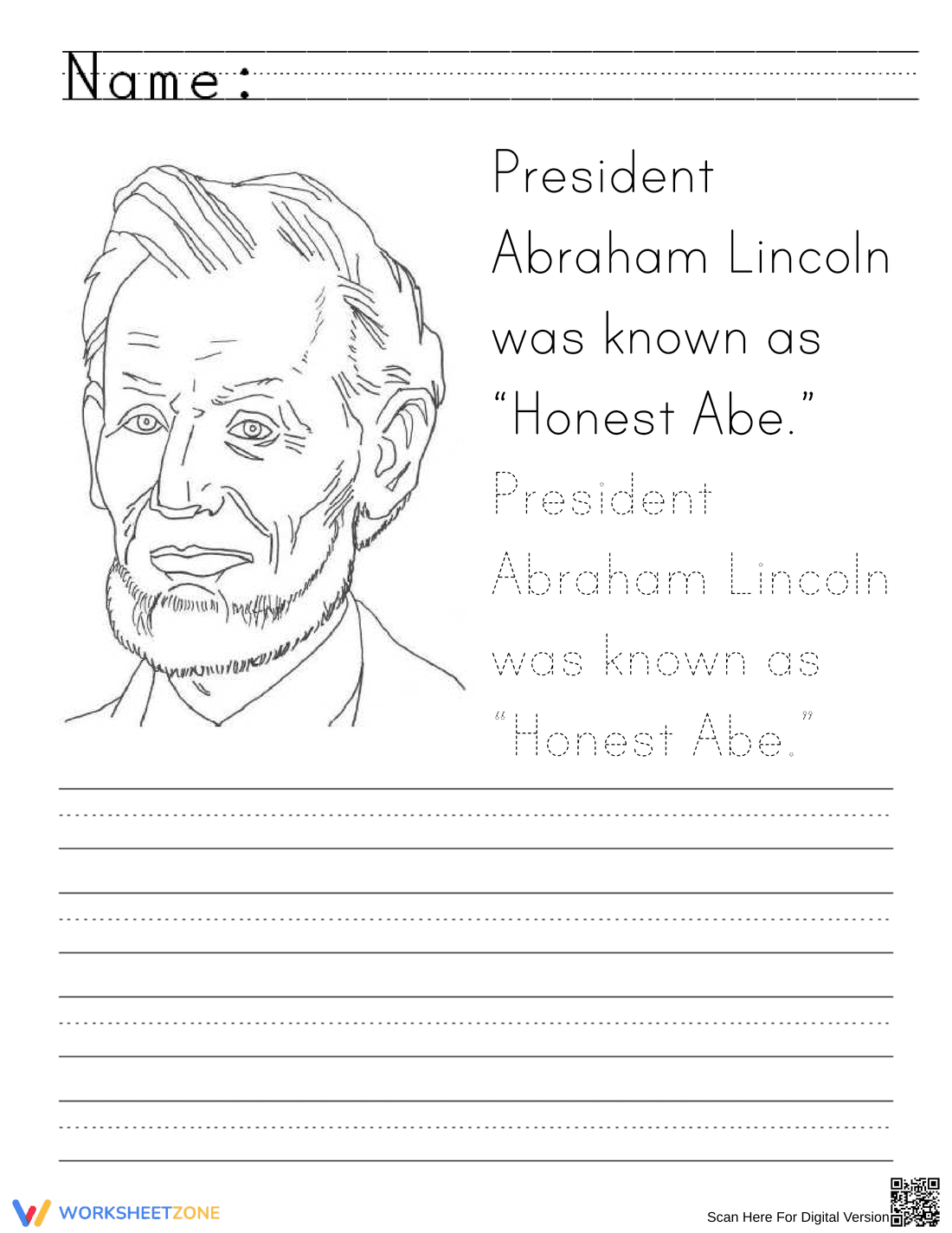

Grade 2 Handwriting Practice — Printable Worksheet
Paste this activity's link or code into your existing LMS (Google Classroom, Canvas, Teams, Schoology, Moodle, etc.).
Students can open and work on the activity right away, with no student login required.
You'll still be able to track student progress and results from your teacher account.
This Grade 2 handwriting worksheet gives students structured practice to improve letter formation and sentence mechanics. By tracing and copying a historical fact about Abraham Lincoln, young learners develop fine motor control while reinforcing proper capitalization and punctuation. The simple format ensures immediate student engagement.
At a Glance
- Grade: 2 · Subject: English
- Standard:
CCSS.ELA-LITERACY.L.2.2— Apply standard English capitalization and punctuation- Skill Focus: Handwriting and Sentence Copying
- Format: 1 page · 2 tasks · No answer key needed · PDF
- Best For: Morning work or independent practice
- Time: 10–15 minutes
This single-page resource features a clear, readable sentence about President Abraham Lincoln alongside a coloring image. Students first read the model sentence, then trace the dotted version to practice exact letter proportions. Finally, primary writing lines are provided at the bottom for independent copying, allowing students to demonstrate their spacing and alignment skills without tracing guides.
Zero-Prep Workflow
- Print (1 minute): Generate the PDF and print a class set immediately. No special formatting required.
- Distribute (1 minute): Hand out the single page along with pencils and crayons.
- Review (1 minute): Briefly remind students to check their capital letters and periods before they begin.
Total teacher prep time is under two minutes. Because the instructions are self-evident, this activity is highly suitable for emergency sub plans or quiet morning transitions.
Standards Alignment
This resource aligns with CCSS.ELA-LITERACY.L.2.2: Demonstrate command of the conventions of standard English capitalization, punctuation, and spelling when writing. By copying a complete sentence, students practice applying these conventions accurately. Both standard codes can be copied directly into lesson plans, IEP goals, or district curriculum mapping tools.
How to Use It
Deploy this worksheet as morning work to settle students into the academic day, or use it as a cross-curricular literacy center during Presidents' Day week. As a formative assessment observation tip, watch how students grip their pencils and whether they start their letters from the top down during the tracing phase. Expected completion time ranges from 10 to 15 minutes, depending on coloring detail.
Who It's For
This material is designed for second-grade students refining their print handwriting. For differentiation, teachers can highlight the capital letters and punctuation marks in the model sentence for students needing visual cues. It pairs naturally with a brief read-aloud book about Abraham Lincoln or a classroom anchor chart on sentence conventions.
Research emphasizes the ongoing importance of explicit handwriting instruction in early elementary grades. According to Fisher & Frey (2014), physical transcription skills directly impact cognitive load; when students can form letters automatically, they free up working memory for higher-order composition and comprehension tasks. This resource supports that automaticity by targeting CCSS.ELA-LITERACY.L.2.2, requiring students to apply standard English capitalization and punctuation through guided tracing and independent copying. By combining a historical fact with fine motor practice, the worksheet reinforces cross-curricular knowledge while building essential transcription fluency. Consistent practice with structured primary lines helps solidify spatial awareness and letter proportionality, which are critical components of early literacy development. Integrating these brief, focused writing tasks into daily routines ensures students maintain the mechanical skills necessary for future academic success.


