


























0
Views
0
Downloads

0.0
0
Save
0 Likes
Share
Homophones Chart: Understanding Commonly Confused Words
0 Views
0 Downloads
Paste this activity's link or code into your existing LMS (Google Classroom, Canvas, Teams, Schoology, Moodle, etc.).
Students can open and work on the activity right away, with no student login required.
You'll still be able to track student progress and results from your teacher account.
Information
Description
What It Is:
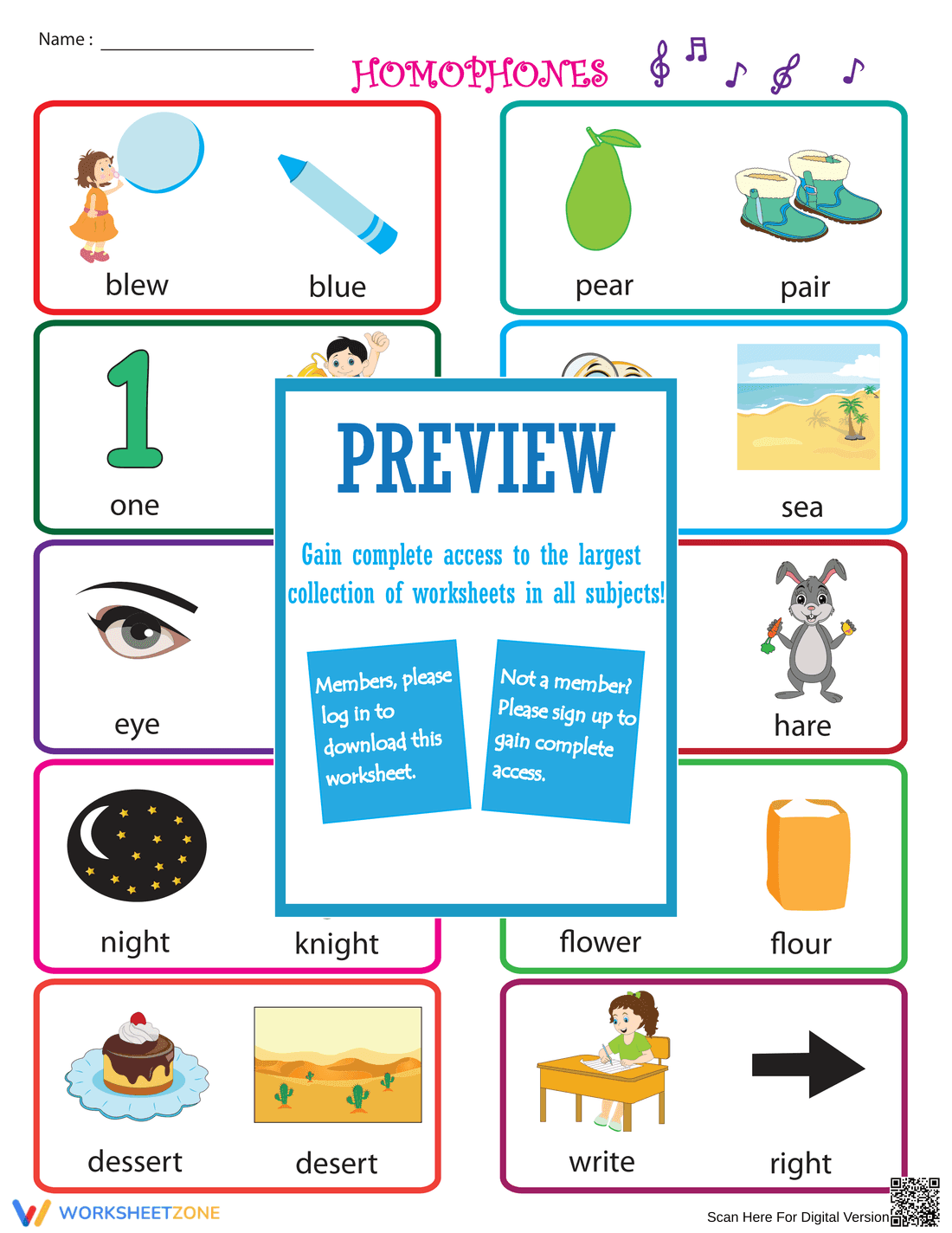
This is an educational worksheet focused on homophones. It presents pairs of words that sound alike but have different meanings and spellings. Each pair is illustrated with corresponding images to help visualize the meaning of each word. Examples include 'blew' and 'blue,' 'pear' and 'pair,' 'one' and 'won,' 'see' and 'sea,' 'eye' and 'I,' 'hair' and 'hare,' 'night' and 'knight,' 'flower' and 'flour,' 'peace' and 'piece,' and 'write' and 'right.'
Grade Level Suitability:
This worksheet is most suitable for 1st to 3rd grade. The vocabulary and concepts are relatively simple, focusing on basic homophones commonly encountered in early reading and writing. The visual aids make it accessible for younger learners.
Why Use It:
This worksheet helps students learn and differentiate between homophones. It improves vocabulary, reading comprehension, and spelling skills by associating words with images. It's a fun and engaging way to reinforce the concept of words that sound the same but have different meanings.
How to Use It:
Students can use this worksheet to match the correct word to the corresponding picture. They can also practice writing sentences using each homophone to demonstrate their understanding of the different meanings. It can be used for individual practice, small group activities, or as a classroom review.
Target Users:
This worksheet is designed for elementary school students, particularly those in the early grades who are learning about homophones. It is also useful for ESL students who need visual aids to understand new vocabulary.
This is an educational worksheet focused on homophones. It presents pairs of words that sound alike but have different meanings and spellings. Each pair is illustrated with corresponding images to help visualize the meaning of each word. Examples include 'blew' and 'blue,' 'pear' and 'pair,' 'one' and 'won,' 'see' and 'sea,' 'eye' and 'I,' 'hair' and 'hare,' 'night' and 'knight,' 'flower' and 'flour,' 'peace' and 'piece,' and 'write' and 'right.'
Grade Level Suitability:
This worksheet is most suitable for 1st to 3rd grade. The vocabulary and concepts are relatively simple, focusing on basic homophones commonly encountered in early reading and writing. The visual aids make it accessible for younger learners.
Why Use It:
This worksheet helps students learn and differentiate between homophones. It improves vocabulary, reading comprehension, and spelling skills by associating words with images. It's a fun and engaging way to reinforce the concept of words that sound the same but have different meanings.
How to Use It:
Students can use this worksheet to match the correct word to the corresponding picture. They can also practice writing sentences using each homophone to demonstrate their understanding of the different meanings. It can be used for individual practice, small group activities, or as a classroom review.
Target Users:
This worksheet is designed for elementary school students, particularly those in the early grades who are learning about homophones. It is also useful for ESL students who need visual aids to understand new vocabulary.


